By Fiona Keegan-McGlinn
[Photo Credit: Denison University]
I was deep in the stacks of Denison’s library when I came across a pink, glittery book. As I flipped through the pages, I found this wonderfully made figure (my guess was R studio). I struck gold – it is Denison’s very own burn book! While Denison’s version of a burn book isn’t as juicy with details like the one in Mean Girls, it does provide some details on how students feel about one another.
Other articles on OneTwentySeven have written about campus involvement, but mostly from the angle of what it does for the individual: whether it brings emotional benefits, affects students’ health, or provides social support. It’s no secret that involvement matters at Denison, both to the individual students and to the feel of the whole campus. In the March 2026 survey, 97% of students said they were involved in at least one activity, and the typical student was in three.
With so many groups promising belonging, I wanted to flip the question. Instead of asking what these groups do for their members, I asked: what do their members think of everyone else?
Based on campus survey data collected in March of 2026, the figure below depicts how student groups on campus feel about other campus groups and figures. Each row is a group of students, and each column is someone they were asked to rate. The number in each square is that group’s average score, from 0 (very cold) to 100 (very warm), with 50 meaning neutral or lukewarm. Students can appear in more than one row; a senior varsity athlete who leans Democratic counts in three rows.
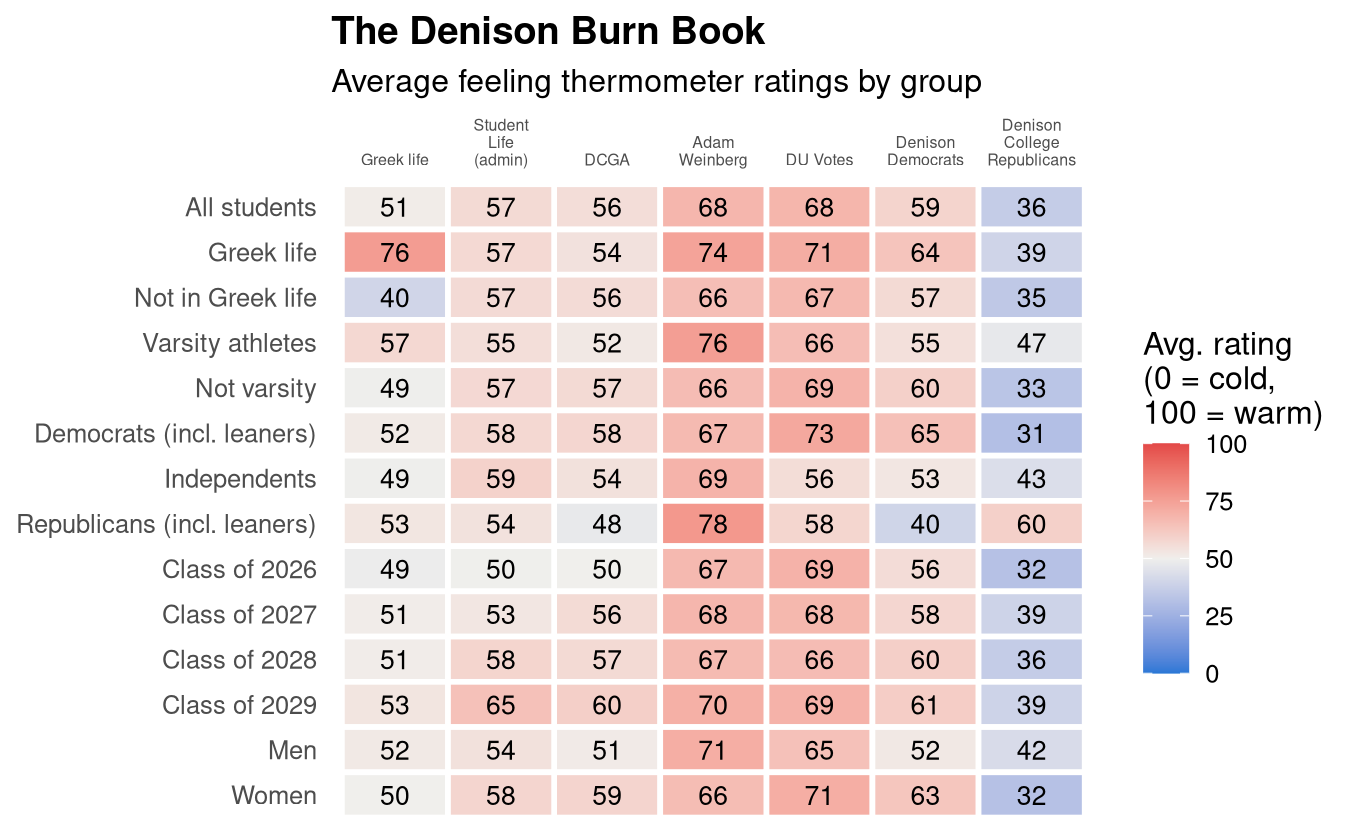
Greek life members rate Greek life 76, among the warmest scores on the chart, while non-members give it a 40 – a 36 point gap between members and non-members. This is the largest disagreement on the whole chart, bigger than Republican and Democrat’s opinions of their opposing party. There are generally positive ratings of President Weinberg across campus, with Republican leaning students giving Weinberg a score of 78 – the highest rating of the figure. College Republicans get the coldest ratings overall, 36, with the majority of students having a negative opinion towards the group. Even campus Republicans rate their own club (61) lower than they rate Weinberg (78). While DU Votes is a nonpartisan club, its approval ratings are split by party, with Democrats rating it the highest at 72, followed by Republicans at 57, and Independents at 56. Enthusiasm for Student Life and DCGA drops by class year. Overall, students have lukewarm feelings toward institutions across the board. That’s probably ok – it may mean they’re doing their jobs without being noticed.
Do you feel “sorted” into a group?
Besides what students feel about one another, how do students feel about being placed into certain social groups? Each bar in the figure below shows the share of students in that group who somewhat or strongly agreed with “I feel socially sorted or stereotyped into a category on this campus.” The dashed line is the campus average.
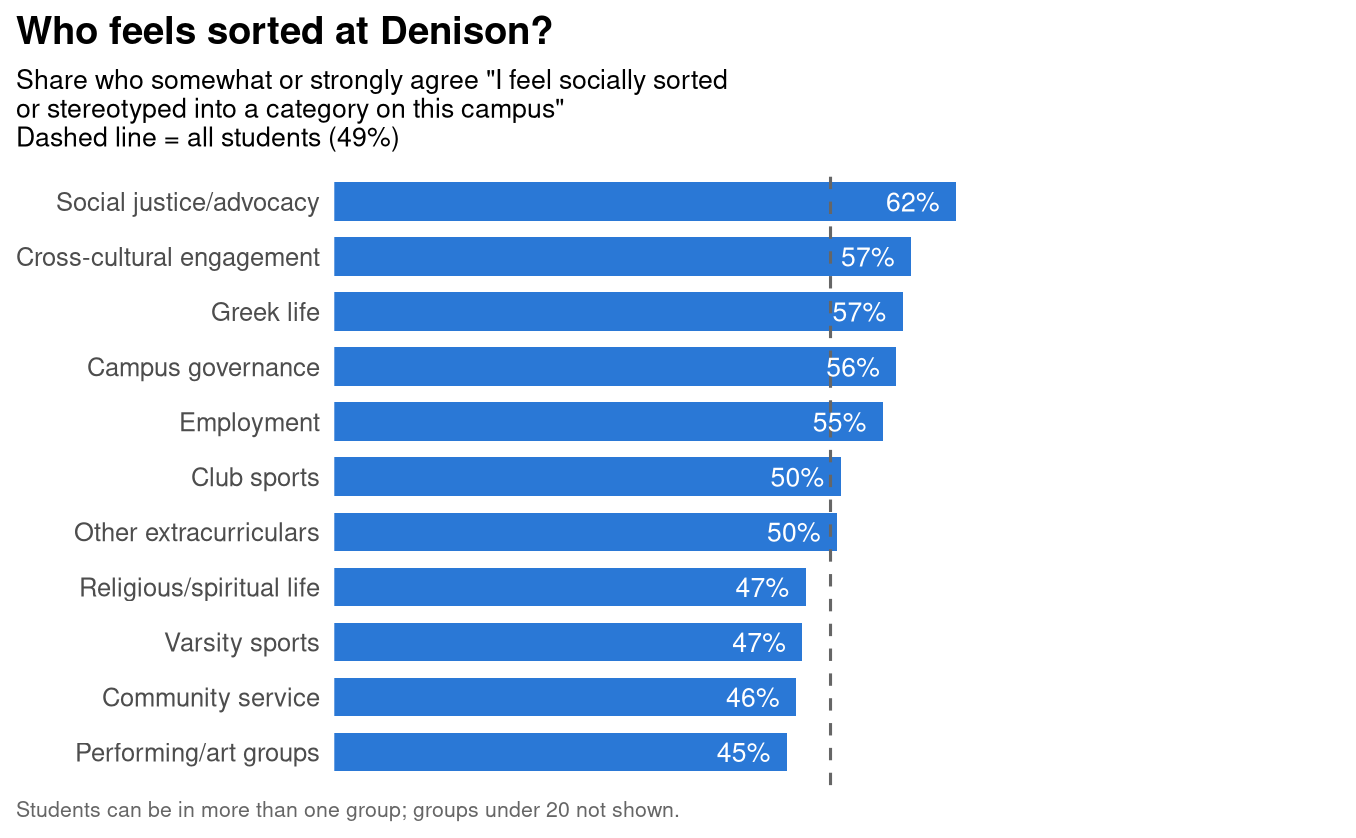
Across campus, about half of all students (49%) agree they feel socially sorted or stereotyped. These “groups” are where students spend their time outside of class, teams, chapters, and clubs. On a campus of any size, the group you join can become your identity quickly, and can explain why so many students feel labeled.
Students in social justice and advocacy groups feel the most sorted (62%), followed by cross-cultural engagement and Greek life (57% each). Varsity athletes, often the most stereotyped groups in pop culture, land just below the campus average (47%). The survey can’t tell us what category students feel sorted into, only that many of them feel it.
Greek life members stand out for another reason: they feel sorted at above-average rates and they feel warmer about their organization compared to other groups, 76/100. Rather, they feel labeled, but they approve of their label.
This information is interesting, because one could argue “well, it’s college, and you have a choice in what group or label you want to be associated with.” To an extent, I agree. I think we have autonomy in who we want to be associated and grouped with based off of our involvement on campus. Therefore, we have to acknowledge that there might be a stereotype that is attached to the group we associate with.
I would also make the argument that it honestly doesn’t even matter. I do not care what other people think about the fact that I am in x club and do x things with my friends. I don’t care what other people do on this campus either. I think to feel stereotyped into a group isn’t necessarily a bad thing. I think it’s problematic when a stereotype constantly dictates how you act, speak, or think. Bottom line – I hope that those who feel “sorted” are proud of the stereotype they belong to, and believe it represents who they are as a person. While campus involvement may matter now, it should not be the most defining aspect of who you are and the trajectory of your life.
We Should Probably Talk to New People
With this discussion of social groups and division on campus, that leads me to wonder: do students wish to know students of different backgrounds on campus? Using the same social groups, each bar shows the share of students that somewhat or strongly agreed with “I wish I knew more students of different backgrounds on campus.” The dashed line is the campus average.
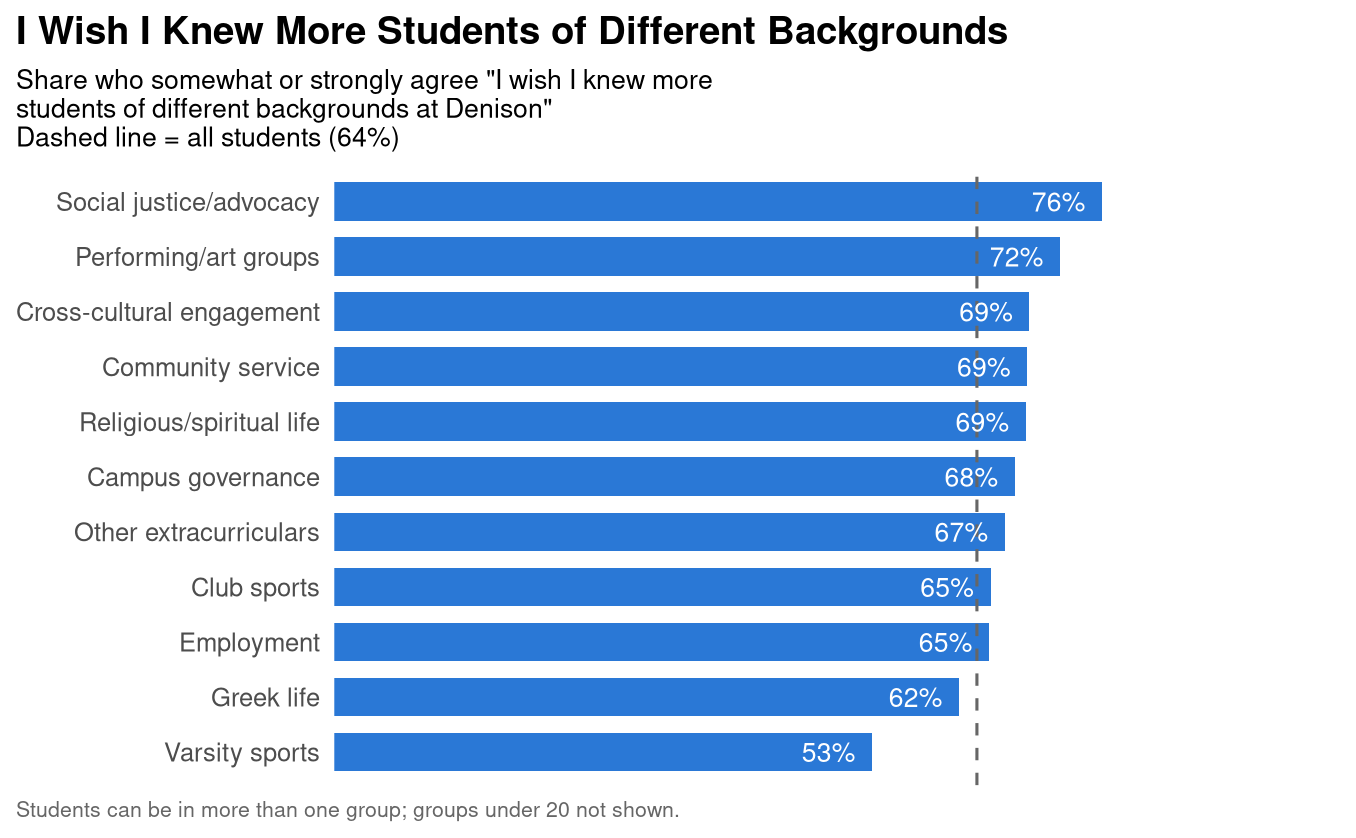
The general student body wishes they knew more students of different backgrounds. Social justice students are the most likely to say they wish they knew more people of different backgrounds (76%). That might not be ironic; students who spend their time thinking about differences may simply be more aware of who’s missing from their circles. Towards the bottom of the figure, those in Greek life and Varsity sports are less inclined than the average student to want to get to know students of different backgrounds, with 53% and 62% wishing to get to know different students, respectively. Before you get too judgey, it is important to realize that varsity athletes face the most political diversity on campus among their ranks.
We don’t need a kumbaya moment. At a small, residential college like Denison, proximity already does a lot of the work: you share dorms, dining halls, and classes with people unlike you. The question is whether we use this context. Research has shown that physical proximity predicted friendship more than shared interests or majors. At the same time, much of sticking with a clique is traced back to ingroup bias: the tendency to favor people who share your group over people who don’t. I am willing to make the argument that much of Denison’s campus is filled with open-minded, kind students who are just comfortable with the people around them.
Mean Girls’ ending isn’t finding a better clique, it’s Cady realizing the labels were made up. And sue me if this is cliché, I truly believe that the college experience is only achieved when you get out of your comfort zone and meet new people. My final piece of advice: ask that class friend who you see twice a week to get lunch, maybe don’t make your own burn book, and once a day give a stranger a compliment.
Fiona Keegan-McGlinn is a junior who is getting an A+ in procrastination.

