By Fiona Keegan-McGlinn
With midterm elections around the corner, the campus has a buzz of voting conversations. Students are asking “Where do you vote?”, “did you sign up to vote in Ohio?”, and “what do you think of that candidate?” With control of the House and Senate at stake, the buzz feels especially strong. So what are Denison students thinking ahead of the election, and are they ready to vote?
This piece uses data from a March 2026 survey of Denison students to look at three things: how closely they follow the news, what they want from the government on key policy issues, and how confident they feel about the mechanics of voting. Together, the results show where students stand politically and how prepared they are to act on it.
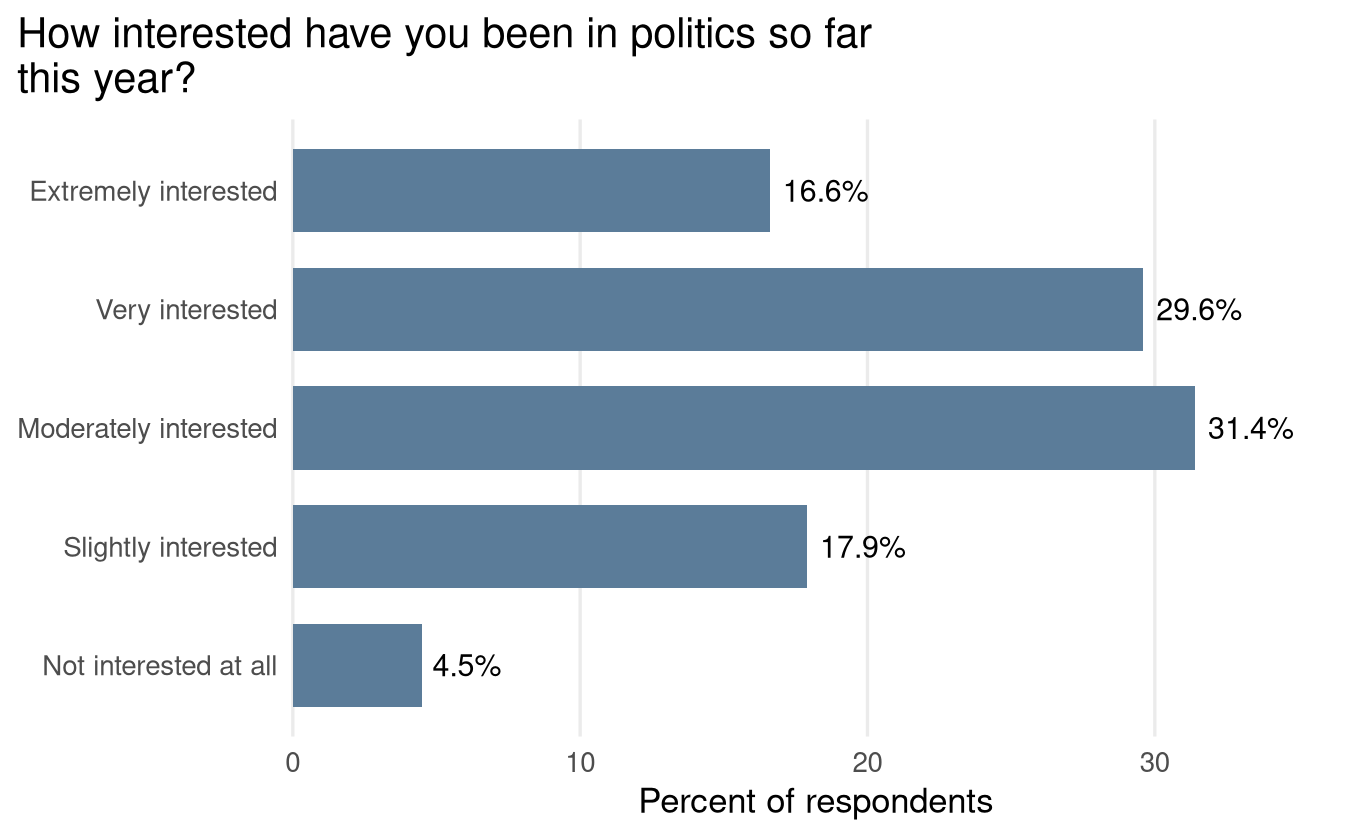
Overall, the majority of Denison students seem at least somewhat interested in politics. About 78% describe themselves as at least moderately interested in politics so far this year, and only 4.5% say they are not interested at all. With the election still months away at the time of the survey, politics was on most students’ radar, even early in the campaign season.
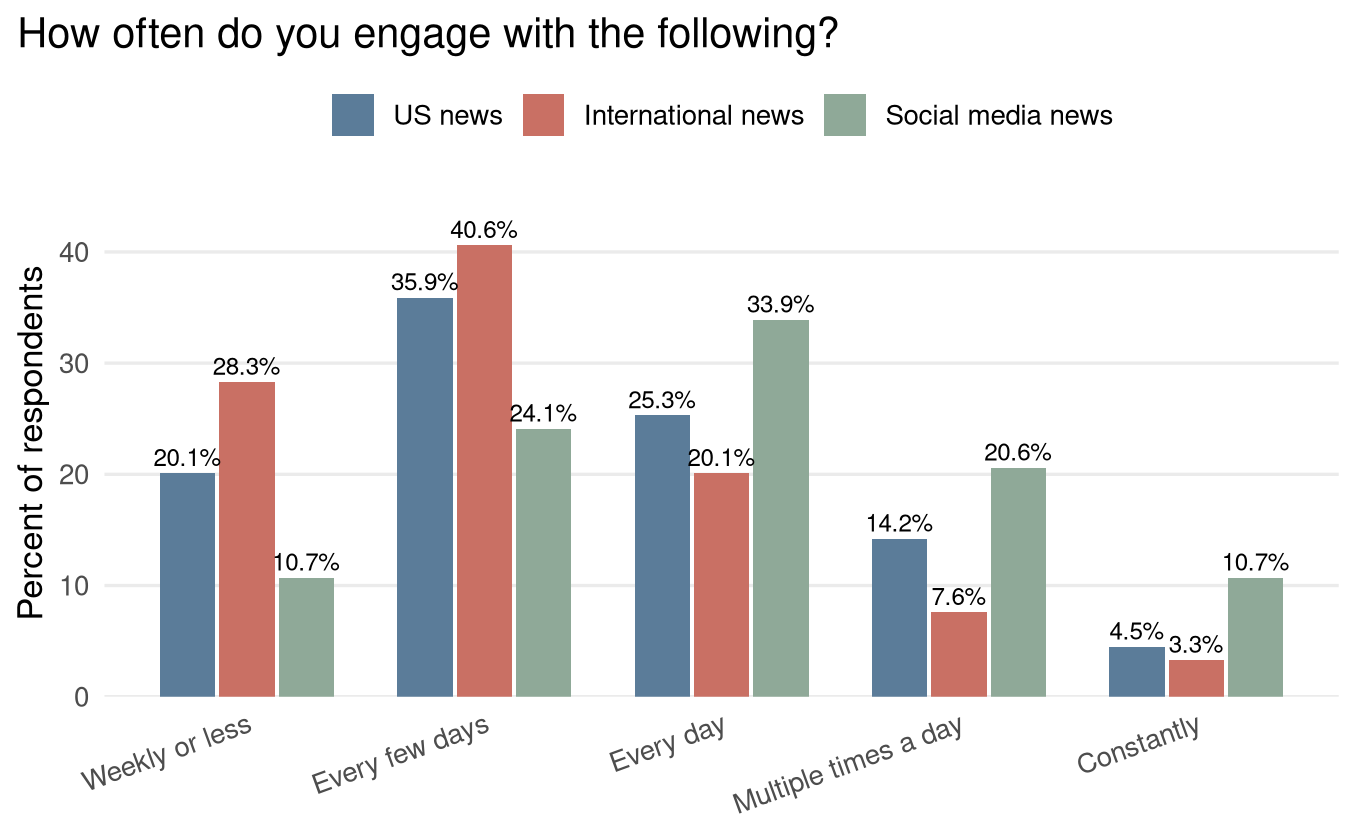
Where do Denison students get their news, and how often? We asked students how frequently they engage with US news, international news, and news on social media, from “weekly or less” or “constantly”. Social media is students’ default news source: nearly 65% of students engage with it daily or more, compared to 44% for US and 31% for international news. This doesn’t mean that students ignore the world, since nearly a third check international news every day, but it is the source they follow least closely. As the next section shows, that doesn’t stop them from having strong opinions about what US policy should be prioritized.
Students were also asked whether the federal government should cut back, keep the same, or expand six policy areas, from defense spending to health care. The answers split along a clear line.
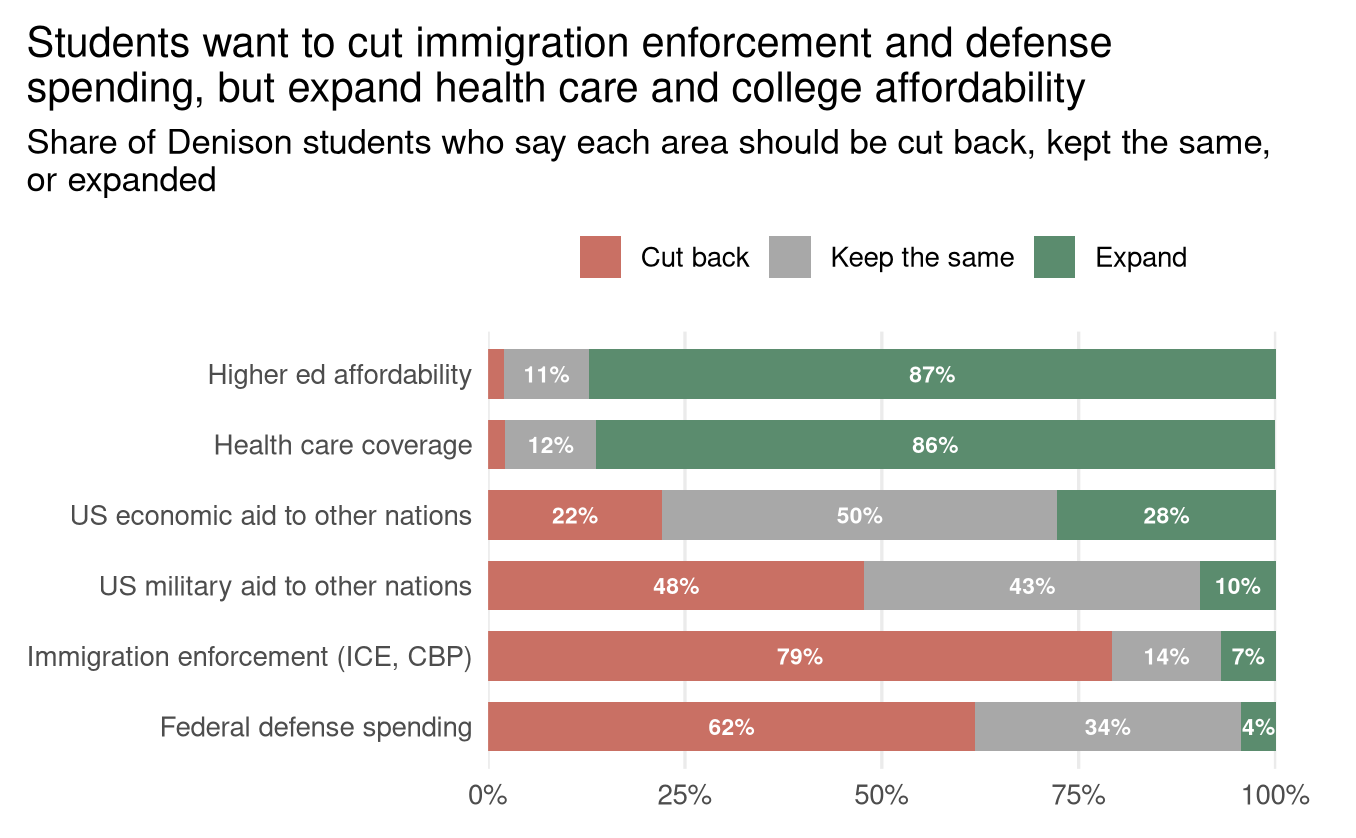
The clearest result is on the domestic issues. Roughly 87% of respondents want to expand higher education affordability and 86% want to expand health care coverage, and almost no one wants to cut either. At the other end, 79% say immigration enforcement should be cut back, the strongest cut-back sentiment of any item. Views on foreign policy are more mixed but lean toward restraint: 62% want to cut federal defense spending and 48% want to cut military aid abroad. Economic aid is the most divided, with half saying to keep it the same, 28% wanting to expand it, and 22% wanting to cut it.
The survey is weighted to closely match Denison’s student body, so these results are a reasonable picture of where students’ priorities sit. With the midterms approaching, the pattern is clear: more spending on policies that affect student lives, less on enforcement and the military.
Are students ready to cast their vote? We asked students how confident they feel about the mechanics of voting, from registering to knowing where to go on Election Day.
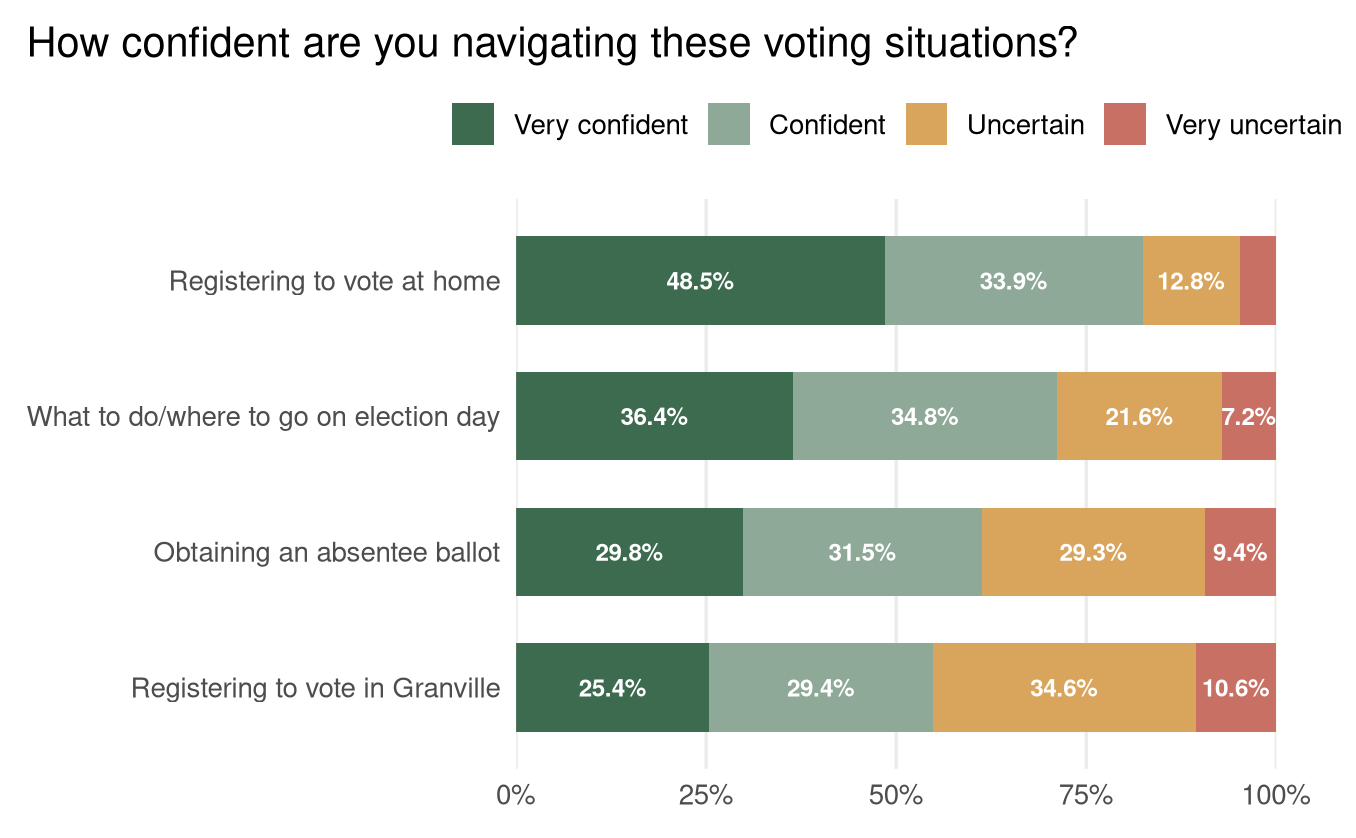
Students feel most prepared to register at home – 82% say they’re confident or very confident. Confidence is lower for every other step. About 71% feel confident about what to do on Election Day and 61% about getting an absentee ballot. Registering to vote in Granville is the weakest, with 55% feeling confident.
DU Votes, a nonpartisan voting initiative at Denison, has been working to close that gap. When asked whether the survey results, which show students feel least confident registering in Granville, match what the group sees, and why that might be, a DU Votes representative agreed: “Students don’t know you can vote in Ohio. You can have residence in Ohio through your Denison residence.”
Ohio is home to this year’s most closely watched races, Republican Sen. Jon Husted and Democrat Sherrod Brown are competing for a vacant seat that could help decide which party controls the chamber. Republican Vivek Ramaswamy and Democrat Amy Acton are running in an open race for governor. Students who register in Granville will see both on their ballots.
With the midterms on November 3rd, DU Votes is holding information sessions on different ways to vote, what will be on the ballot, and bios of each candidate on the Ohio ballot. Its biggest push is making sure students know what to do on Election Day, where candidates stand on policy, and how to research candidates, wherever they’re voting.
Nearly half of the students surveyed, 46%, say they have been very or extremely interested in politics this year. The midterms are a chance to turn that interest into a vote. DU Votes put it best: the midterm election is important, and the “it’s only one vote” mindset is dangerous. For Denison students who want their voices heard, the answer is simple: vote.
Fiona Keegan-McGlinn is a junior PPA major and a DPR minor. She is from Boston, MA. Yes, the actual city, not a town 30 miles away.

