By Paul A. Djupe
What is college for? Is it to teach timeless arguments and methods of inquiry? Is it to respond to current problems and markets? If you can believe it, there have been times in my lifetime when these questions did not seem so pressing. Not so now.
It feels like we are pressured from every direction – from technology, government, media, and more. In many ways, though, a liberal arts education seems up to the task, providing the communication and organizational skills needed to thrive in a rapidly changing world. We faculty types pose new problems, new methods, and new settings in which to seek paths forward and Denison students are often up to the task. One dimension where Denisonians may be lagging is in their civic engagement.
Perhaps nothing I’ve done on campus has resonated with so many people as asking questions about the place and adequacy of civic engagement. A number of people, especially students but also faculty, have reached out to say roughly the same thing as Elliot Harpham wrote in his op-ed – there is diversity of thought here, but too few are willing to express it.
This piece is part of package that define the contours of the problem and the solutions we are pursuing. Some of those solutions take place among small groups of people and others attempt to involve broad swaths of campus. One that we’re excited about is working on is curricular – a new GE, perhaps a “C” overlay – that would channel everyone through at least one course that pushes forward our civic fluency. More on that soon.
I thought it would be useful to start with some of our core values linked to the liberal arts. We may not all subscribe to the same ideals, but maybe we do. If we do, then we can ground discussions about how to move forward. So where does civic engagement fit in the pantheon?
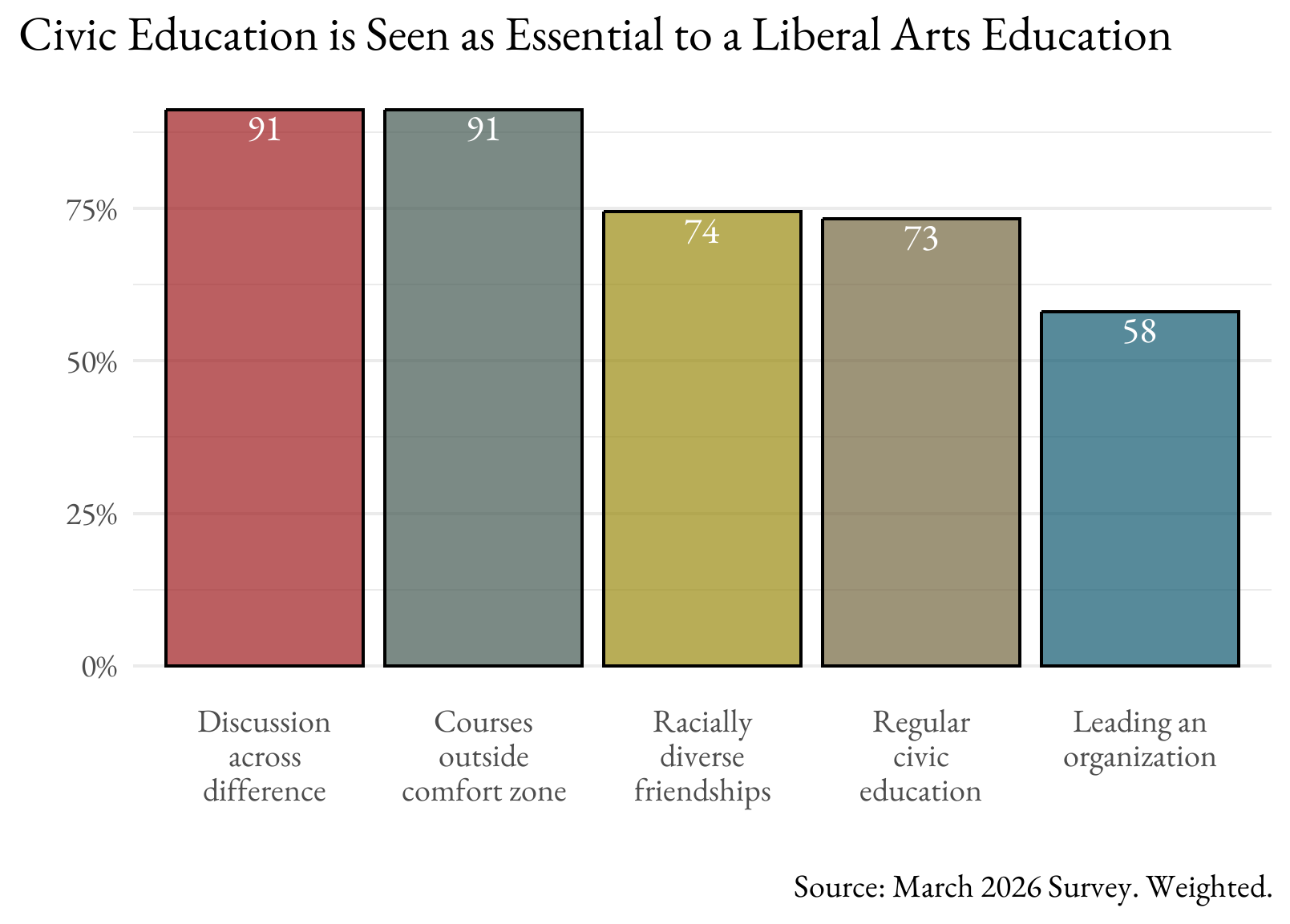
In our recent survey that wrapped mid-March 2026 of about 529 students, we asked about the value of civic fluency in several ways. The figure below shows one of them – we asked, “Do you agree or disagree with the following statements about what is ESSENTIAL to a liberal arts education?” (emphasis in the original).
The results suggest that we are on much the same page. Nearly every student (91%) agreed (the bars show the combined responses of agree and strongly agree) that “Having discussions with others who disagree with you” is essential and nearly three-quarters agreed that “Receiving regular civic education” is essential. These values sit comfortably alongside taking classes outside your comfort zone and having racially-diverse friendships. This is no surprise because a core element of civic engagement is the appreciation for, understanding of, and skills to work with difference in all its guises.
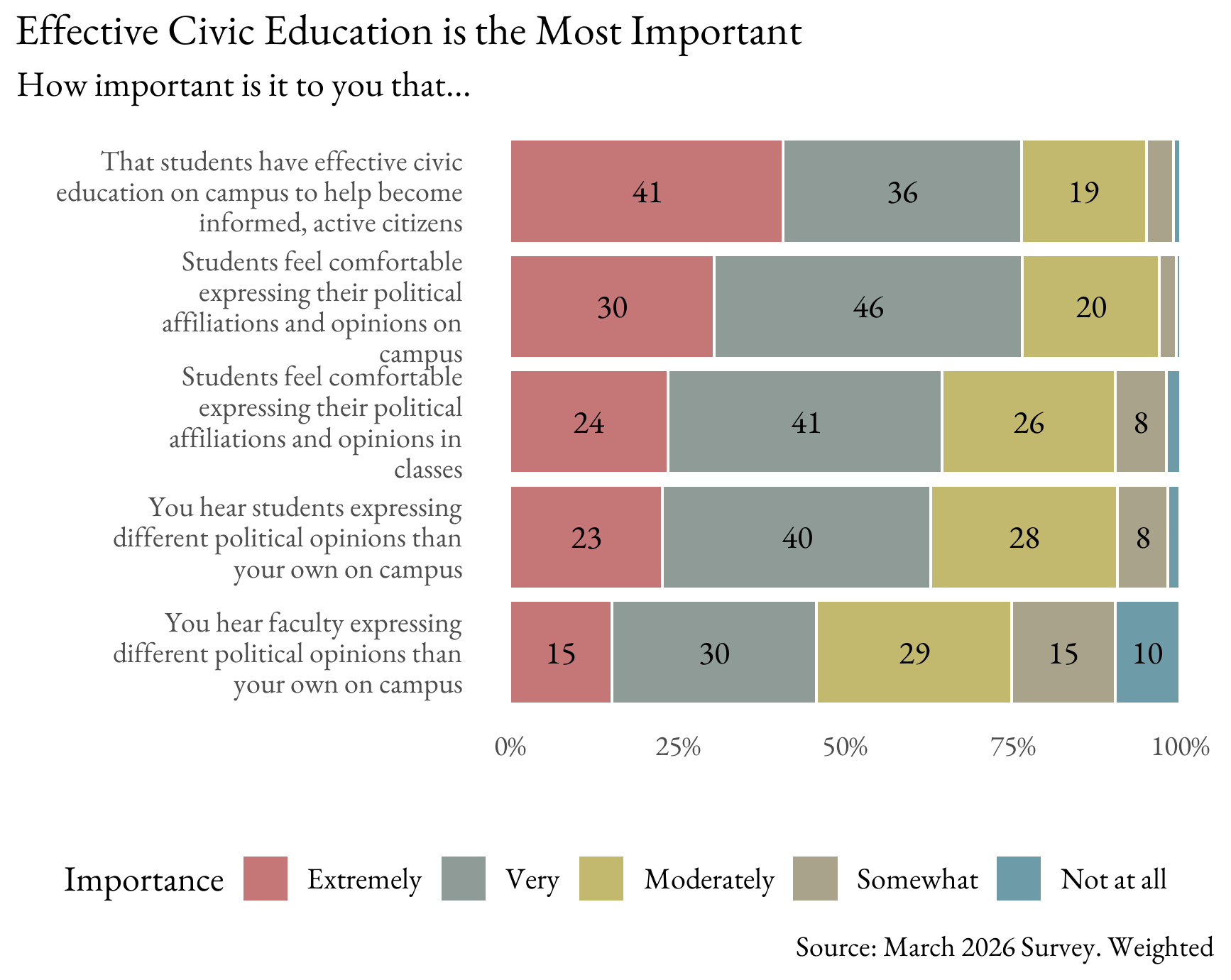
Within that space, we asked another set of questions to get a better sense of what expanded civic stuff might entail. The spur was “How important to you is it that…” and the top of the list here was that students have effective civic education to help become informed, active citizens” (77 percent thought that as extremely or very important). And right at that same level was the importance of students feeling comfortable expressing their opinions and affiliations on campus (76 percent). Campus is not quite the same thing as classes and there’s a 10 percent drop off in the importance of students expressing their opinions and affiliations in classes (65 percent). What they don’t think is all that important is hearing faculty expressing different opinions, though 45 percent still thought that was extremely or very important. There’s almost no rejection of the importance of these positions but there are a number of students who basically shrug.
We are seeing a real need from students to receive ongoing civic education, which makes all the sense in a time where everything appears to be in flux. But they’re also asking for some space to explore ideas and test out opinions without the burden of bearing deep social costs. As I reflect on the nicknames that fellow students acquired more than 30 years ago that have stuck to this day, I know how this works. And phones and social media have made it all so so much worse.
I believe that we can pull this off, but it’s going to take some work, including forbearance when hearing views that you think silly, trite, obnoxious, or even offensive.
Look for more pieces coming soon in this series about the civic state of Denison and its future.
Paul A. Djupe is a local cyclist who runs the Data for Political Research minor. He started onetwentyseven.blog a decade ago in a bid to subsidize collective action and spread accurate knowledge about campus and what goes on there. He also writes about religion and politics in the US.

