By J. Elliot Harpham
Over the last couple of months, Dr. Djupe and I, among others, have been working towards creating a new Civic GE competency. Denison, unsurprisingly, is chock full of diverse thought. The problem is that people appear to be unwilling or lacking confidence in their abilities to express themselves.
In my experience on campus, the civic push has been met positively. Students that I have spoken to, often responding to one or another of my op-eds, have expressed gratitude for helping to spark more conversations about the civic gaps that exist on Denison’s campus. But, where do those gaps actually exist?
It’s a tough question, but it’s one that Dr. Djupe and I have been working to answer. This past month, the Data for Political Research department conducted its semesterly survey of the student population to help answer this question – 529 responded. While there are a number of different places in the survey we could look for insight, a good place to start is whether we talk across differences.
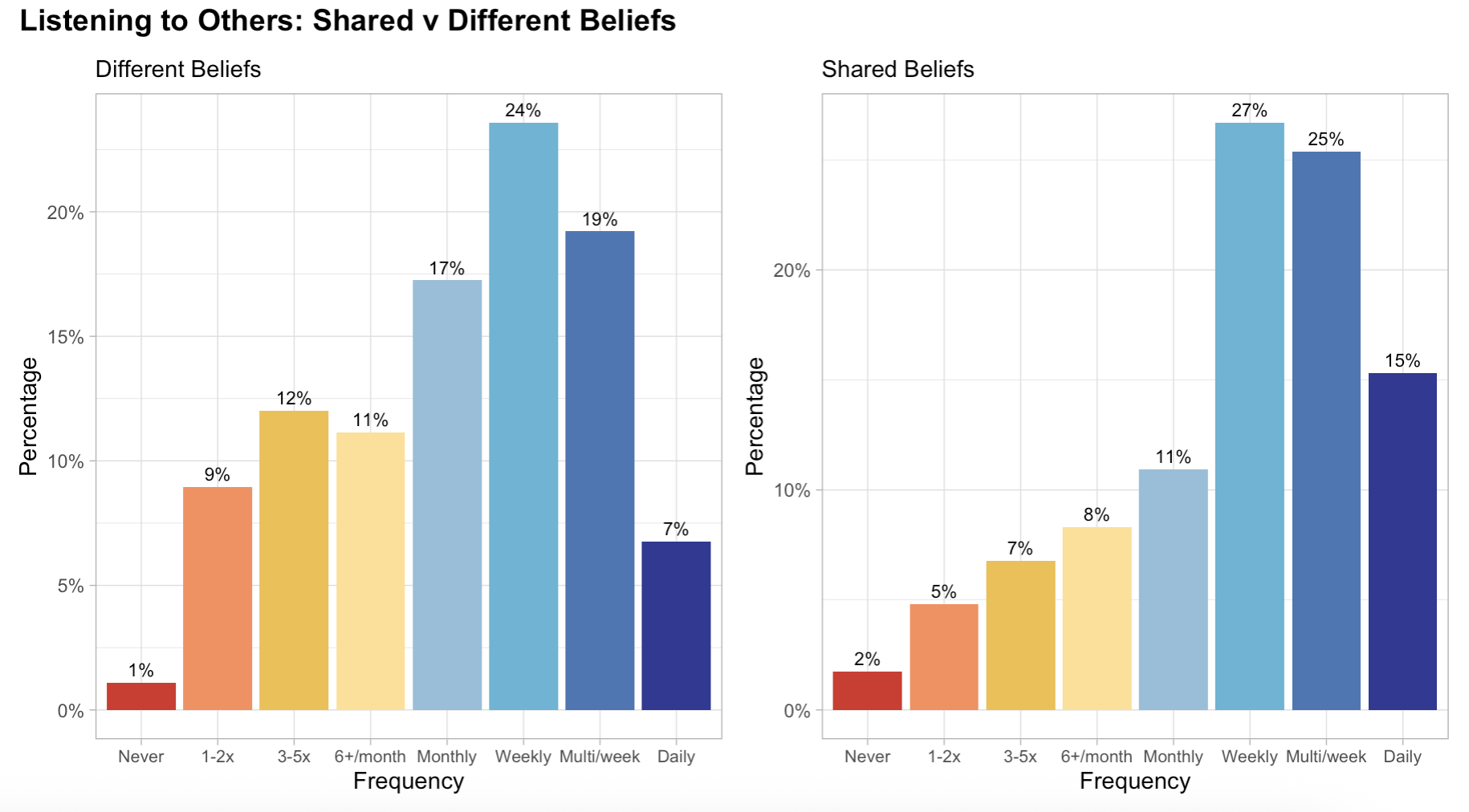
The clearest result is that Denison students are more likely to listen to people who share their beliefs. I probably could have figured that out, but it’s not as much as I thought. The following pair of visualizations shows how often students listen to others they agree/disagree with. More students said that they listened more often when the person agreed with them, but the distribution was interesting – 33% said they listened to students with shared beliefs once a month or less, while 50% said they did so with students that had different beliefs. That means there is also a 17 point gap on the high end, which is concentrated in the most frequent (daily) category. Denison students are not turning off views they disagree with, but there is a clear difference in the degree of exposure.
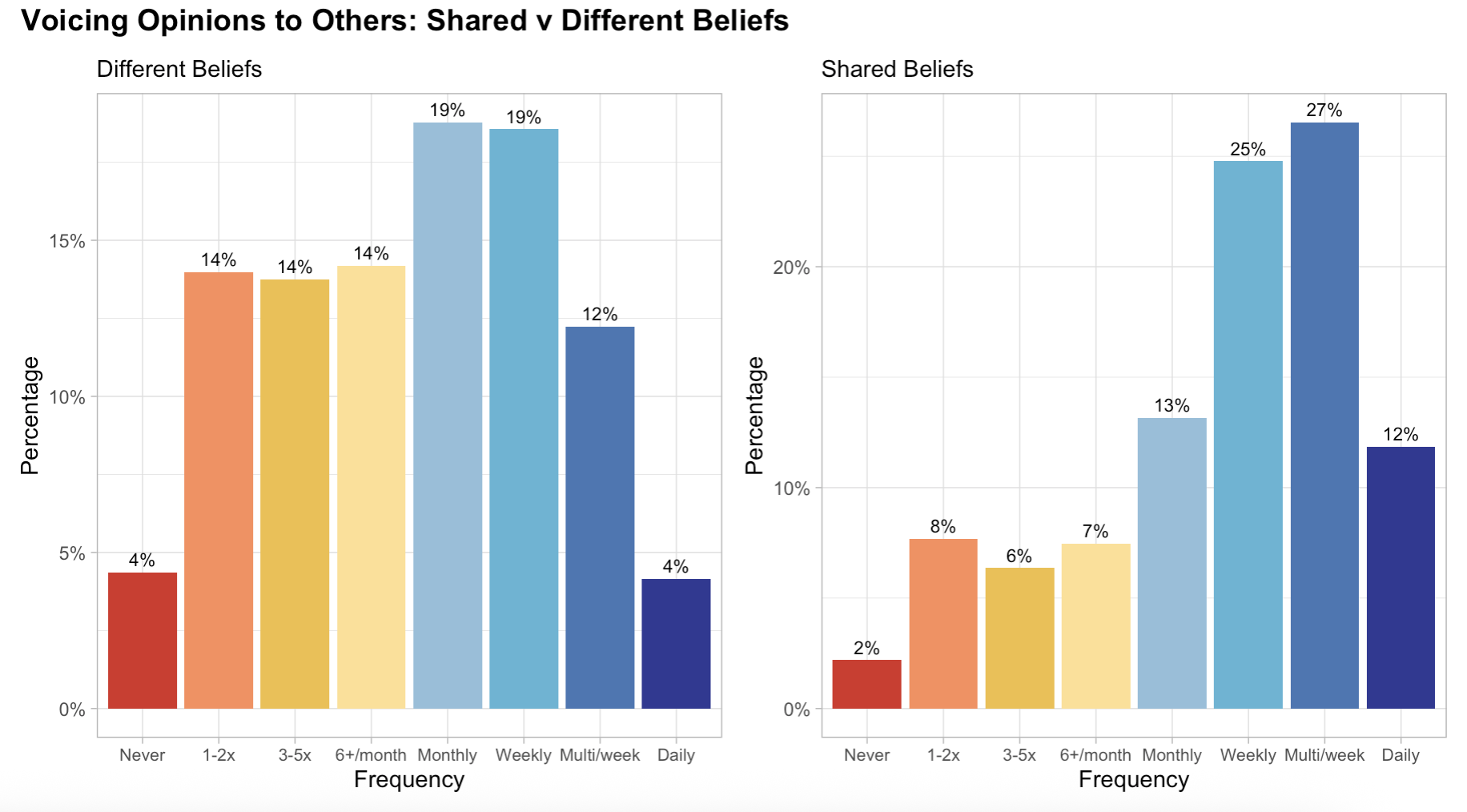
A more striking version of this separation appears when you look at the visualizations showing rates of expressing opinions to people who agree/disagree with a student’s beliefs. Students were far more averse to expressing their beliefs when it came to talking with peers with diverse attitudes. The share of students voicing opinions daily jumped from 4% to 12% between different and similar beliefs and weekly or more from 35 to 64% – almost doubling. For students who shared opinions less than monthly, the share dropped from 46% to 23%.
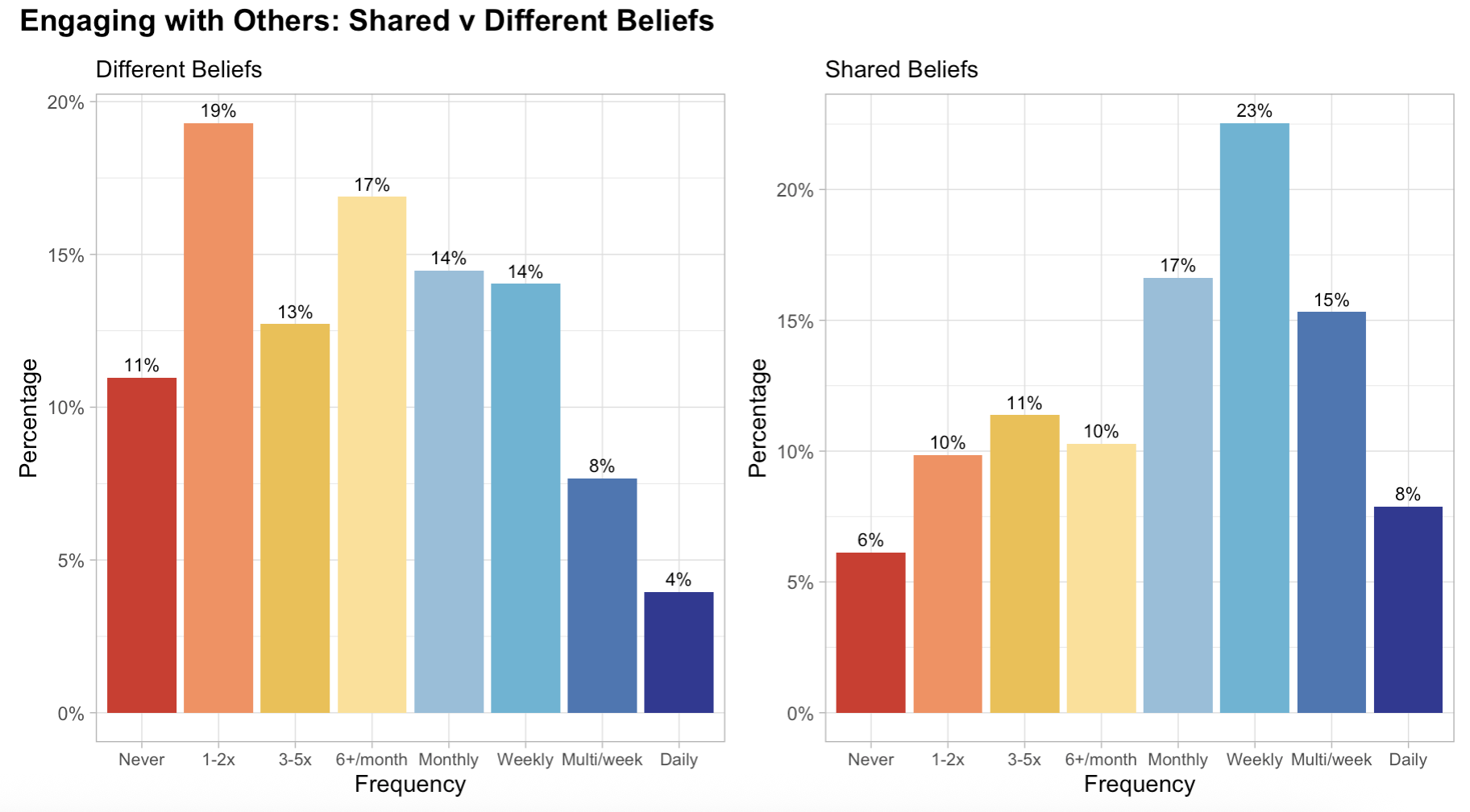
Engagement is even worse (see the figure below). When asked how frequently they had engaged with people who share their beliefs to solve a problem, only 5% said never and a large portion of respondents said that this happened quite a bit – 46% weekly or more often. When considering working with those holding different beliefs, only 26% of students said they engaged once a week or more.
But, whose responsibility is this? Is this a byproduct of our generation being bad at collaboration and confrontation? Or is this a Denison issue that can be realistically fixed with the flip of an institutional switch?
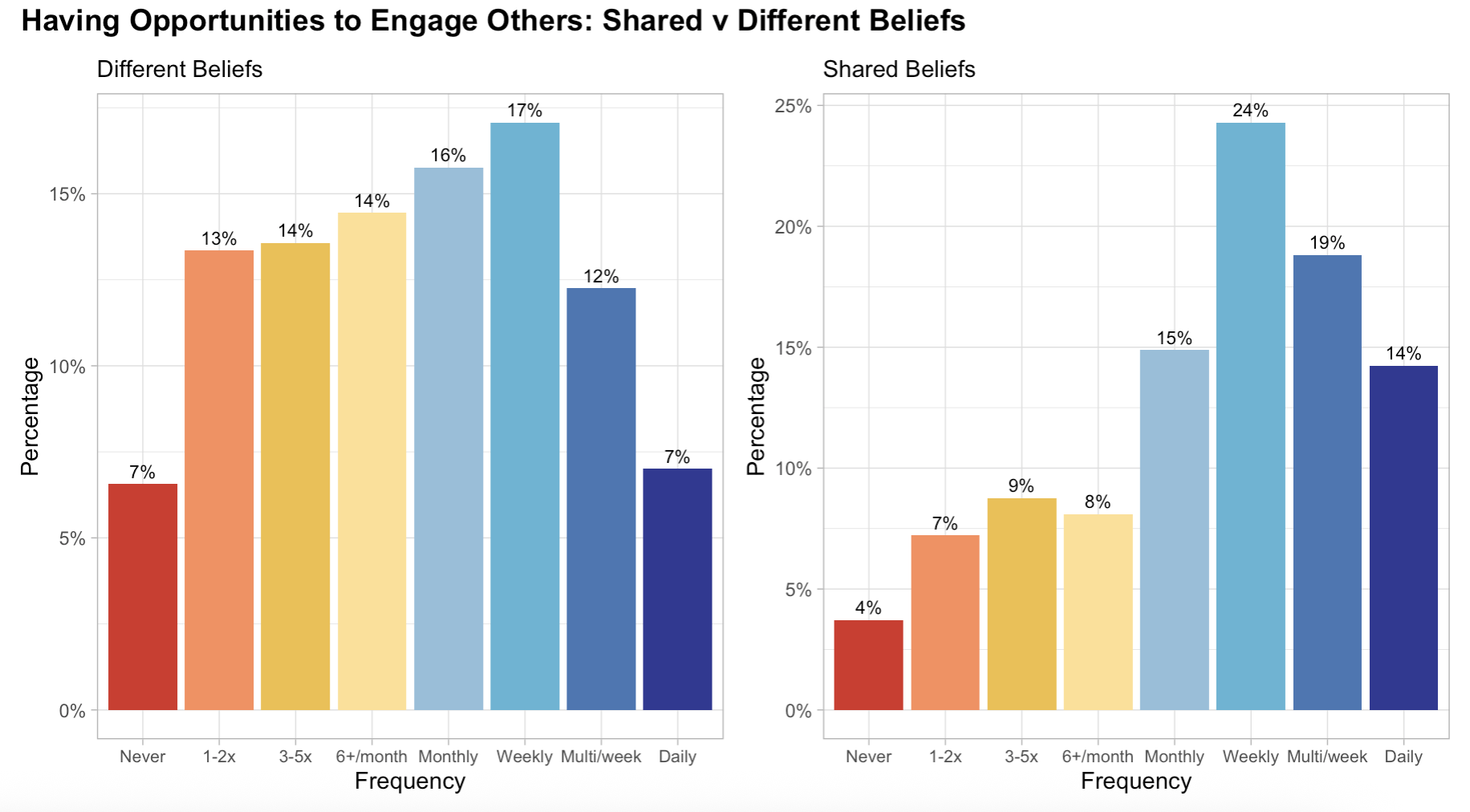
Well, as shown in the figures below, students identified that the opportunities to engage were less common with groups of people they disagreed with. 57% of students said they had opportunities to engage weekly+ when there were shared beliefs, as opposed to 36% when there were different beliefs.
As a senior, I’d like to think that I’ve gotten to know the campus pretty well – these opportunities are happening, but perhaps not in ways that are interesting to most students. Sure, there might be encouragement to grab coffee, or a dinner with 12 Denisonians, or any number of other voluntary activities. But Denison students are constantly surrounded by interesting and fun things to do, especially with friends. Why would a student want to go to a dinner with 11 random students when they could go to dinner with 5 of their closest friends?
Speaking from a student perspective, these opportunities to engage just aren’t packaged in the right way. They aren’t activities that Denison students want to do. That’s why the key is to make it mandatory, make it something that is baked into the structure of academics at Denison. Make it so that a student can’t go through their first year without approaching differences with a structure, just as they can’t go their first year without learning how to write and research in a W101. I have disagreed with, and learned the most from, students in classes where the floor is open for discussion on topics that students care about, and moderated by a professor explicitly asking what other people think. Fortunately, our institution is built to house these kinds of courses.
Students are engaging across differences less often, and less than they really should. But the burden is clearly not on them alone. Students may bear a responsibility to do their due diligence, to listen to others regardless of how they feel, to engage in civil discourse, to take advantage of the myriad opportunities provided to them. In this scenario, where Denison has made a commitment to civil discourse, the responsibility lies with the University to provide students with those opportunities. The data suggests that, provided the chance, students say they are willing to engage.
In our next post for this series, we’ll take a look at what form students, and faculty, want this solution to take.
John Elliot Harpham is a senior Communication major and DPR minor at Denison, and an aspiring sisyphean. He is from Columbus, Ohio. Did I mention that he is from Columbus, Ohio? That’s where he grew up, in Columbus, Ohio.

