By Drew Duffy
President Weinberg often tells students: “If somebody says something in a classroom that you find really uncomfortable — maybe even offensive — take them out for coffee.” Is anyone taking this advice?
That is the question a group of DPR students and I have been trying to answer since this past fall. To be more specific, we’re not interested in students’ caffeine consumption, per se. Rather, we want to learn more about students’ ability to reach across political divisions and engage in civil discourse.
Civil discourse is not the same as mere polite conversation. Civil in this context refers to being civic, i.e., the duties and responsibilities of citizenship. That distinction matters. As President Weinberg alludes to, talking about civic matters (e.g., politics, but not just politics) can feel uncomfortable.
When someone makes a remark you disagree with, it is tempting to change the topic or laugh it off. That may keep a conversation “civil” in the colloquial sense, but it’s a missed opportunity to engage in civil discourse. If we want to understand the health of civil discourse at Denison, we have to examine these missed opportunities— the conversations that never happened because students choose to stay quiet instead of engage.
This phenomenon is exactly what Taylor Carlson and Jaime Settle explore in their research about the dynamics of political discussions. The psychological motivations to talk about politics, they argue, are the same as the general goals of any conversation: “to be accurate, to affirm a positive self-concept, and to affiliate with others.” In Carlson and Settle’s experiments, they found that individuals were far less likely to engage in political conversations when they anticipated being in the ideological minority, especially in large group settings. Denison’s political landscape makes this finding highly relevant.
In our March 2026 survey, about two-thirds of students identified somewhere in the Democratic camp, whereas just 16% of respondents called themselves Republican. This balance is consistent with our previous polling and holds across class years. A partisan gender gap persists, as fewer than 1 in 10 women identified with the GOP, compared to a quarter of men. Among student groups, varsity athletes had the highest concentration of Republicans at 34%.
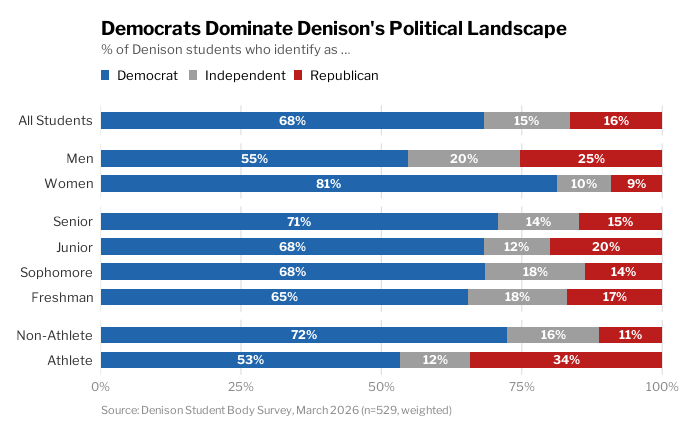
Based on Carlson and Settle’s research, this level of ideological homogeneity could be weighing down civil discourse at Denison. In a classroom, the social cost of being the lone dissenting voice may make students more likely to stay quiet when faced with political disagreement.
It might feel a bit easier to talk about politics outside of the classroom, where strong social ties among discussants help lower the perceived social costs of voicing disagreement. However, people also tend to seek out relationships with those who share their beliefs, which may further limit opportunities for cross-partisan discussions.
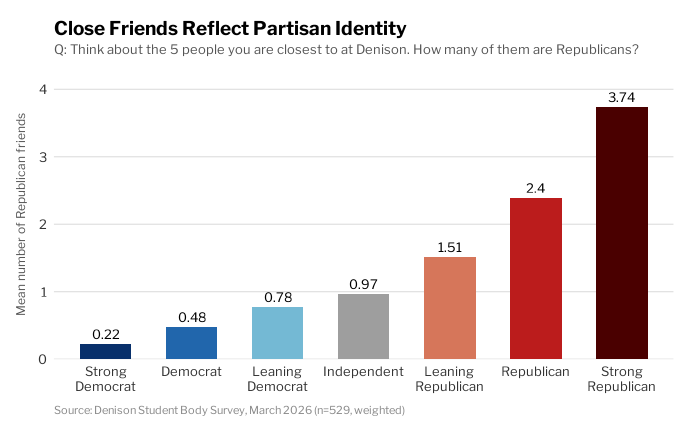
To examine this, we asked students how many of the five people they are closest to at Denison are Republicans, and the results indicate that students tend to self-sort by partisanship. As students move to the right on the partisan spectrum, the mean number of Republican friends rises significantly, from 0.22 among strong Democrats to 3.74 among strong Republicans.
So that’s it, then. Denison is too ideologically homogeneous, friend groups are too insular, and civil discourse is probably hopeless. Not so fast! Despite these potential barriers, there are real opportunities to improve civil discourse on campus.
As Dr. Djupe and Elliot Harpham highlighted in their recent posts, Denison students actually believe that civil discourse is very important. An overwhelming majority say that having discussions with people they disagree with is essential to a liberal arts education. Students also value political diversity among peers, professors, and within course materials. However, far fewer students report that they regularly express disagreement about topics in and outside of the classroom. Though the results above might help explain that disconnect, the question remains as to how to make students’ normative commitments match their lived experience.
It’s difficult to imagine a way to make talking about politics more comfortable, but maybe we can teach students the skills to better navigate that discomfort. Students must take classes to develop their writing, oral communication, and quantitative reasoning through the curriculum. However, the ability to thoughtfully engage, listen, and sometimes push back against those with different beliefs receives no official recognition. If Denison genuinely strives to cultivate “autonomous thinkers, discerning moral agents and active citizens of a democratic society,” then perhaps it’s time to rethink that approach.
Drew Duffy is a junior PPE major and DPR minor on the football team. When not bashing his head into offensive linemen, he can be found making graphs to avoid writing his final papers.

