By Thomas Kreske
You’ve got a playlist for it. Maybe it’s called “focus mode” or “study mode” or just “lo-fi”. You put it on, you settle in, and you feel productive. But here’s the question nobody asks: are you actually performing better, or just more comfortable while performing worse? The research has an answer. You’re not going to like it.
The myth that started everything
In 1993, psychologists Rauscher, Shaw, and Ky published a study in Nature claiming that college students who listened to Mozart scored significantly higher on spatial reasoning tasks than those who sat in silence. The press ran with it. “Mozart makes you smarter” became a cultural shorthand. Parents played classical music to babies. Schools piped it through hallways.
There was just one problem. It wasn’t true. Or at least, not in any way that matters to a student trying to read a textbook.
A 1999 meta-analysis by Christopher Chabris reviewed 16 studies and found the so-called Mozart Effect was negligible, roughly a 1.4 point IQ bump. This bump was limited to one narrow type of spatial task, and was likely explained by a temporary mood lift rather than anything Mozart-specific. The effect evaporated almost immediately in other contexts. It had nothing to do with reading, writing, or memorizing new information – the things students actually need to do.
Why your brain can’t multitask sound
To understand what music actually does to studying, you need one concept: cognitive load. Your working memory, the mental workspace where active thinking happens, has a fixed capacity. When you read or write, that system is fully engaged in processing language. When you add music with lyrics into the mix those words don’t politely wait in the background. They compete directly with the words on your page for the same cognitive resources.
Lehmann and Seufert’s 2017 study, published in Frontiers in Psychology, tested 81 college students and found that background music impairs learning on complex tasks by functioning as what researchers call a “seductive detail”. This means that the music is attractive enough to pull attention away from what actually needs to be learned. The brain doesn’t ignore it, it processes it, whether you tell it to or not.
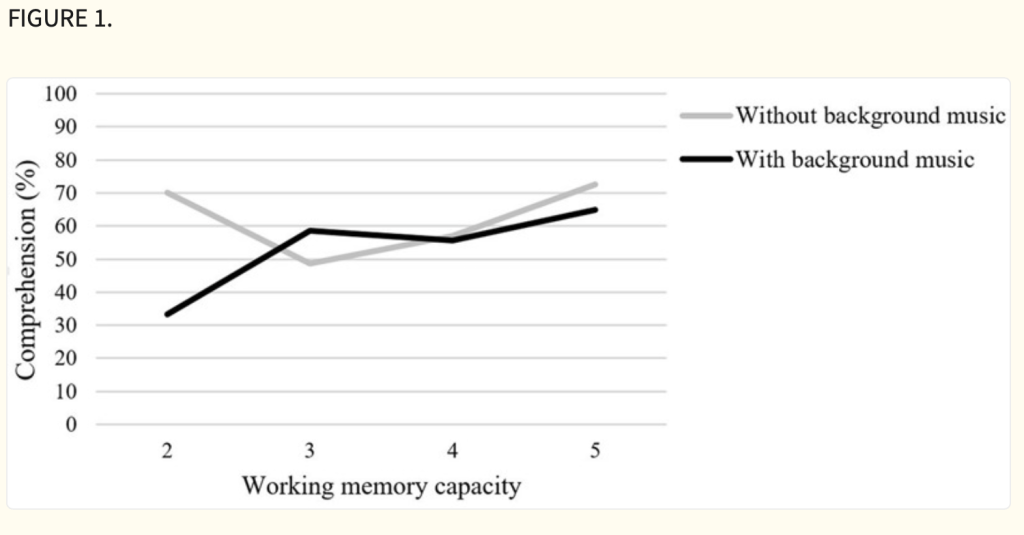
But the damage isn’t equal. Figure 1, from Lehmann and Seufert’s 2017 study, shows comprehension scores across working memory capacity levels for students who studied with and without background music. At the lowest working memory capacity, the gap between the two groups is staggering, nearly 40%. Students with more cognitive resources to spare close that gap considerably. The music doesn’t disappear as a burden, it just becomes a burden some students are better equipped to carry.
This matters because most students vastly overestimate their working memory capacity, and even those who have it are still paying a cost.
Figure 1: Comprehension scores by working memory capacity, with and without background music. From Lehmann & Seufert (2017).
Instrumental music is less damaging. Lyrical music, the kind most students actually listen to, is the most disruptive. And the louder and faster it is, the worse the effect.
The finding that should change how you study
Perham and Currie’s 2014 study in Applied Cognitive Psychology found that music students preferred actually produced worse reading comprehension than music they actively disliked. Not slightly worse, significantly worse. Familiar, enjoyable music grabs more of your attention, not less. You follow it. You anticipate it. You’re engaged with it in ways you don’t notice until you check your score.
And that’s the second problem: participants believed they performed equally well across all conditions. They felt fine. The data disagreed. Music doesn’t just hurt your performances, it hides the damage while it’s happening.
So when does music actually help?
It’s not all bad news. The research does identify conditions where music provides a real benefit, just not the ones most students use it for. Music can improve performance on simple, repetitive, low-stakes tasks: highlighting, re-organizing notes, flashcard review, data entry. In these cases, music lifts mood and arousal enough to push through without competing for cognitive resources the task doesn’t need.
The fault line is task complexity. Simple work plus music can equal a net gain. Complex work like reading new material, writing arguments, solving problems plus music almost always equals a net loss.
The honest takeaway
The most effective study environment, according to every study reviewed here, is silence. That’s not a satisfying conclusion for anyone with a curated playlist. But the research is consistent: match your audio environment to your task, and save the music for when your brain doesn’t have to work so hard.
Thomas Kreske is a graduating economics major and Spanish minor from Michigan.
 one twenty seven