By Chase Daniel
I’m one of the few hunters here at Denison, and being the deer-nerd that I am, I probably talk about it more than my friends care to hear. So when my teammate asked me why so many deer frequented the hill above the football field every day while we practice — instead of deep in the woods where they ‘belonged’ — I was thrilled. He opened up Pandora’s Box, and I shared all of my theories.
I talked about how their biggest predator on campus was a car, but my main argument was that Denison’s landscaping drew them in. I didn’t mean the mulch beds or the perfectly cut grass, but the acorns that drop from the oak trees planted around campus. Those oaks, I claimed, are pretty rare in Ohio. In my walks around the bio reserve, I’ve noticed that most of the forest is composed of big maple trees, which provide very little nutrition for deer (they don’t drop fruit or nuts, and their leaves are too high for deer to reach). I theorized that this could make Denison’s plethora of acorns a hot commodity for hungry deer.
I’ll try to keep my enthusiastic rambling to a minimum this time, but as it turns out, my deer theories weren’t too far off from what ecologists have found. While 63% of forests across Ohio are predominantly oak or hickory trees, Licking County is divided between oak/hickory forests in the southeast and maple, beech, and birch forests in the northwest.
Denison sits amid an ecological divide, but favors maple trees.
Figure 1: Map from a 2019 report by Ohio Division of Wildlife showing the predominant tree species of each county.
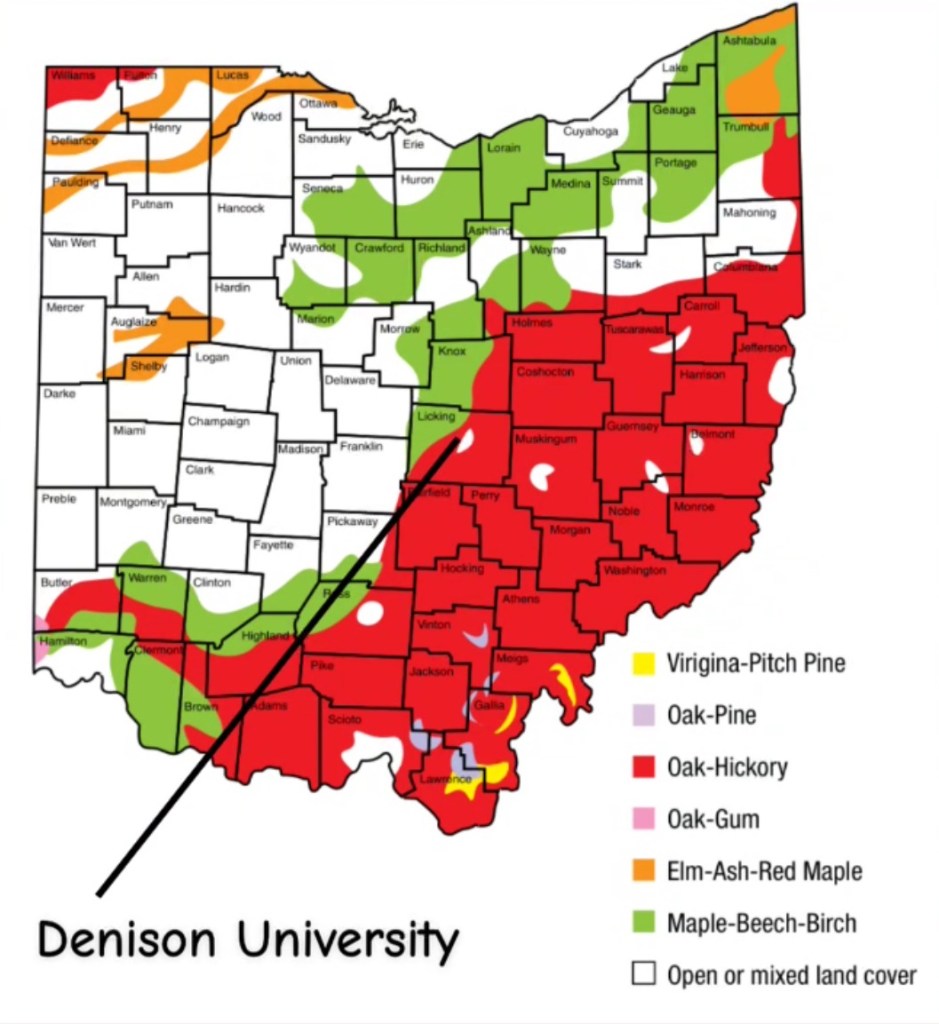
Granville straddles the divide in forest composition. Substantiating my observation, Denison ecologists have found that maple, beech, and birch trees (shaded in green) make up 75% of the bio reserve’s forest.
According to the Ohio Woodland Journal, this hasn’t always been the case. US Forest Service data show that oaks have declined from nearly 40% of Ohio’s trees in 1965 to 20% in 2016, while maples have risen from about 10% to 20%, gradually outcompeting the oaks due to their higher shade tolerance in mature forests.
Ohio’s forests are no longer oak-dominant
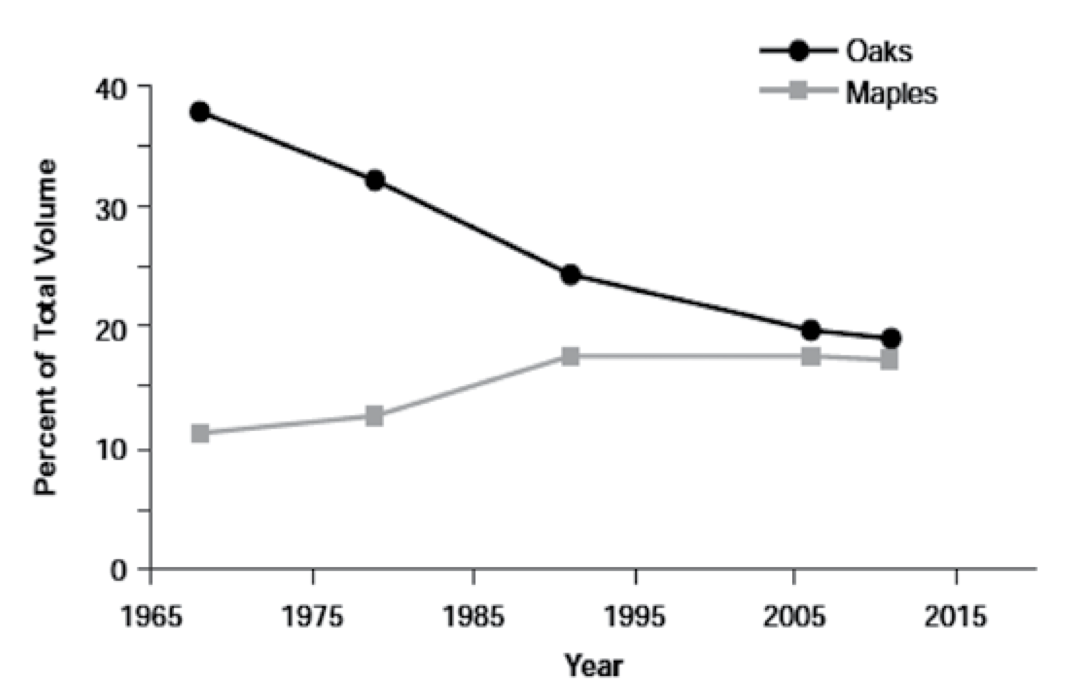
Figure 2: Trends in Ohio forest composition, 1965–2016: Percentage of trees that are oaks versus maples
This is an issue for deer. Fewer oaks mean fewer acorns, which constitute a vital part of deer’s fall and winter diets. A 1990 study from the University of Georgia tracked acorn availability over five years alongside dietary and reproductive data from deer harvested in southern Appalachia. The researchers found that when acorns were available, deer highly preferred them as fall and winter food sources.
Though this study is dated and from a different part of the country, it clearly shows how vital acorns are to deer’s nutrition. In years with bad acorn crops, does had lower kidney fat reserves, ovulated less frequently, conceived later, and had fewer fawns — clear signs of reduced reproductive success. This study offers scientific evidence for what deer hunters like myself have long known: find the acorns, and you’ll find the deer.
Even with the limited acorns in our area’s maple-dominated forests, it’s clear that Denison’s deer are not struggling to reproduce. In fact, there may be too many. In an article in the Denisonian, biology professor Geoff Smith expressed his concern that a potential overpopulation of deer was preventing saplings from growing into mature trees. This harms the forest ecology because when a mature tree dies, there are no young ones ready to take its place.
If the deer in the bio reserve woods – where they ‘should be’ according to my friend – don’t have many oak trees to drop acorns and have eaten all the other plants, then of course they have to come right up to us on campus. Here, the great oak trees planted decades ago don’t have to compete for sunlight with a dense maple forest. In fact, this helps Denison’s planted oaks make even more acorns than trees deep in the timber. I’ve consistently seen trees planted on the edge of the forest or out in a field drop the most acorns out of any oak around. Land managers say this is because they get the most sunlight, so they can put that extra energy into growing more acorns.
But just because Denison has big, open oak trees doesn’t mean they always drop the same number of acorns for the deer to eat. On average, 55% of red oaks (the kind most prevalent at Denison) produce acorns in a given year. Last year had a great acorn crop, as the Ohio Department of Natural Resources reported that 72% of red oaks made acorns. While they haven’t published their annual acorn report yet this fall, I’ve been keeping my own tabs on this year’s mast crop. Walking to class, I notice less crunching underfoot while passing by the big Northern Red Oaks outside Herrick or by the bridge over President’s Drive by Knapp. While these trees are still dropping a few acorns, it seems nowhere near the level of previous years. Even if 2026 is shaping out to be a bad acorn year and – let’s imagine only 40% of red oaks are producing acorns now – that’s still a lot more acorns on campus than they can get in Granville’s surrounding forests. This may result in fewer deer on campus this fall than other years.
Next time my friend sees a deer on campus, he can stop wondering why – it’s just following one of its favorite foods.
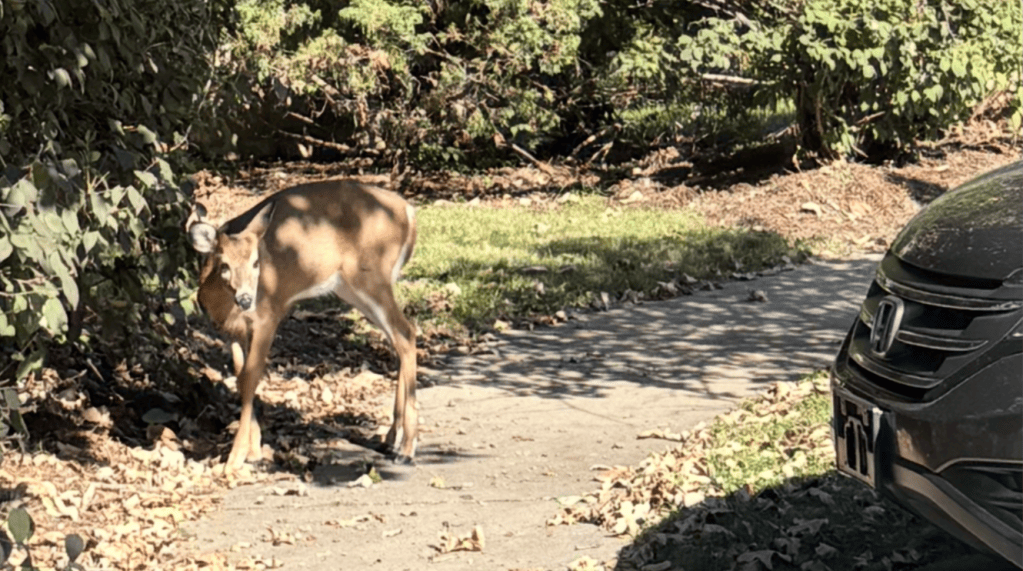
This little guy was eating acorns under a big Post Oak next to Upper Elm last week.
Chase Daniel is a senior Spanish and Global Commerce major from Rocky Mount, Virginia.

