By Miles Williams, Data for Political Research
I write a weekly newsletter where I talk about international relations and global affairs using data. A few weeks ago, I talked about a question I got to ask a nationally representative sample of Americans: did the Trump administration’s 2025 aid cuts hurt America’s image in the world?
The majority response to that question was “yes.” About 55% said the cuts made America’s image somewhat or much worse. When I broke responses down by partisanship, I found that Democrats and Independents drove this finding, while a plurality of Republicans thought the cuts had no effect. When I zoomed in on voters, the main trends held up, meaning the aid cuts likely weren’t a winning issue for the president’s party going into the Midterms.
All that is interesting, but not satisfying. I wanted to embed a randomized experiment in the question that varied the framing of aid cuts. Alas, I could only use one. The framing I used mentioned that China would continue its foreign aid spending to make up for some of the gap left by the U.S. I wanted another framing that mentioned that the cuts were meant to cut wasteful government spending and a baseline frame that only mentioned the cuts without additional context.
I got to ask all my wished for versions of this question in the recent survey of Denison students. While not a representative sample of Americans, the results still say something useful about how competing frames influence attitudes about aid cuts. In this piece, I want to talk about the results.
Details About the Data
Denison’s Data for Political Research Department fielded a survey of Denison students just a few weeks ago in October. Of the approximately 2,300 undergraduates enrolled at Denison, over 540 responded. Those 540 aren’t necessarily a representative sample of students, so the findings I’ll report are weighted based on administrative data on Denison’s student body. But, for the record, the weighted calculations I show here aren’t much different from the unweighted calculations, so perhaps the sample of respondents is representative, if only by accident.
The survey included a battery of questions, but there are just two that I want to focus on here. The first is my survey experiment. I asked three variations of a question, and students were randomly assigned to see only one version. One out of three saw the following baseline, or control, question: “In 2025, the United States significantly cut its foreign aid spending. What impact did this have on the United States’ image in the world?” Another third saw a version that included the phrase “China has continued its own foreign aid to fill some of that gap,” and another third saw a version that said the U.S. cut aid “in order to reduce wasteful federal government spending.” All students were then given the same set of possible responses. They could indicate whether the aid cuts made America’s image “much better,” “somewhat better,” “no different,” “somewhat worse,” or “much worse.” They could also say that they didn’t know.
The second question I want to focus on is partisanship. Students could indicate which of the two major parties (Democrats or Republicans) they identify with. Alternatively, they could identify as Independent or with some other third party. Responses to this question provide helpful context for the first. As I found in my previous analysis of the American electorate, party affiliation had a dramatic impact on attitudes toward aid cuts. This could be the case for students, too.
Now for some descriptive results
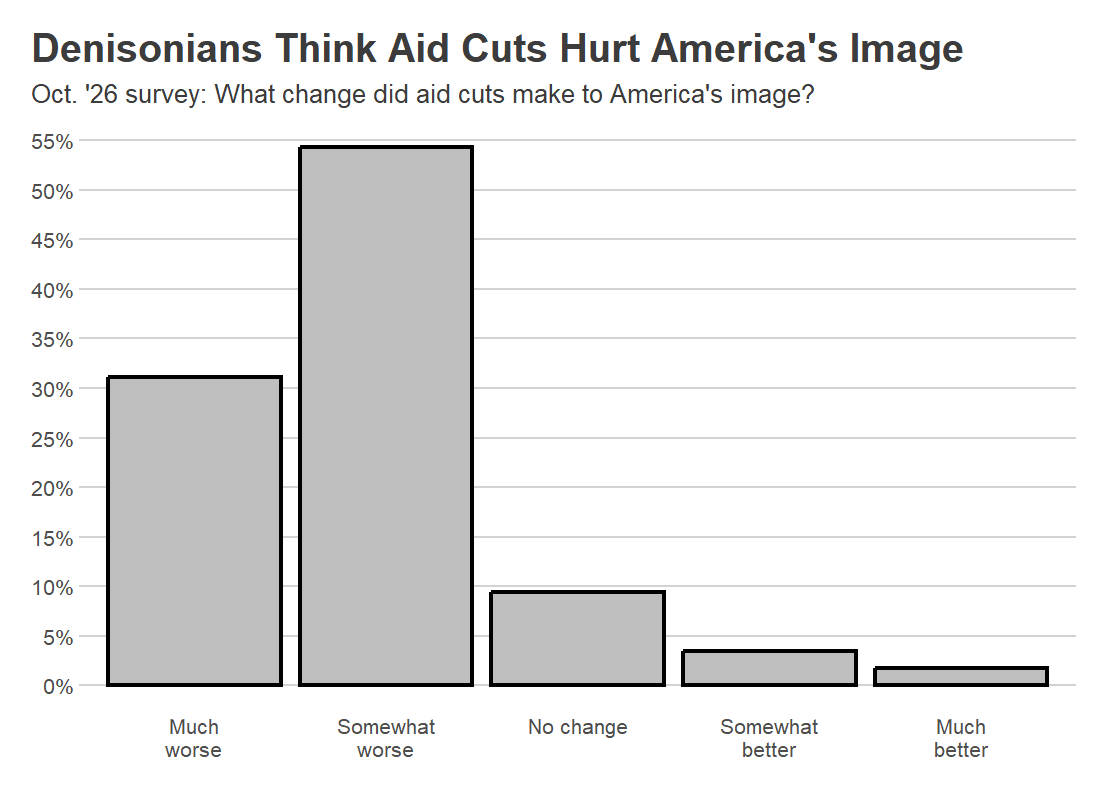
The first finding from the data is that Denison students overwhelmingly think that aid cuts hurt America’s image in the world. The below figure shows the distribution of responses to the question about aid cuts. Even though there are three versions of this question, I’ve lumped all the responses together for this plot to get a sense of students’ overall attitudes. Over 30% said that the aid cuts made America’s image much worse, and nearly 55% said the aid cuts made America’s image somewhat worse. That adds up to about 85%. A little less than 10% said the cuts had no impact, about 4% said the cuts made America’s image somewhat better, and a hair over 1% said they made America’s image much better. The margin, here, is massive: -80% net sentiment that aid cuts made America’s image better.
Now, I know what you might be thinking: this data is full of liberal college students, so of course they don’t like the aid cuts.
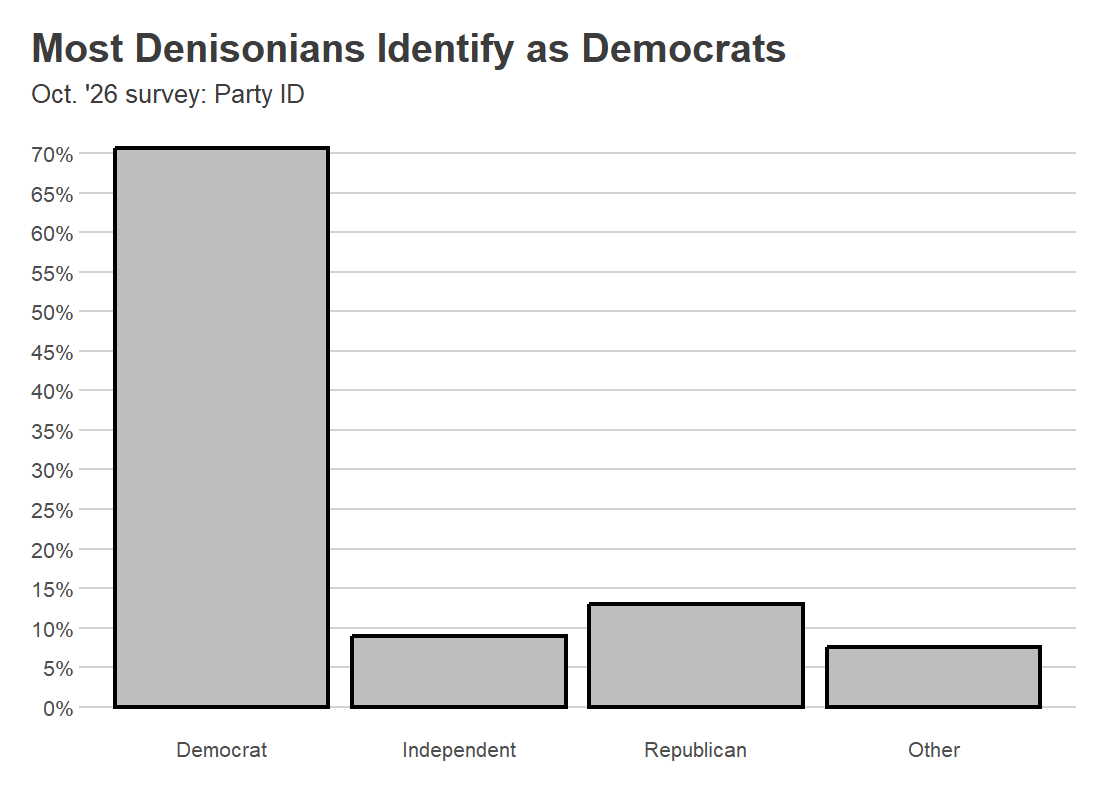
That’s a fair point, and it’s also true. The below figure shows the distribution of party identification for Denison students. More than 70% identify with the Democratic Party. Fewer than 15% identify as Republican, and fewer than 10% identify as Independent, while about 8% identify with some other party. If I were to break the data down by party affiliation, how would attitudes toward aid cuts shake out?
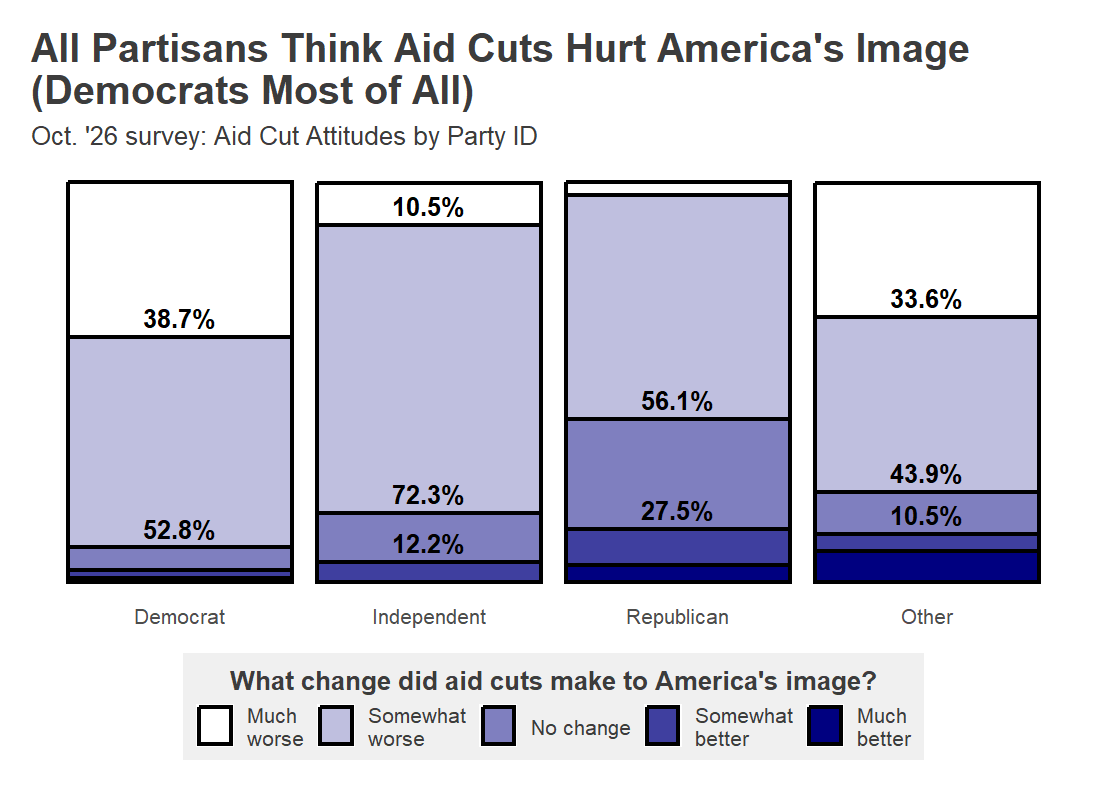
Remarkably, while there is variation by party, a majority of students think aid cuts hurt America’s image regardless of their affiliation. As you can see in the next figure, Democrats most strongly believe aid cuts hurt America’s image, followed by Independents, others, and Republicans. About 90% of Democrats think last year’s aid cuts hurt America’s image, and over 80% of Independents agree. A little less than 60% of Republicans also think the aid cuts were harmful, which is more than 30 points less than Democrats, but still a strong majority. Furthermore, the reason for this 30 point gap isn’t that a lot of Republican leaning students thought the aid cuts helped America’s image. Instead, a sizable minority (about 28%) believe the aid cuts had no effect.
Turning to results from the survey experiment
Aside from partisanship, does framing affect student attitudes? The answer is yes, but in a surprising way.
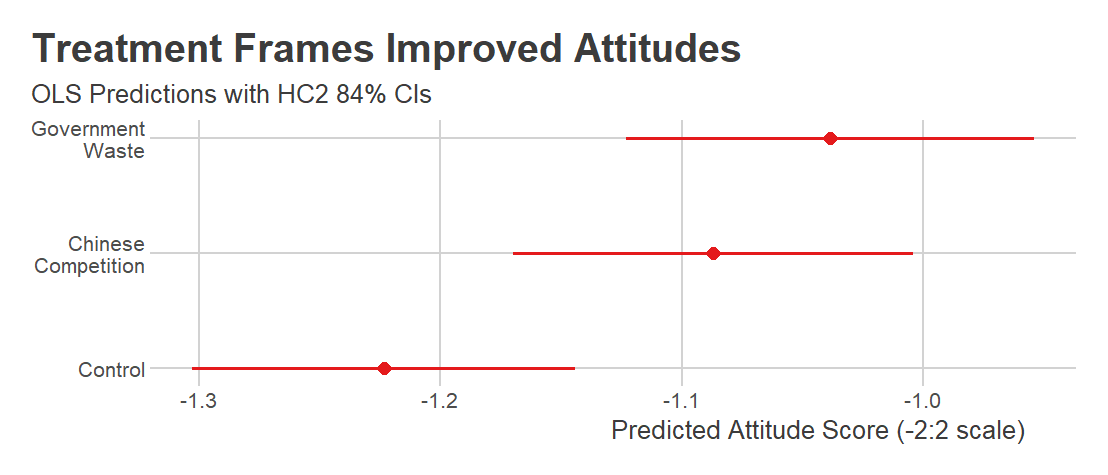
To estimate the effect of my two framing treatments on attitudes, I converted responses to the question about aid cuts to a scale running from -2 to 2. -2 = the aid cuts made America’s image much worse. 2 = the aid cuts made America’s image much better. 0 = the aid cuts made no difference. I then used indicators for which treatment group students belonged to in order to predict their -2 to 2 score in a regression model. I further used statistical inference appropriate for data from a randomized experiment (I used HC2 standard errors, which are robust standard errors appropriate for when you want to draw inferences from a randomized trial).
The results show that, compared to the control group who was only told about U.S. aid cuts, the government waste experimental frame changed students’ sentiment in a more positive direction. You can see this in the figure below. The point estimates are the mean scores on the -2 to 2 scale, and the bands are 84% confidence intervals. If those intervals overlap, the difference between means isn’t statistically significant. The only estimates without overlap are for the control group and the government waste treatment group. The difference isn’t chasmic, however—just about 0.2 points on the scale, or a 5% difference—and both groups on net still think aid cuts had a negative impact on America’s image. The results for the Chinese competition frame aren’t statistically different from either the control or the government waste frame. Its estimate also falls between the other two, which defied my expectations. I thought that framing aid cuts as ceding responsibility for giving aid to China might make students all the more worried about America’s image. That’s not what the data shows.
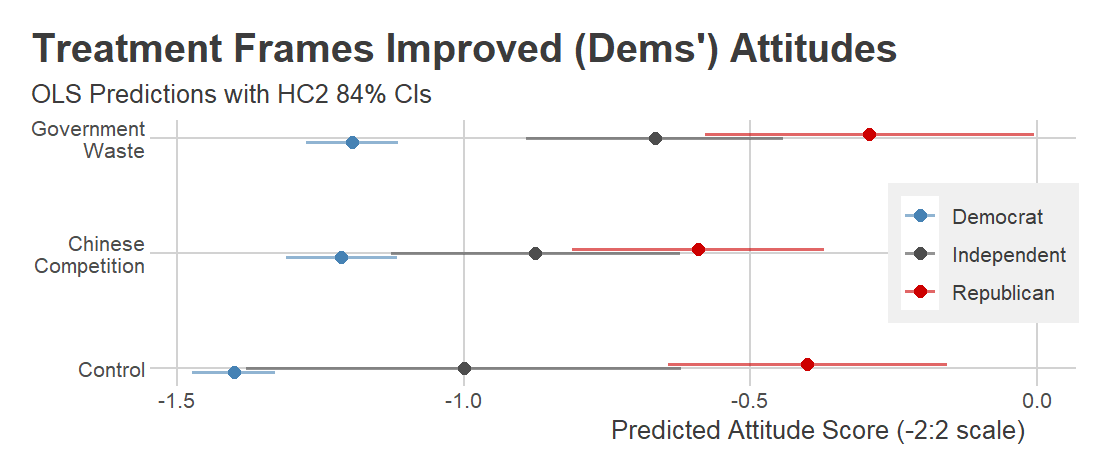
I estimated another regression model, this time interacting students’ self-identified party affiliation with their treatment assignment (note that I dropped students in the “other” category because they were such a small number). The model predictions are in the below figure. They show that the experimental frames only changed the attitudes of Democratic leaning students. Democrats further responded to both frames, and in the same positive direction. Estimates for Independents and Republicans are too noisy to draw clear inferences, but I have to ask, if I had a larger sample, particularly of Republicans, what results I would have gotten. If you look at the point estimates for the different experimental conditions among Republican respondents, you can see that the China competition frame changed their score on the -2 to 2 scale in a negative direction. This could suggest that Republicans are uniquely sensitive to the idea that cutting aid puts the U.S. behind in its competition with China. If only my estimates had more statistical precision!
The bottom line: students think aid cuts hurt America’s image
I could, and probably should, spend a lot of time doing a post-mortem of my experiment. In retrospect, I have doubts about whether my verbiage for the China competition frame was adequate. I only mention in that experimental condition that China would make up for some of the gap left by the U.S., which is just vague enough that students could have interpreted that as cooperation or competition. Given the different results for Democratic and Republican leaning students, I think this was a problem. My gut tells me Democrats defaulted to cooperation, while Republicans defaulted to competition, but I don’t know for sure. If I choose to pick up this thread in future research, this little insight will be good to remember.
However, if I had framed Chinese aid more explicitly as competition, that likely wouldn’t have changed the headline finding. Regardless of partisanship or the frame, students on net believe last year’s aid cuts hurt America’s image.
This adds yet one more tessera to the mosaic of why the GOP lost, and lost badly, in the Midterms. Youth turnout was the second highest it’s been in the last 30 years, and clearly aid cuts weren’t a winning issue for them, at least among the college going variety. And as I found a couple weeks ago, this wasn’t a winning issue among the general electorate either.
This, of course, is ironic. Most everything I’ve written on public attitudes toward foreign aid suggests that the typical American prefers aid cuts. I wonder if thermostatic voting is at work—the idea that the electorate tends to flip its opinion on issues every time the policy pendulum swings, much like a thermostat keeps a room set to a specific temperature, heating or cooling it as needed. People could also be reacting to the way aid cuts were implemented—that is, with little foresight or planning.
Whatever the reason, a majority of voters, and college students especially, think aid cuts were bad for America’s image. Yet another ironic twist is that foreign aid was meant to be good for America’s image. So much for that.
Miles Williams is a political scientist by training, but aspires to be a metal guitarist. He also is a dad to a 2 year old and a new 1 month old, which makes it very difficult to do much political science or guitar playing. Code for this post can be found on my GitHub.

