By Paul A. Djupe
An old rule of policing is that showing up to one area merely serves to push crime to other neighborhoods. I feel like Denison has been doing some of this in recent history, trying to break the stranglehold of the Sunnies or the notorious suites of East, which served to push the murmuration of partygoers to different cramped, sweaty rooms. Denison tried out party tents and then the Moonies, leading at least one senior to wonder what Denison party culture even was anymore. Since we’re now safely past the pandemic (which didn’t seem to have any effect on drinking rates), we can take a fresh look at where students have been drinking and how much.
New reports are consistent and clear – younger American adults are not drinking as frequently or as much as they used to. According to Gallup polling, young adults are keeping up with their grandparents in reduced drinking levels. Two decades ago 72 percent of young adults said they drank alcohol (at all), which has fallen to 62 percent. Drinking to excess is also falling: “The rate of overdrinking among all 18- to 34-year-olds is now 13%, down from 21% in 2001-2003.”
THIRTEEN PERCENT.
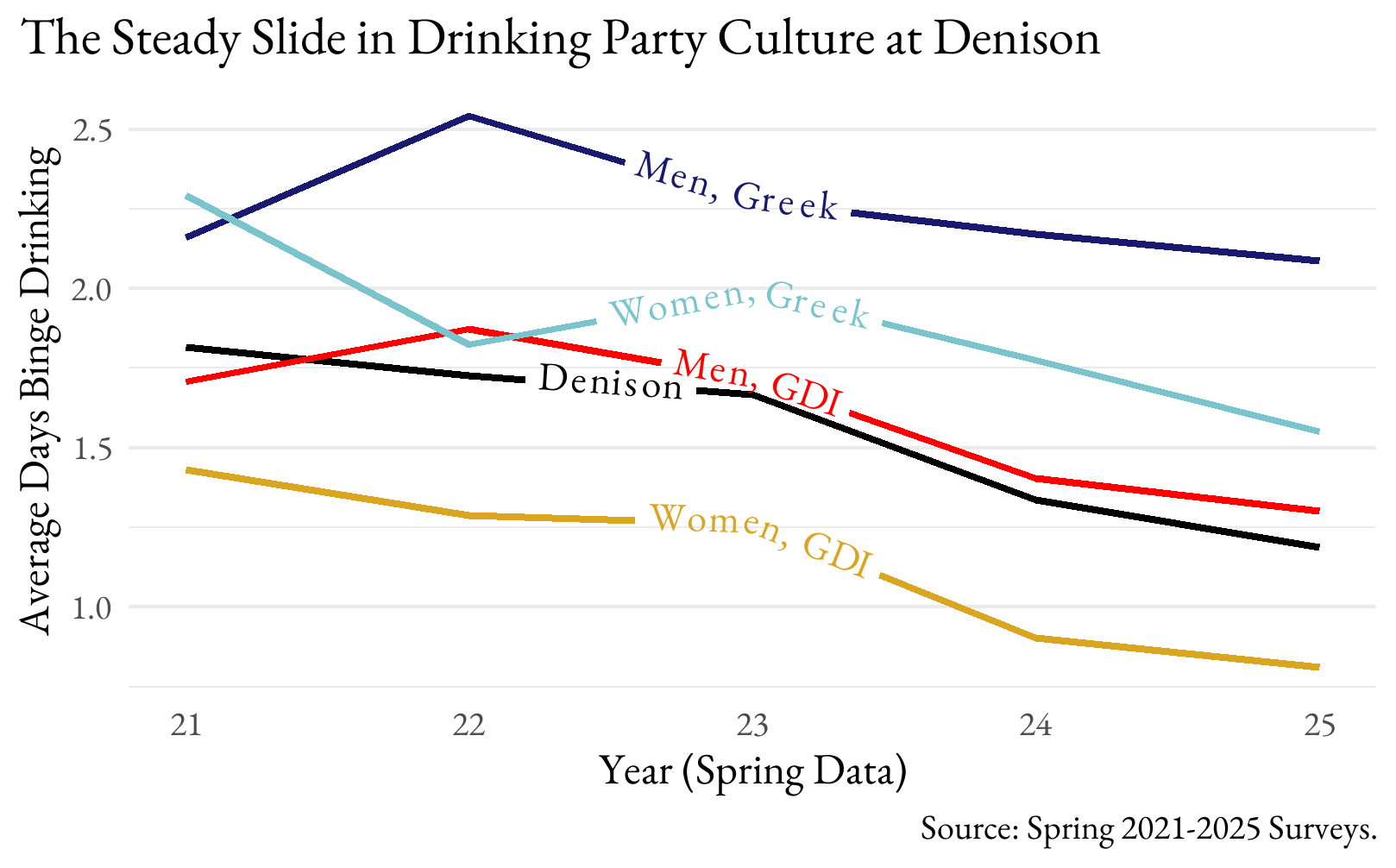
In a previous post I reported that 70+ percent of campus survey responders report binge drinking at least once a week. And this figure has held steady since February 2020 (a month before campus shut down due to Covid-19). For the first time this semester that rate is lower, coming in at 66 percent. And even that figure masks the steady slide in drinking rates at Denison. The figure below shows this clearly with the possible exception of greek men. At the beginning of the period (Spring 2021), the campus averaged nearly 2 binge drinking days a week and now that figure is gaining on 1 day a week. And it’s not clear that the campus is growing apart because of it. Sure some groups drink more than others, which has always been true, but the downward trend has come for all groups.
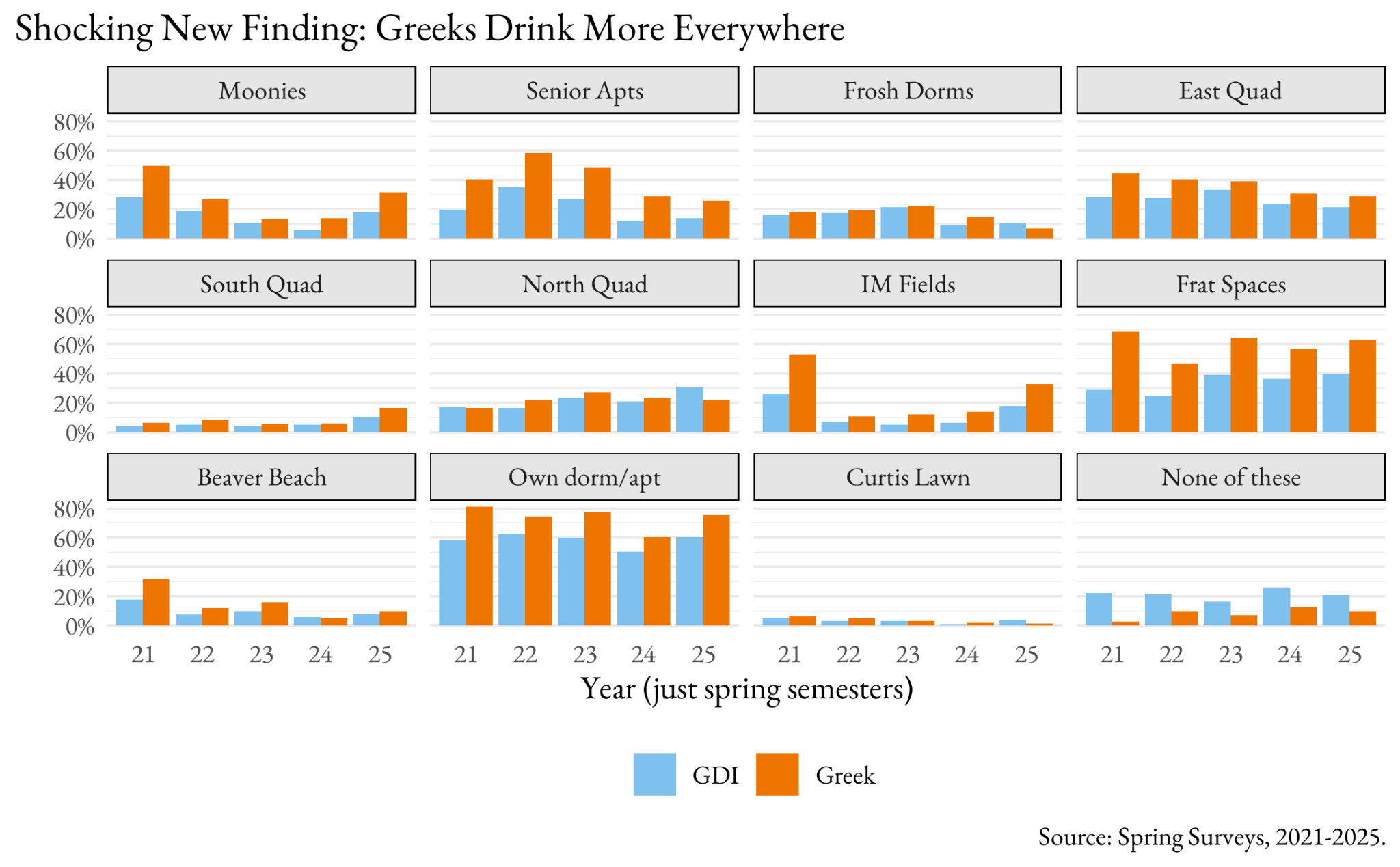
So, where is it happening? For several years, we’ve been asking students how often their best friend on campus has been binge drinking and where. If they’ve had a drink in a location, that counts, so this may not be capturing typical party locations, but the furthest extent of it. And we can find quite a bit of shifting around in the data. We have these data for the fall too, but I’m just looking at spring semester reports.
I split the data by Greek involvement status because, well, Greeks dominate party culture. So, no great surprise, Greek affiliates drink more and report drinking in more places. The only “location” Greeks do not dominate is “none of the above.” [fyi, “GDI” stands for goddamn independent, which is a term that I still like from the middle ages when I was an undergrad]. But note the slide in multiple places. What used to be called the Sunnies (now the blase “senior apartments”) have really dropped off the party map. East Quad, once a party powerhouse has been on a steady slide across this period. But North and South Quads have seen a bit or resurgence, which I would guess highlights a fragmenting party scene.
Denison aims to be counter-cultural in many ways, though I don’t think use of intoxicating substances is at the top of the Denison Forward goal list. However, that distinctiveness is starting to ebb in the post-pandemic era. I wouldn’t say that either high or lower levels of partying are necessarily net bads, as GPAs and campus involvement tend to be robust for all except the Thor-level drinkers, and party culture is pretty well entrenched among (white) students and linked to social support. It’s still worth reflecting on just how distinctive Denison students are compared to the culture at large.
Paul A. Djupe is a local cyclist who runs the Data for Political Research minor. He started onetwentyseven.blog a few years ago in a bid to subsidize collective action and spread accurate knowledge about campus and what goes on there. He also writes about religion and politics in the US.
 one twenty seven