By Joanna Passalaris
Denison prides itself on providing students with a well-rounded education. Part of our education should include political knowledge as we try to become “active citizens of a democratic society.” Unfortunately, in my previous post I found that the majority of students seem to be disinterested in America’s political climate. Despite this general lack of involvement, is the information students are learning, at the very least, correct?
Students were asked a series of two types of questions to gauge political awareness. First, students were given five facts and asked if they were associated more with the Democratic or Republican Party. Then, they were presented with five categories (crime rates, federal budget deficit, immigration levels, tariff levels, and unemployment rates) and asked if they were increasing, decreasing, or were relatively stable.
Below, Figure 1 shows the percent of students who answered each question correctly. For most questions, the incorrect answer was more common than the correct answer. There are only three questions that the majority of students were right on – abortion restrictions, taxes on wealthy, and the federal budget deficit. Guesses on which party had the Senate majority (at the time of the survey it was Democrats) was about 50/50, meaning someone is just as likely to get the question right if they blindly guessed. The Senate majority, and taxes on the wealthy are associated with Democrats while abortion restrictions and the first women on the Supreme Court (Sandra Day O’Connor in 1981 by Ronald Reagan) are associated with Republicans.
Other questions portray a more concerning trend. Students were far more likely to get the wrong answer for crime rates, immigration levels, and unemployment rates. This suggests that students are using incorrect information to answer the questions. If students are being given misinformation then they can’t effectively judge the efficacy of the government.
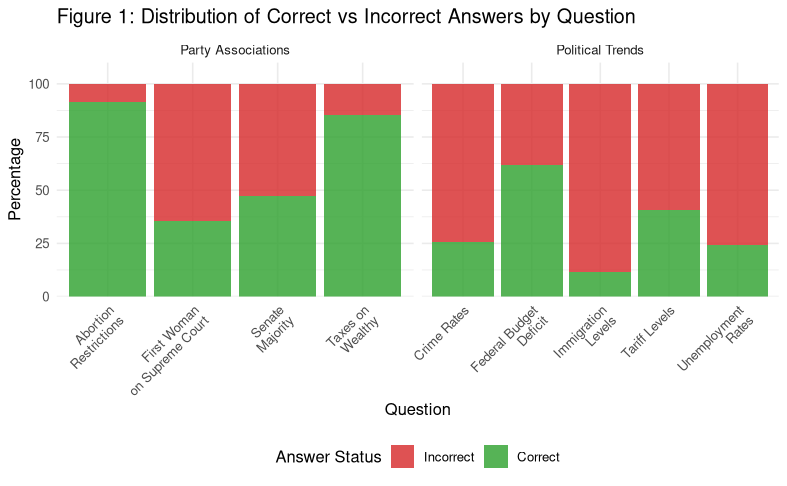
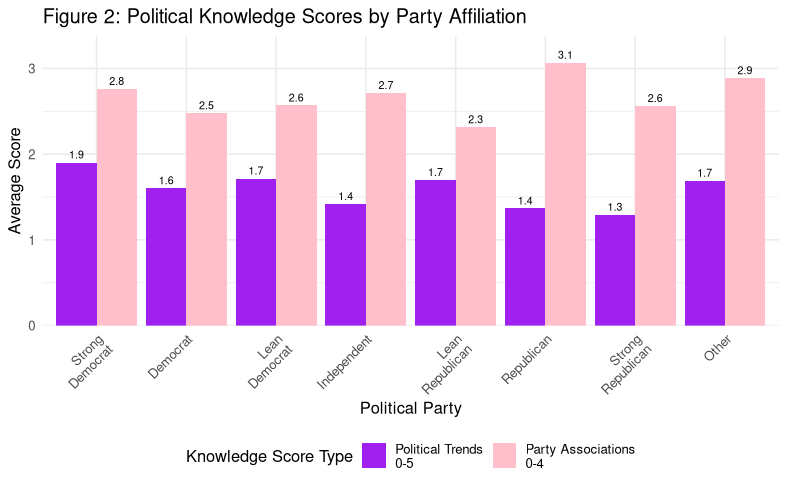
I took this information to create two indexes of the number of correct answers for each section. Figure 2 shows the average score broken up by partisanship. Democrats did slightly better than Republicans for identifying political trends (right panel in Figure 1), but overall the average scores are very low. The index for questions about party associations (left panel in Figure 1) had higher scores and Republicans scored the best, though not by an overwhelmingly large amount.
What is the cause of these low scores? It is true that not many students are heavily involved in politics, but this cannot be the whole problem. As mentioned earlier in Figure 1, the question responses are not evenly distributed, with some incorrect answers sometimes in the overwhelming majority. So can biased news sources be contributing to the problem?
In Figure 3, I took an average of the two scores and compared them to different types of news platforms. I grouped strong Democrats, Democrats, and lean Democrats together (and the same for all Republicans) to represent the two political parties. These graphs show an alarming trend. Regardless of the type of media, the more news Republicans consume, the worse they scored on the political knowledge questions. Youtube has the weakest effects, and with such high variation that there is no clear correlation, but the other platforms show more alarming trends. Democrats did not completely avoid this trend either. Increased usage for news from radio/TV and TikTok was related to lower scores. Despite this, news apps/websites usage is linked to a small increase in political awareness and Twitter/X users showed the largest increase, though only among Democrats.
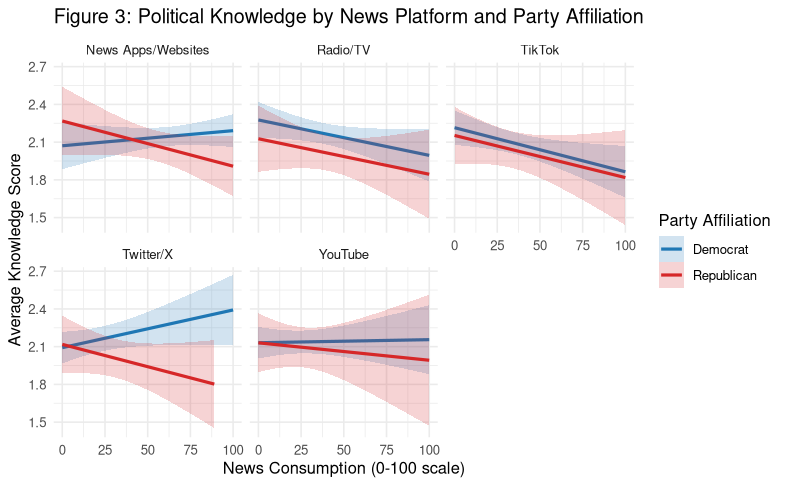
These consistently low scores and, for certain questions, an overwhelming selection of incorrect answers point to a student body that is not just disengaged, but actively misinformed. This misinformation appears to be fueled by the very news sources that are meant to inform us. The most concerning finding is that for many students, especially Republicans, consuming more news is linked to knowing less correct information. This counterintuitive relationship suggests that the problem is not a simple lack of information, but a media environment that pushes inaccuracies.
Joanna Passalaris is a senior Cinema major and a DPR minor at Denison. She tends to reread the same books and rewatch the same movies instead of trying something new.

