By Maya Schaefer
[Photo courtesy of Chambered Nautilus, 2016]
One of the first things I remember hearing as a freshman in the fall of 2021 was President Weinberg’s advice to students. One part stood out to me and arguably most of the people I’ve interacted with since then: he encouraged students to get coffee or lunch with someone who has different views than you and try to understand them. To this day, I struggle to agree with that sentiment.
After the election, my mom would occasionally ask me if my friends and I talk about politics together. My usual answer was “No”. While some members of my friend group are more outspoken about their beliefs and others are quieter, my general mindset was to keep my opinions to myself unless I knew for sure that the whole group would likely agree with me. I’ve noticed a change in this trend as talking politics became common amongst my friends after the recent election. While those who have always been quiet about their opinions in the past still remain so, the discussions have increased in frequency, intensity, and frustration. As our country has become more polarized than ever, I wonder if other students are having similar experiences to my friend group or if they’re keeping their opinions to themselves.
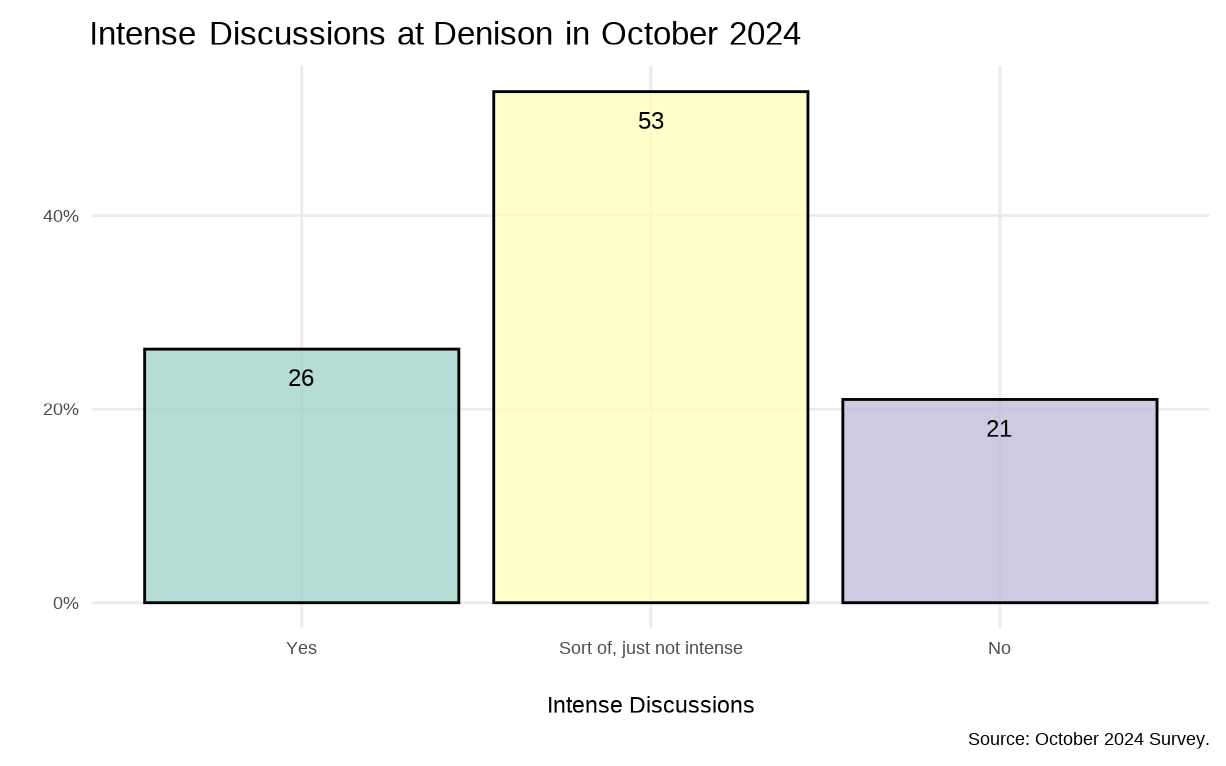
In 127’s most recent survey, we asked Denisonians whether they had had an intense discussion (marked by disagreement) about any topic with others at Denison (outside of a class) this year. Of the nearly 500 students surveyed in October, 26% reported having intense discussions on the Hill, while 53% reported “Sort of, just not intense.” This answer is how I would categorize my own conversations with my friends – some feelings of frustration, riddled with varying opinions, but not necessarily intense.
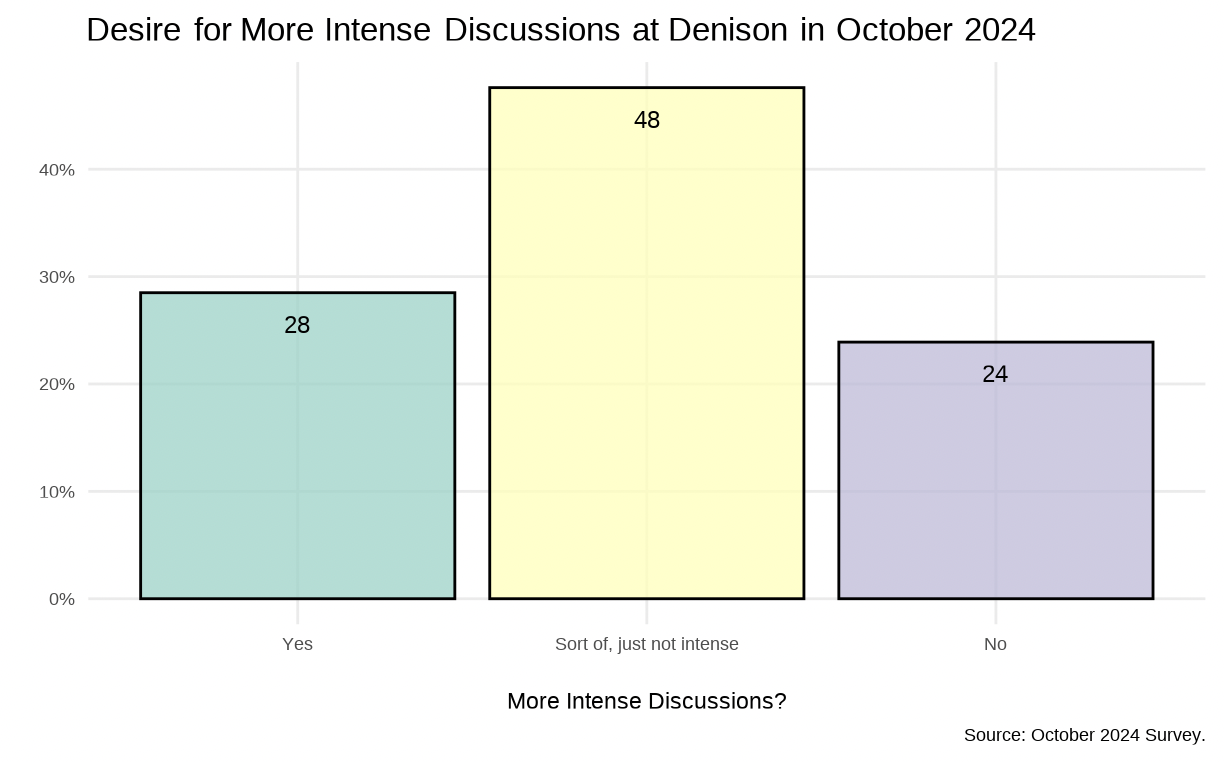
When asked if they would like to have more intense discussions with others, students reported similar patterns: 28% said Yes, 48% said Sort of, and 24% said No. Both figures suggest that Denisonians do have an interest in engaging in conversations with others but they are not interested in a tense debate. This could be due to a variety of reasons, from Denison’s small size – the likelihood of running into that person you just had an uncomfortable conversation with is very high – to the prominence of cancel culture. These combined could quickly lead to social ostracization and a nasty YikYak referring to you only by your initials (but still making your identity completely obvious).
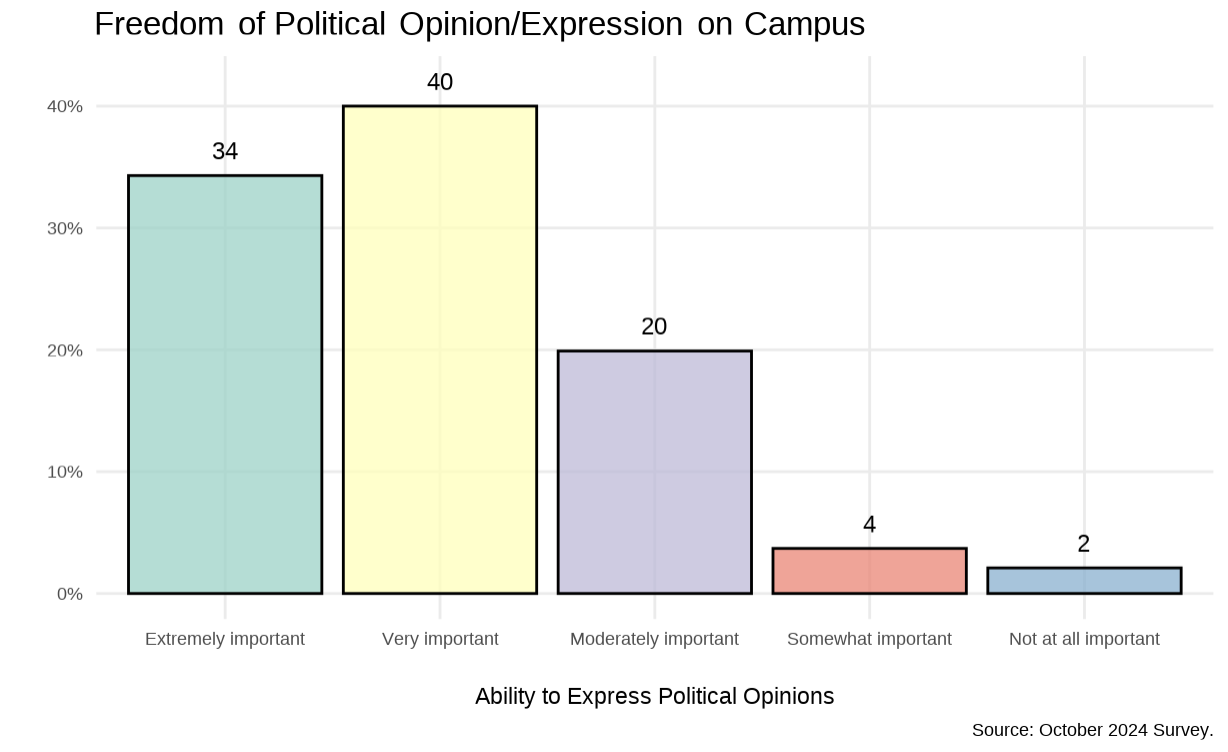
I wonder if this interest in intense discussions translates to perceptions about political expression on campus. We asked students how important it is that students feel comfortable and are able to express their political affiliations and opinions on campus, with responses ranging from “Extremely important” to “Not at all important”. 74% of students said freedom of political expression was Very to Extremely Important, while 24% said Somewhat to Moderately, and only 2% said “Not at all.” The results suggest that students feel much more strongly about freedom of political expression than having intense conversations. But don’t those kinda go hand-in-hand? Aren’t intense discussions with people you disagree with a form of political expression?
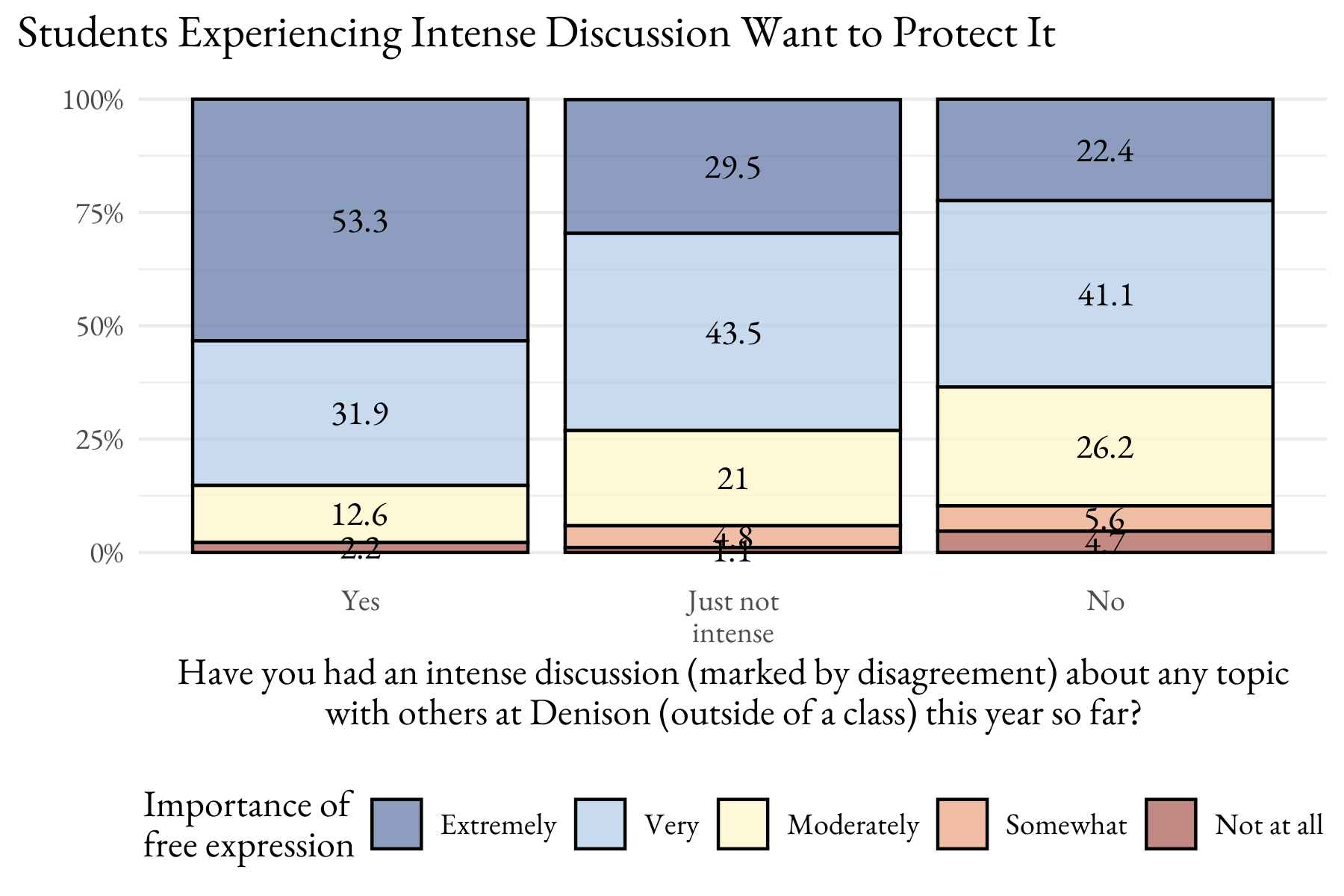
Well, yes. And as the following figure shows, students who have had intense conversations are the most invested in making sure students can express themselves comfortably. A majority suggested it was extremely important compared to just a quarter of those who did not have an intense conversation. It’s not that the latter two groups think protecting free expression is unimportant, they’re just not quite on fire about it.
While doing a little background research into this topic, I stumbled across an article written by President Weinberg when he was working toward his PhD in Sociology at Northwestern in 1994. The piece, titled “Discussion of Controversial Topics in the Classroom: Creating a Context for Learning,” found that students arrive in the classroom feeling “uncomfortable about conflict in general, in or outside the classroom” and/or “they are concerned with how their peers will perceive them if they voice anything but ‘middle-of-the-road’ views on controversial topics” (Weinberg and Lusk 1994, 301). Their framework for understanding students’ inhibitions likely rings true for Denisonians today. They even address the importance of peer interactions, stating that “concerns about their relationships as peers… may create a reluctance to say anything in class which might jeopardize their relationships as friends, participants in the campus Greek system, or romantic partners” (Weinberg and Lusk 1994).
Students may be more hesitant to engage in intense discussion with others they disagree with because that interpersonal interaction involves less control over the direction of the conversation and more confrontation. In contrast, expressing one’s political opinions or affiliations doesn’t always require a tense or difficult conversation. Regardless of the exact reason, it is evident that the majority of Denisonians are okay with having discussions with others they disagree with, they just don’t want it to be intense. So maybe President Weinberg has a point.
Maya Schaefer is a senior Politics and Public Affairs major with a Data for Political Research minor. She is avidly searching for post-grad opportunities to avoid being a babysitter for the rest of her life.

