By Maya Schaefer
A liberal arts education is arguably Denison’s most central component. As a small school in Granville, Ohio that offers 65 different majors, minors, and concentrations, its 2,400 students not only have the opportunity to explore different courses, but also broaden their perspectives, build their leadership skills, and connect with students of diverse backgrounds. As I near the end of my time at Denison, I’m left wondering how students feel about these qualities of a liberal arts education. As someone involved in Greek life, I’ve wondered how members of Greek life feel about these qualities, especially as the various councils on campus continue to expand and reflect the diversity of Denison as a whole.
In 127’s most recent survey, we asked Denisonians how they felt about what is essential to a liberal arts education, with four prompts: “having intense political discussions with others who disagree with you”, “leading an organization”, “having racially diverse friendships”, and “taking courses outside of your comfort zone”. We also asked which, if any, Greek council, they were a member of. Denison has a fairly diverse selection of Greek councils, including the National Panhellenic Conference (predominately white sororities), the Multicultural Greek Council, the National Pan-Hellenic Council (predominantly African American fraternities and sororities), and the Interfraternity Council (predominately white fraternities). We used these two questions to compare student opinions towards liberal arts education qualities depending on their Greek affiliation.
Students most agreed with taking courses outside your comfort zone (see the figure below), followed by leading an organization, having racially diverse friendships, and having intense political discussions with others who disagree with you. For non-Greeks (the NAs), taking courses outside your comfort zone took first place, followed by having racially diverse friendships, having intense political discussions with others who disagree with you, and leading an organization.
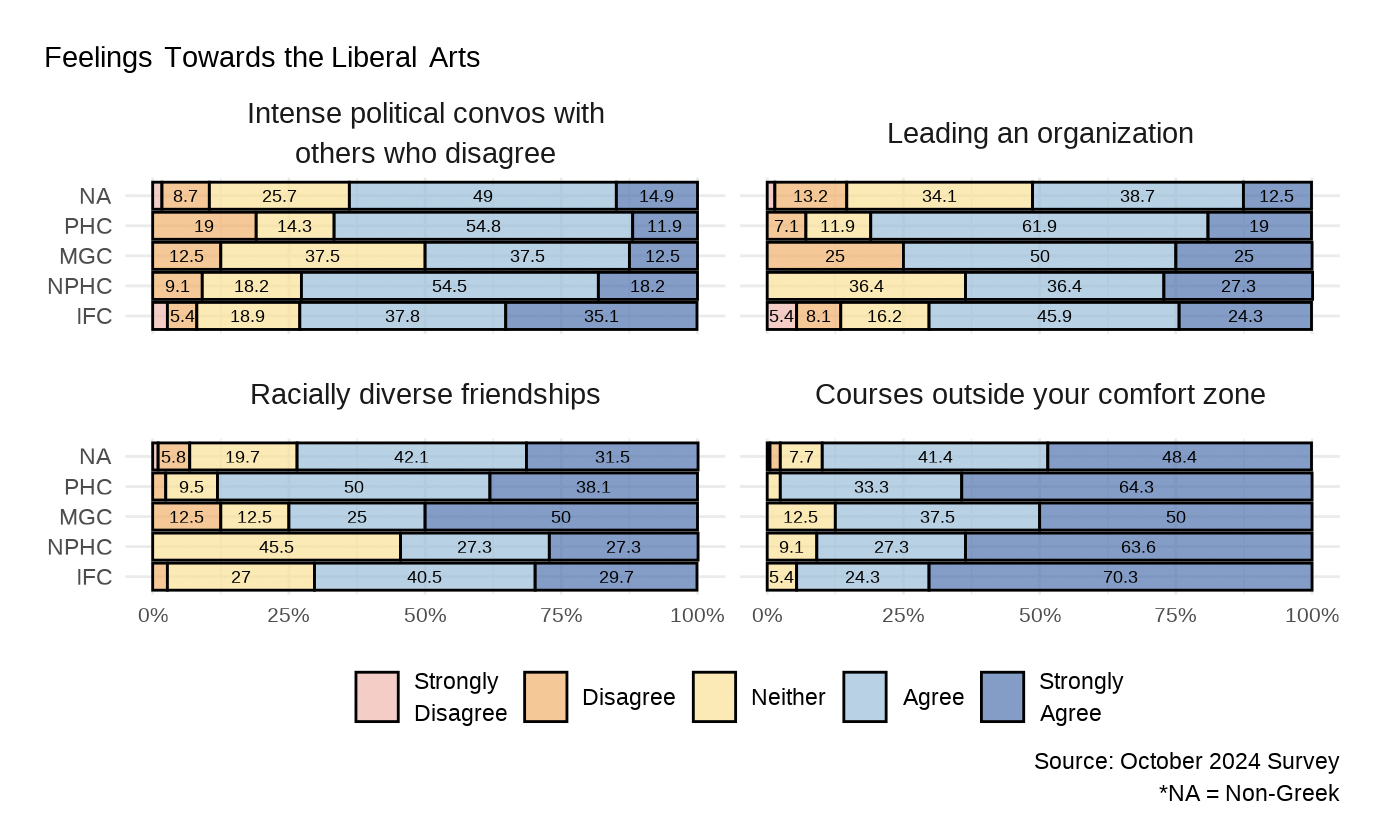
The notable difference in priority regarding leading an organization can be attributed to the obvious leadership opportunities that Greek organizations provide for members. Taking courses outside of your comfort zone is arguably the least controversial aspect of a liberal arts education, making its first-place ranking for both groups understandable. The differences in ranking for the last three spots are interesting. Greeks place leading an organization second, followed by racially diverse friendships and intense political conversations while non-Greeks place racially diverse friendships second, followed by intense political conversations and leading an organization.
Diving deeper into the data, we can see that when asked whether having intense political discussions with others who disagree with you was essential to a liberal arts education, members of the IFC had the highest level of agreement (“Agree” and “Strongly Agree”), closely followed by members of the NPHC, and then followed by members of the PHC and MGC.
When asked whether leading an organization was essential to a liberal arts education, members of the PHC had the highest level of agreement, followed by members of the MGC, the NPHC, and the IFC. I found this interesting. As a member of the PHC and someone who has held a leadership position within my sorority for almost four years, the difference between how PHC sororities and IFC fraternities regard involvement and leadership is distinct. Aside from the obvious differences in partying and drinking culture, fraternities typically have around ten leadership positions while sororities have nearly twenty. Sororities also follow stricter rules from both the executive office and the university, which, combined with the difference in involvement and leadership, could contribute to their having the highest levels of agreement and the IFC having the lowest.
When asked whether having racially diverse friendships was essential to a liberal arts education, members of the PHC had the highest level of agreement, followed by members of the MGC, the IFC, and the NPHC. Predominately white organizations like the PHC and IFC could feel more social pressure to demonstrate their sensitivity towards diversity than members of predominantly black organizations like the NPHC.
Overall, the results seem to reflect trends at both Denison and the larger Greek community. Greek life has a positive impact on leadership and dealing with political differences compared to non-Greeks. There are still notable differences in feelings towards these qualities between predominantly white fraternities and sororities compared to predominately black and multicultural organizations. I wonder if any of these patterns will change in the next few months as recruitment across Greek life begins and the country experiences a transition in leadership.
Maya Schaefer is a senior Politics and Public Affairs major with a Data for Political Research minor. She is avidly searching for post-grad opportunities to avoid being a babysitter for the rest of her life.
 one twenty seven