By Paul A. Djupe, Data for Political Research
Shellshocked. Stunned. Trump swept to power with an astonishing victory that picked up support across the board. Former Democratic strongholds – the Blue Wall of Wisconsin, Michigan, and Pennsylvania – crumbled, though the margins were still tight (about 1%). Trump picked up Georgia and he’s poised to take Nevada and Arizona as well, though counting won’t be completed for a few more days. He’ll likely win the popular vote too, which hasn’t happened for a Republican since 2004.
Of course, I knew Trump had at least an even chance of winning, but I had hope that this time the contrast was so clear, his record and character so obviously abysmal, that Americans would make a choice for sanity and democracy. Wouldn’t voters remember the pandemic? The insurrection? All of the anti-democratic things he said in this campaign? The rambling nonsense speeches? Nope. Or at least all of that didn’t matter.
When I walked into class yesterday (the day after the election), one thing I noticed was that it was not like November 9, 2016. Then, when Trump defeated Hillary Clinton, students looked lost and, frankly, afraid. Not so much on November 6th, 2024. Did they see the same stakes that I did?
Mostly they did. Below are responses to a series of questions about their expectations for the election, among a few other things. Almost ⅔ think Trump should have been disqualified because of his role in the January 6th Insurrection. More than half think the US may lose its world power status if Trump was reelected. Three-fifths think that democracy was on the chopping block and American democracy would decline as a result of a Trump victory. It is stunning to see that nearly 80 percent thought the election might lead to violence and turmoil. They’re not alone – I said as much because I believed the things members of The Right were advocating (civil war) in the run up to the election. But the clear statement from the electorate rendered that expectation moot.
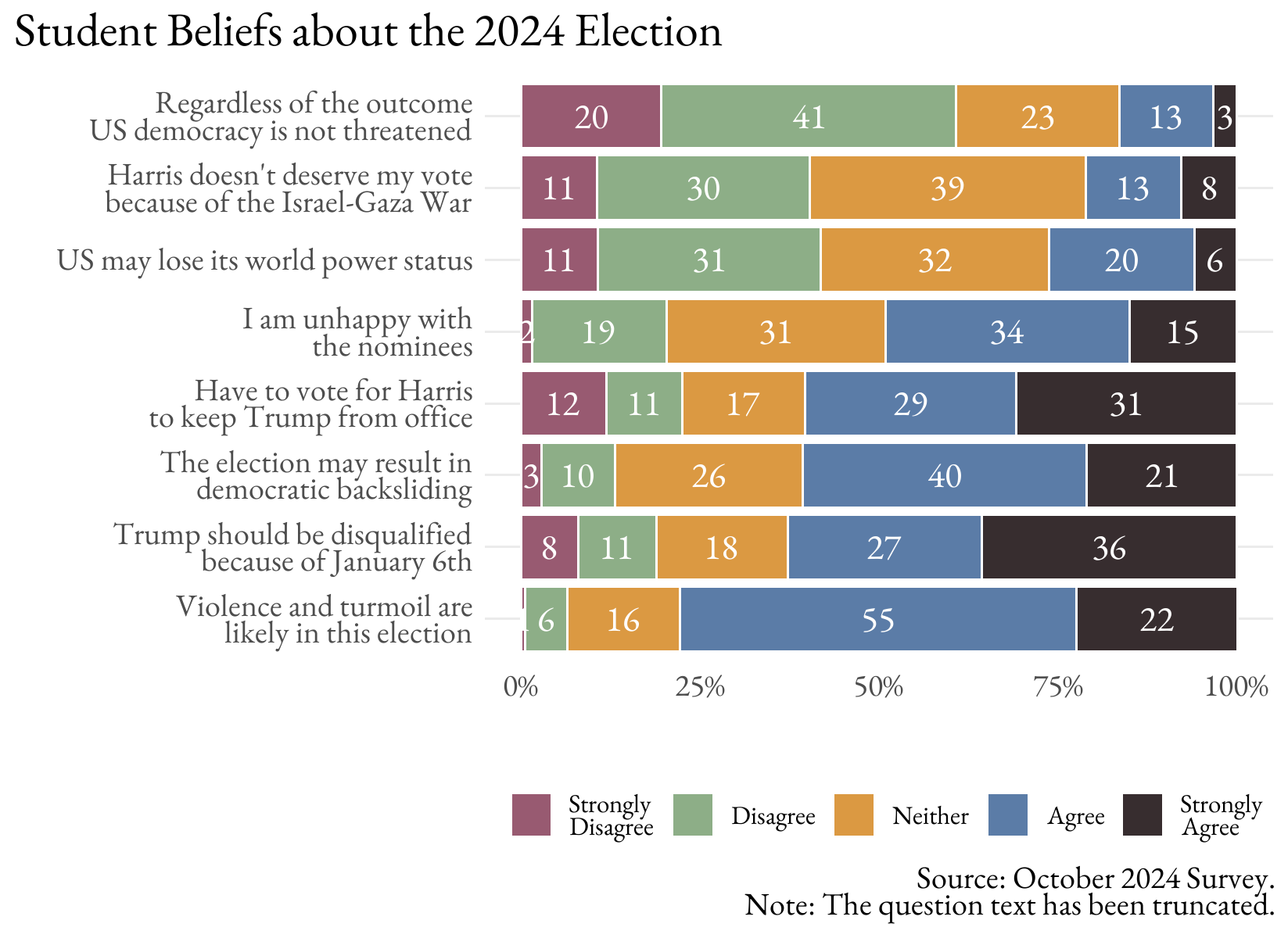
There are some other lessons from the figure above, including widespread dissatisfaction with the candidates (nearly 50 percent) and some rejection of Harris because of her association with the Biden Administration, which many on the left see as committing genocide by their support for Israel.
Why Did It Happen?
It is going to take observers some time to distill the stories of the election – sorting out why this happened. I have a few observations that I’ll share here as part of that process.
1. Denison isn’t “young people”. There is a growing educational divide in the US that really took off in 2016 and has continued since. College-educated Americans are growing in number and increasingly Democratic, but they still constitute a minority of the population. Currently, 37.7 percent have a college degree or more and there’s a slightly higher rate among women. If the Democratic Party can’t overcome the perception of being coastal, educated elites, they won’t win.

2. The results do not suggest the power of identity politics. Yes, there was a gender gap; yes, racial minorities voted Democratic more than whites. But Latinos have been moving steadily rightward since 2016 despite or because of the awful things Republicans say about immigrants and Latino countries. A MAJORITY of Latino Men voted for Trump. More white women voted for Harris than Trump, and at a slightly higher rate than they voted for Biden. And a big story is that men, especially young men, showed up for Trump. Lots of new voters equalized the turnout rate for under 30 men and women, when normally women vote at higher rates. Moreover, young people voted for Harris, but at below “normal” rates (around 60 percent) seen in previous elections.
NBC Exit Polls Comparing 2020 & 2024 by Sex and Race

3. There is little doubt in my mind, subject to empirical verification, that Harris lost big because she’s a black woman. I was super worried about this when Biden dropped out and was replaced with Harris. I think she was a great campaigner, she was definitely fully funded, and she made many of the right campaigning decisions – lots of media, lots of rallies, etc. I felt almost the same about Hillary – she was arguably the most qualified person to ever run for president and got beat. I still don’t think the US is ready for a woman, let alone a black woman in the White House. No black woman has even been a governor, yet. I hope I am proved wrong in my lifetime.
4. The other big story is about misinformation, especially about the economy and immigration. There’s no invasion, with hordes of criminals crossing the border. But the right sounded that alarm regularly. The US economy is the envy of the world with high growth, low inflation, robust job growth, and rising wages. And Trump continued to say that the economy was a disaster with the country run into the ground. That dovetailed with alarms about rapidly rising crime sounded by the right, and of course the opposite is true. Crime has been dropping consistently since the 1990s (see the figure below). But if you’re being told repeatedly that the country is a smoldering ruin run by demonic forces, then you sure would want a big change in who is running the government.

There’s a religious story to this as well, but I’ll save that for another blog or next semester’s Religion and Politics in the US course.
I have so many intense feelings about this – not just the election, but about how the world is likely to change over the next four years. One of the ways I know to process it is to do research and write about it, which I did a few weeks ago to cope with middle-of-the-night election anxiety. I want to know what the stories are to understand how we got to this dark place and what societal and political forces we will continue to contend with. Much of that processing will not take place on this blog because the forces are only visible outside of the bubble. But I’m grateful for our bubble where we can continue to debate ideas, think big thoughts, and take intellectual risks without recrimination.
Paul A. Djupe is a local cyclist who has taught social science research methods and political science at Denison for millenia. He started onetwentyseven.blog a few years ago in a bid to subsidize collective action and also writes about religion and politics.
 one twenty seven