By Paul A. Djupe, Director of Data for Political Research
Democrats and Republicans can’t agree on much these days. In many ways that’s fine, parties are supposed to be different in order to offer a real, distinct choice to voters. So, it’s always surprising to find common ground.
Ohio has an election coming up and it’s a consequential one. While it’s mostly a season to decide who runs local government and school boards, there are some high-profile ballot measures to vote on. And the quirk in Ohio is that these measures are constitutional – they amend the state constitution if they pass.
Issue 1 looks to enshrine contraceptive rights, including but not limited to abortion rights, in the state constitution. You may know that state support for such a provision has run about 59 percent, which is why Ohio Republicans wanted to change the percentage of the votes needed to pass ballot measures to 60 percent. That measure failed handily in a special election in August 57 to 43%.
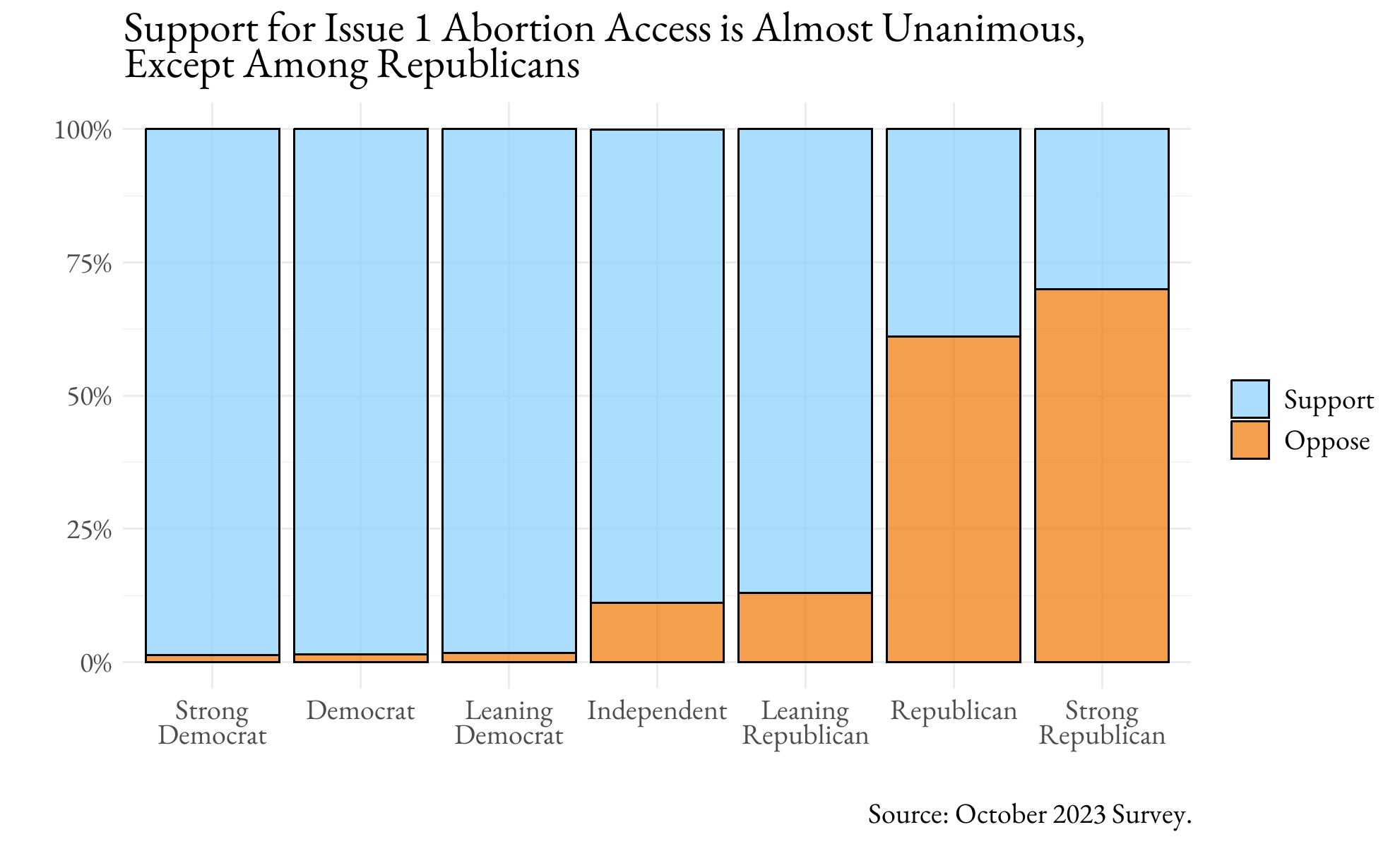
In our recently wrapped up survey of Denison students (n=504), we asked about support for the new Issue 1 measure and the results are decisive, if not unanimous. Fully 92% of student respondents said yes to the statement, “Ohio’s Issue 1 would establish in the Constitution of the State of Ohio an individual right to one’s own reproductive medical treatment, including but not limited to abortion.” Basically everyone except self-identified Republicans are on board, though as the following figure shows, Denison Republicans are split on this. Just about 40 percent of Republicans said yes as did 30 percent of Strong Republicans.
The other marquee ballot measure has language to the effect, “Ohio’s Issue 2 would legalize marijuana, allowing adults 21 and over to buy and possess up to 2.5 ounces of cannabis flower and 15 grams of extract.” Somewhat fewer students support this measure (86%), but the pattern is quite different across partisans as the following figure shows. This is clearly an idea that disparate partisans can rally around because very strong majorities in each partisan category would vote yes, including 72 percent of Republicans and 64 percent of Strong Republicans. So a unifier of campus partisans is weed.

Obviously, that doesn’t mean everyone agrees about weed and the predictors of opposition to the ballot measure are intriguing: Republicans (clearly from the figure above), first gen students, those with higher GPAs, and international students. These aren’t just a proxy for party culture — participating in that is unrelated to support for weed legalization.
It’s too bad that not all students know that these measures are on the ballot or more might have registered to vote. Only 56 percent indicated that they thought the abortion rights measure was on the ballot, though 72 percent claimed to know that the weed measure was up for a vote. I guess we’re getting a sense of student priorities or at least what their social networks talk about.
The Republican stances are more symbolic than effectual since they constitute such a small proportion of the student body (more on that soon). But finding common ground across the yawning chasm of partisan difference is something to celebrate. And given the content and typical usage rates, that’s probably just what they’ll do, whether it’s legalized or not.
Paul A. Djupe is a local cyclist who runs the Data for Political Research minor. He started onetwentyseven.blog a few years ago in a bid to subsidize collective action and spread accurate knowledge about campus and what goes on there. He also writes about religion and politics in the US.
 one twenty seven