By Sarah Sollinger
Everyone has their pregame routine. I always put on my left sock and shoe before my right. My teammate eats the same breakfast—two eggs and a piece of toast. For many of my teammates, the routine includes an energy drink, usually a Celsius.
Of my 30 teammates, most are reliant on their pre-game energy drinks to feel like they are ready to face 90 minutes of soccer in the scorching heat. As a water-only girl and a caffeine-induced shaker, I am in the minority.
While their “Peach” or “Arctic Vibe” beverages feel necessary to my teammates, a 2025 study from the European Journal of Sports Science suggests that I may be better prepared after all.
Celsius, and similar energy drinks, contain caffeine, a stimulant meant to increase energy and focus. They also contain taurine which is an amino acid that helps maintain proper hydration and support the central nervous system. This combination is offered to give you a boost of energy before the big game. In a can of Celsius, there is 200 mg of caffeine and 1,000 mg of taurine.
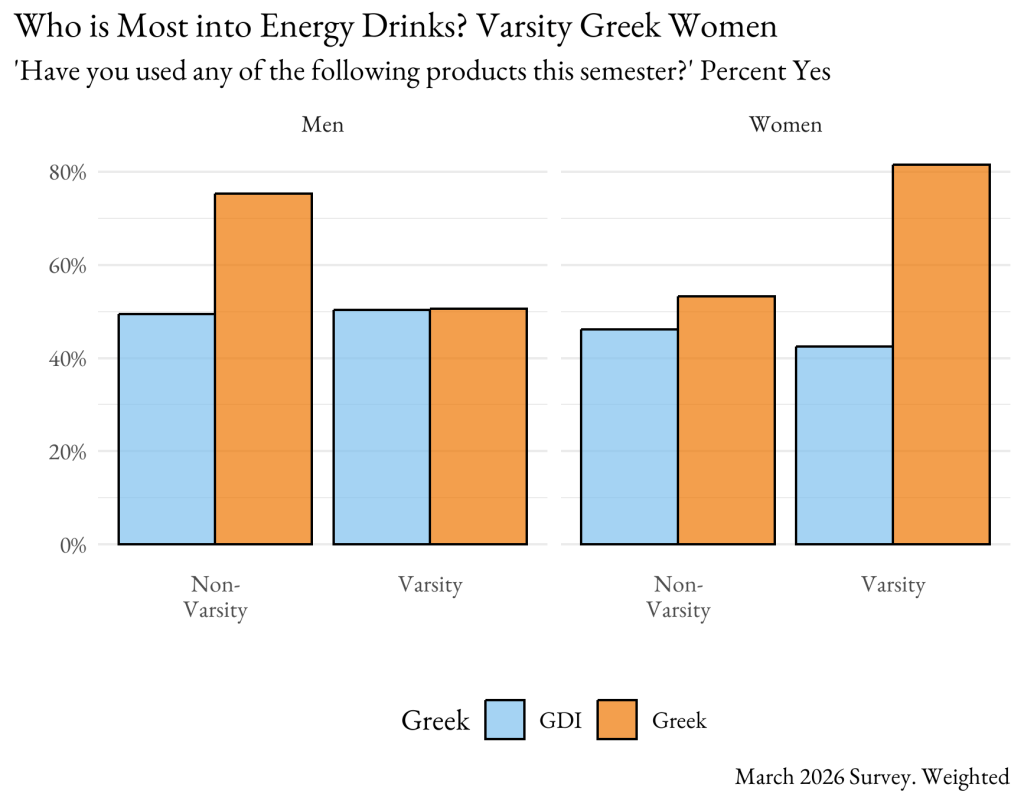
Energy drink consumption is not exclusive to the women’s soccer team. In February of 2024, the NCAA reported that 44% of college athletes consumed energy drinks. At Denison, athletes can purchase energy drinks from the vending machine in the lobby of Mitchell Athletic Center on their way to practices and games. And many do, as the following figure shows – over 80 percent of Greek women varsity athletes use energy drinks.
But, does it really help performance?
Researchers ran a double blind, placebo-controlled study where participants were given either a sugar pill, the placebo, or a high dosage of caffeine and taurine. They were given 5 mg of caffeine and 50 mg of taurine per kg of body weight. Participants then rode stationary bicycles in a 95 degree room at 40% humidity.
The goal was to find participants’ time until exhaustion. Researchers measured how hard they were breathing, how much they were sweating, their core temperatures, and how much oxygen they consumed, among other things.
The results showed more people should stick to water like me.
Those who took the caffeine and taurine mix showed no increased performance over the non-caffeine group. Both groups’ time until exhaustion was roughly 40 minutes.
However, the caffeine and taurine group consumed 5.6% more oxygen and produced 6.2% more internal heat. They were working harder just to keep up with the placebo group. Even while producing 6% more internal heat, participants’ core temperatures did not rise.
Basically, the body’s furnace was pushing out heat at a faster rate, but the vents and cooling system were able to get rid of it before the body got measurably hotter.
The researchers theorize the balance is because of the taurine. Caffeine, a stimulant, typically increases heart rate, breathing speed, and blood pressure. But taurine, which has not been extensively studied, is thought to help with body regulation and temperature. Some studies suggest it might even increase aerobic capacities. These benefits could have balanced out the caffeine and let the body cool itself down enough that there was no measurable increase in core temperature.
But this balancing act takes work. The cogs of their body were spinning faster just to reach equilibrium.
In the long run, where endurance athletes are exercising for longer periods of time, would the increased internal effort make an impact? Because the furnace is producing more heat, is the energy bill going to be higher?
So, on a particularly hot day at Denison’s Kinsle-Hylbert field, my internal systems are not working as hard as my amped up teammates. At 40 minutes we may be equal, but by the 90th minute, are my teammates who are breathing harder and consuming more oxygen getting tired quicker?
For now, I am going to stick to water.
Sarah Sollinger is a senior Journalism major at Denison and is currently taking suggestions for what to do with her life. Mathematicians need not apply.
 one twenty seven