By Bella Bergeron
Turning on my phone after a thrilling five-set match, I saw the time: 8:58pm. My high from the win immediately turned into a low. There was no way I could change, shower, and walk to the dining hall before it closed at nine. I had two options: either sprint to a different dining option which doesn’t take meal swipes and is a twenty-minute walk from my dorm, or go back to my dorm, shower, and survive off snacks for the night. The second option was the obvious choice for my teammates and me.
For Division III athletes, moments like this are routine. We are expected to compete, study, lift, and recover like Division I athletes, but without the same resources to make that balance possible. Whether it is the lack of athletic trainers, limited nutrition options, or the shortage of strength coaches, the expectations keep rising while the support stays the same.
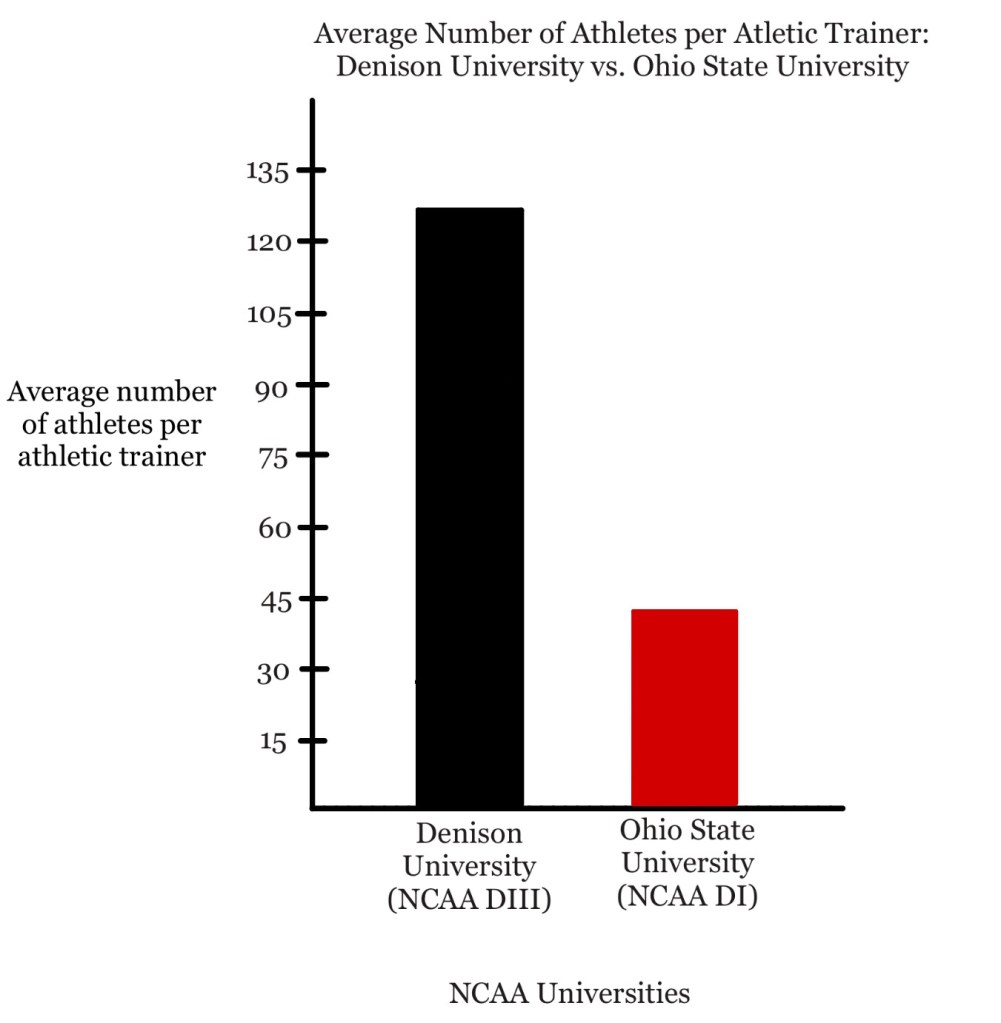
In order to understand the severity of the gap, I compared the number of athletic trainers at Denison University with those at The Ohio State University. Denison currently has five full-time trainers covering 629 athletes across nearly 30 varsity teams. At Ohio State, there are twenty-one trainers for 859 athletes. This means that, on average, each Denison trainer is responsible for about 126 athletes, while each Ohio State trainer is responsible for about 41 athletes.
As you can see in the graph, the ratio of available care is three times higher at larger programs – this difference affects recovery time, delayed injury reporting, and growing pressure to keep performing through fatigue.
That’s not just our feeling – academic research backs up that assertion. Matthew Bejar, Assistant Professor of Exercise Psychology at San Jose State University, conducted a study in which collegiate athletes were interviewed about how accessible athletic trainers were and their comfortability with them. After Bejar analyzed all of the interviews, he found that athletes who had regular access to athletic trainers recovered faster and felt more supported both physically and mentally during injury rehab. Athletic trainers who have more time and energy to support their athletes are able to help athletes stay motivated and confident throughout the entire duration of their recovery.
At Denison, trainers are responsible for multiple teams every single day, so they are often fully booked and have to run from one practice to another. If you manage to find one, getting seen right away isn’t always possible.
While accessibility to athletic trainers is scarce, the resources in the weight room make the training room look like the Four Seasons Hotel. Marcel Lopes Dos Santos, an Assistant Professor of Biomechanics at Oklahoma State University, investigated the impact of stress on athletic performance for 173 elite junior alpine skiers. He found that there is a strong correlation between stress levels and depressed mood, sleep disturbance, fatigue, performance demands, goals and development, and academic requirements. Since the strength coaches are with these athletes often, they are able to track these shifts and better accommodate them and set them up for success.
Division I programs usually have multiple strength coaches who monitor workloads, track recovery, and adjust programs to prevent burnout. At smaller Division III schools, that kind of individual oversight doesn’t exist. Denison’s strength staff are excellent, but there are only three coaches responsible for 629 athletes. This leaves many athletes without adequate supervision during high-intensity workouts. Athletes themselves are often their primary source of support on the court, in the classroom, and in the weight room. These pressures add up and can feel suffocating at times. Santos noted during his investigation that unmanaged stress like this raises injury risk, slower recovery time, and impaired focus. For many of us, the hardest part isn’t the training, it’s trying to manage it all while not feeling enough support around us.
Once you add poor recovery habits to that stress, such as bad sleep or bad nutrition, the stress becomes unbearable. What we want to eat versus what is available to us is hardly ever the same. Late night games, early lifts, and lack of options make it almost impossible for Division III athletes to fuel properly.
Nutrition might be the most overlooked part of being a college athlete, but it has one of the biggest effects on performance and recovery. Aaron J Riviere, Clinical Assistant Professor and Director of Sports Nutrition at Texas A&M University, looked at a multitude of studies where participants (ranging from paralympic athletes, DI, to DIII) took tests on how well they knew nutritional facts, diet habits, and other food resources. Riviere found that collegiate athletes who worked with sports dietitians had significantly better eating habits, recovery rates, and energy levels than those who did not.
The issue is that most Division III schools, including Denison, don’t have access to that kind of support. We have one nutritionist at Denison who is booked most of the time. Dining halls are closed before we go to morning lifts, and are closed after we finish a late-night match. After dining halls close, our options are far from campus and often limited to unhealthy fast food. For many of us athletes, dinner ends up being whatever fits in a dorm mini-fridge or our snack stashes. Without consistent access to fueling stations or dietitian guidance, it’s easy to under-eat or choose foods that don’t help with our recovery.
Thinking back to those late five-set match games where I had to rely on my mini fridge for pickles and cheddar cheese sticks for dinner, it’s become clear to me that the problem was never just about the food. It’s about the system in which athletes at Denison and across DIII are expected to give their everything to their schools while receiving very little love back. Of course, winning games feels amazing, but it shouldn’t have to come at the cost of recovery, health, or balance. If colleges want athletes to perform their best, they have to give them the resources to do so.
Bella Bergeron is a sophomore at Denison as well as a HESS and Communication double major. In her free time she likes to tell people she reads but she really only has time for volleyball practice.
 one twenty seven