By Joanna Passalaris
This past year has been an unfortunately historic year for American politics. Every week there seems to be a new breaking story about yet another executive order, increased international conflicts, or cultural tensions approaching a breaking point. With all of this going on, people should be interested in the news. In the digital age, people have unprecedented access to news, and yet the public is increasingly misinformed or entirely disinterested. On Denison’s campus, one that tries to create “active citizens of a democratic society,” students should hopefully uphold the campus values and be at the very least informed citizens. A recent survey of Denison students gives us a chance to see if this is true.
The political composition of the students is shown in Figure 1. As expected for Denison, the student body leans left, with Democrats and Lean Democrats constituting a majority. Even so, there are some Republicans on campus, but everything right of Independent are relatively small groups. This is a slight increase from previous years which reported 16% Republicans compared to the current 19%.

However, a student being a Democrat or Republican is not a perfect predictor of engagement. Rather, Figure 2 reveals a strong correlation between the strength of a student’s party identity, regardless of left or right, and their interest in politics. Strong Democrats and strong Republicans tend to be extremely or very interested in politics. Conversely, the middle of the political spectrum, Independents and leaners, contains the vast majority of students who are only slightly or not at all interested. The most politically disengaged student at Denison is statistically most likely to be an Independent.

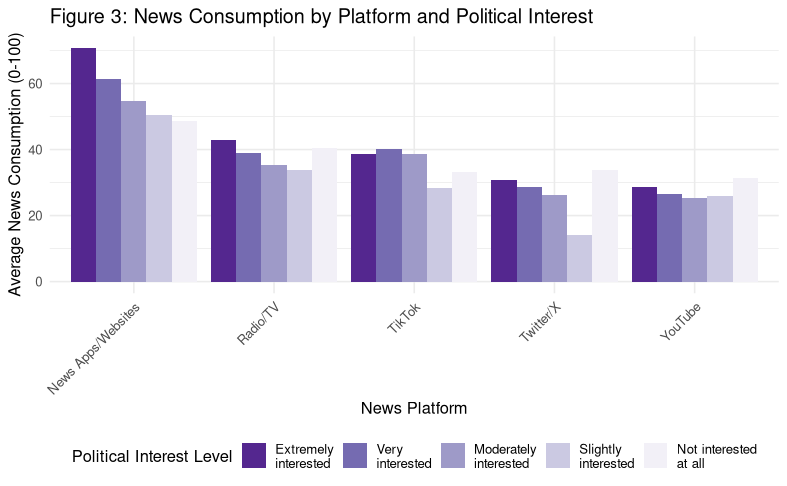
These varying levels of political interest directly relate to news engagement. Figure 3 shows the average news consumption from various platforms, broken down by interest level. There is a positive linear relationship, as interest increases so does news consumption. This trend is most obvious among more traditional news options: news apps/websites and radio/tv. Youtube, though, stands as an outlier as it is rarely used for news regardless of political engagement.
Given this trend, it would be reasonable to guess that those who are not interested at all in politics would have the lowest media engagement, but rather it is the slightly interested. This could mean that some students overestimated their own interest in politics or those who are not interested at all still passively consume news media regardless of interest. Overall, though, the extremely interested tend to use all news sources the most, and the slightly and not at all interested the least.
A trend explaining news engagement is less clear when looking through the lens of political affiliation. Each type of news source is affected by political affiliation differently. For instance, Republicans use Twitter/X more than Democrats (expected given Musk’s connection with the Trump administration). Radio/TV is also more popular amongst Republicans while TikTok usage seems to be more impacted by strength of partisan identity, as opposed to political party.
News apps/websites have an interesting trend as usage decreases the farther right a person’s politics are, and then it jumps back up for strong Republicans. I am guessing that this is because of the strong affinity of the Right for FOX News. Youtube is minimally used across the board, except for partisan others. Upon further looking at the data, those who selected partisan others frequently identified as Socialists, but I genuinely don’t know why they like using Youtube for news so much.

The data reveals that political engagement on campus is powered more by a student’s general interest in politics than by their specific partisan identity. The result is (at least) two different experiences of the political world, one more active by strong partisans, and the other more passive by the less interested. The type of news consumption can be dependent on where a student falls on the political spectrum. This means students are likely seeking out news that reaffirms their pre-existing beliefs, a dangerous practice. With partisan news sites and social media algorithms, it is easy to ignore opposing views, leading to increased polarization.
Many of these results are discouraging. For a liberal arts college dedicated to informed citizenship, so many students remain uninterested in politics. Political engagement cannot be seen as a hobby but rather a necessity. Recently, America had one of its largest protests ever, No Kings, and the White House responded by posting an AI video of Trump, as a King, dumping excrement on American cities. With this happening, interest in politics is actually interest in the future of America.
Joanna Passalaris is a senior Cinema major and a DPR minor at Denison. She tends to reread the same books and rewatch the same movies instead of trying something new.
 one twenty seven