By Paul A. Djupe, Data for Political Research
A recent report by Pew Research shows a remarkable thing – the gender gap in religious affiliation has closed among Gen Z in the US. That women are more religious than men has been almost a universal constant, holding across time and the world, so to see any deviation in that pattern turns heads. Do we see any evidence of this on The Hill?
Yes, well sort of. Overall in the most recent survey conducted late this year in April, there is no real difference between men and women – 49 percent of men are non-religious, while 52 percent of women are, and a whopping 80 percent of trans/non-binary identifiers. We need to dig a bit deeper to see a gap between self-identified men and women (trans/n-b identifiers need to drop out of the analysis at this point because there aren’t enough in the sample to permit it).
We have to remember that Denison is distinctive in several ways from a general population sample beyond just being younger – there are too many Democrats and a sizable chunk are international students. Let’s take the latter first.
International students are much less religious than domestics and show the expected pattern – men are much more non-religious than women – it’s almost a thirty percent gap! On the flip side, domestic women are more non-religious than men by 12 percentage points. This is akin to the unexpected finding Pew found.

One of the big shifts in American religion and politics is the decline of religious identification among Democrats (and the maintenance of religious ID among Republicans). We see the same thing here among students. In the figure below, we can see the degree of non-religious identification by partisanship and gender. There are small differences within each group, but nothing confidence-inspiring. Democrats and independents are majority non-religious and at about the same rate (~55%). Republicans, however, are half as non-religious and men a bit more so than women.
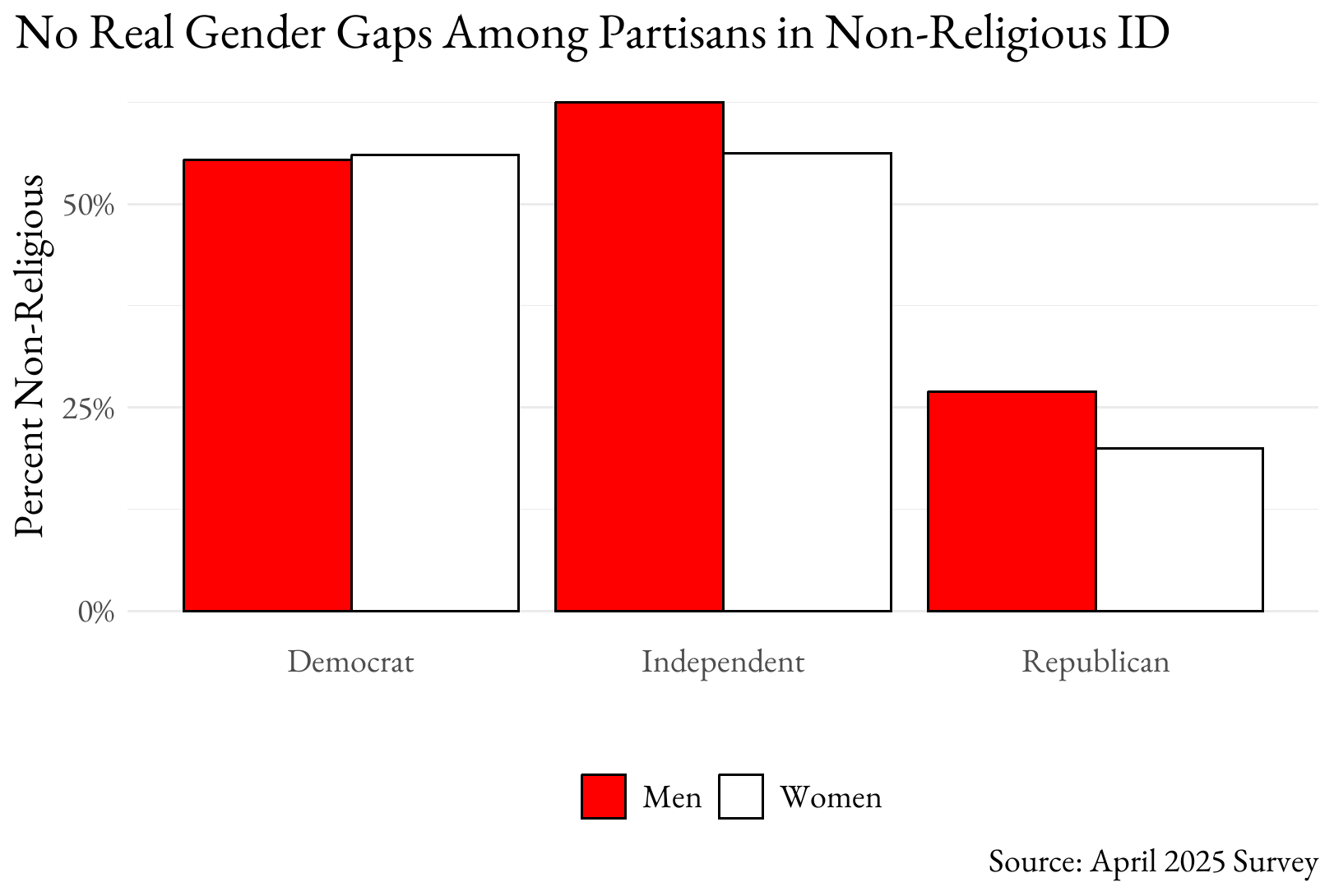
The way that this produces a gender gap overall is that men are more likely to be Republican than women. Therefore, the political gender gap is strongly linked to the religious gender gap.
I wrote about the bump in religious involvement among young men at my other blog. Young men appear to be attracted to religion nationally as a reaction to their perceived loss of status – they see growing equality as a loss or even as discrimination. The data show that young men are more Christian nationalist than women and have much stronger victimhood beliefs (captured by, for example, “The system works against people like me” and “I rarely get what I deserve in life”).
I don’t have all the same measures to repeat that analysis, but can get some hints through agreement with the statement, “Christians seem to want the US to be a Christian nation.” The figure below is mindblowing. Everyone, across party lines, agrees at roughly the same rate that Christians are Christian nationalists, with a small gender gap. But the gender gap shows men believe this at a higher rate.
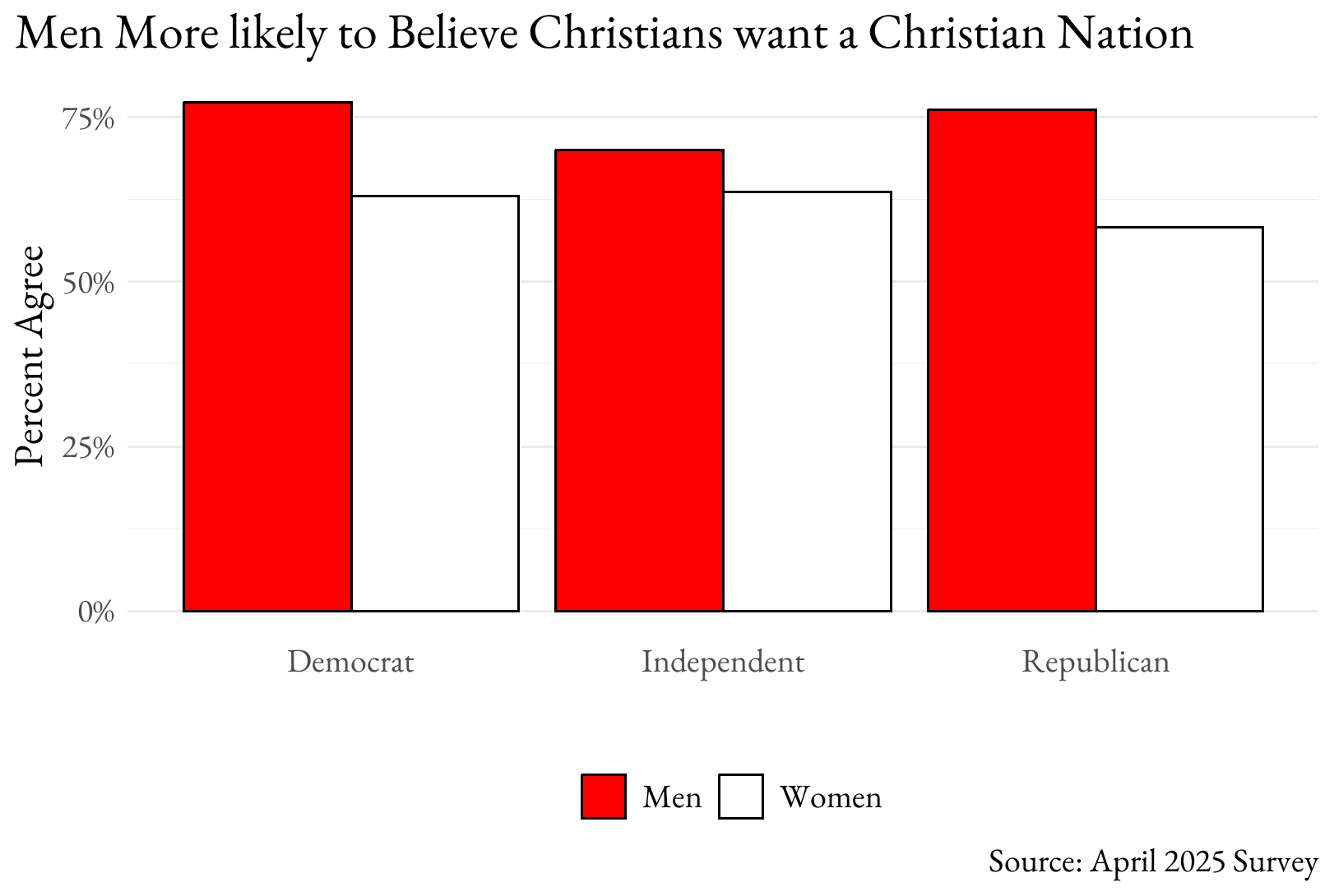
It looks like Denison Republicans are cut from different cloth than national Republicans. They don’t appear to be on the same page about the conflation of religion and the state. We can see it in how they feel about Trump, too. Sure, they have warmer feelings toward Trump than everyone else (see figure below), but those feelings are lukewarm rather than blood-boiling hot, which is what you’d expect in this highly polarized age.
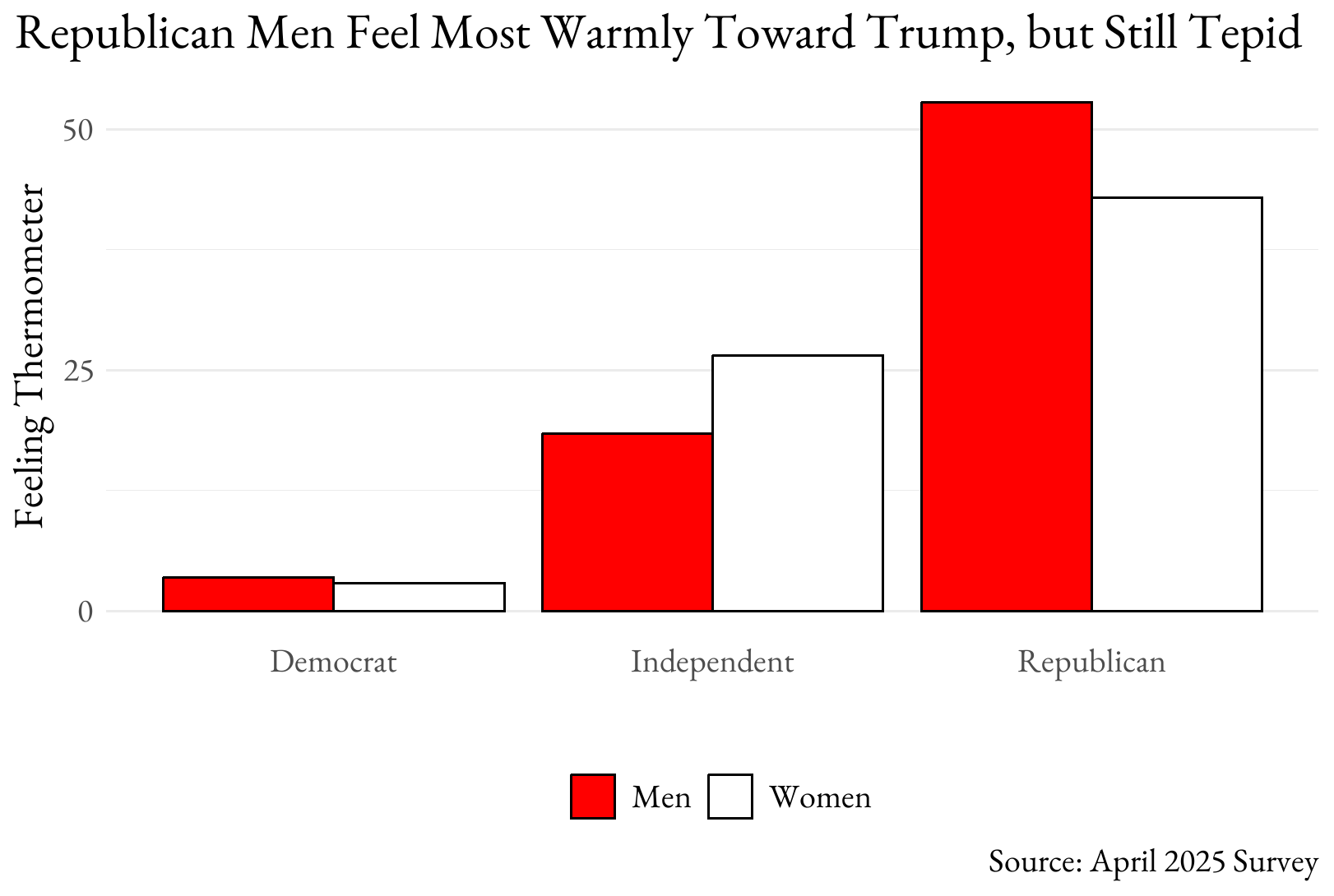
So, yes, Denison does show signs of a religious reversal, with men more religious than women. However, this is mostly a function of the partisan gender gap. If that’s true nationally, then the tension over Christian nationalism will just intensify. That’s not what the future looks like if Denison partisans are tomorrow’s leaders. From my perspective of researching just these issues for a long time, one essential shift in American politics is de-escalating the threat perception that has conservative Christians in a perpetual frenzy. That’s what I hope I see in the data here.
Paul A. Djupe is a local cyclist who has taught social science research methods and political science at Denison for millenia. He started onetwentyseven.blog a few years ago in a bid to subsidize collective action and also writes about religion and politics.
 one twenty seven