By Emma Miller
I grew up in a household where my political views closely aligned with both of my parents. When we watched the news together, we’d usually mutter a few swear words and insults whenever certain people appeared on the TV. But when I got to Denison, I became part of a friend group where most of us held opposing political views, and many of whom come from families with different beliefs than their own.
As my friends and I sat around the TV during the 2024 Presidential Debate, I bit my tongue to the insults that I usually let fly alongside my family. And, for the first time, I was able to actually listen to the other candidate, and come to understand that they had less of a chance of winning than I had thought. Have other Denisonians had the same experience as me?
In 127’s October 2024 survey, we asked students to list what party label they identified with, and to their knowledge, where their friends and parents stood on a seven-point partisanship scale. Then I took the difference between the student and their friends and family. With nearly 500 responses, other students seem to have a slightly different experience to mine.
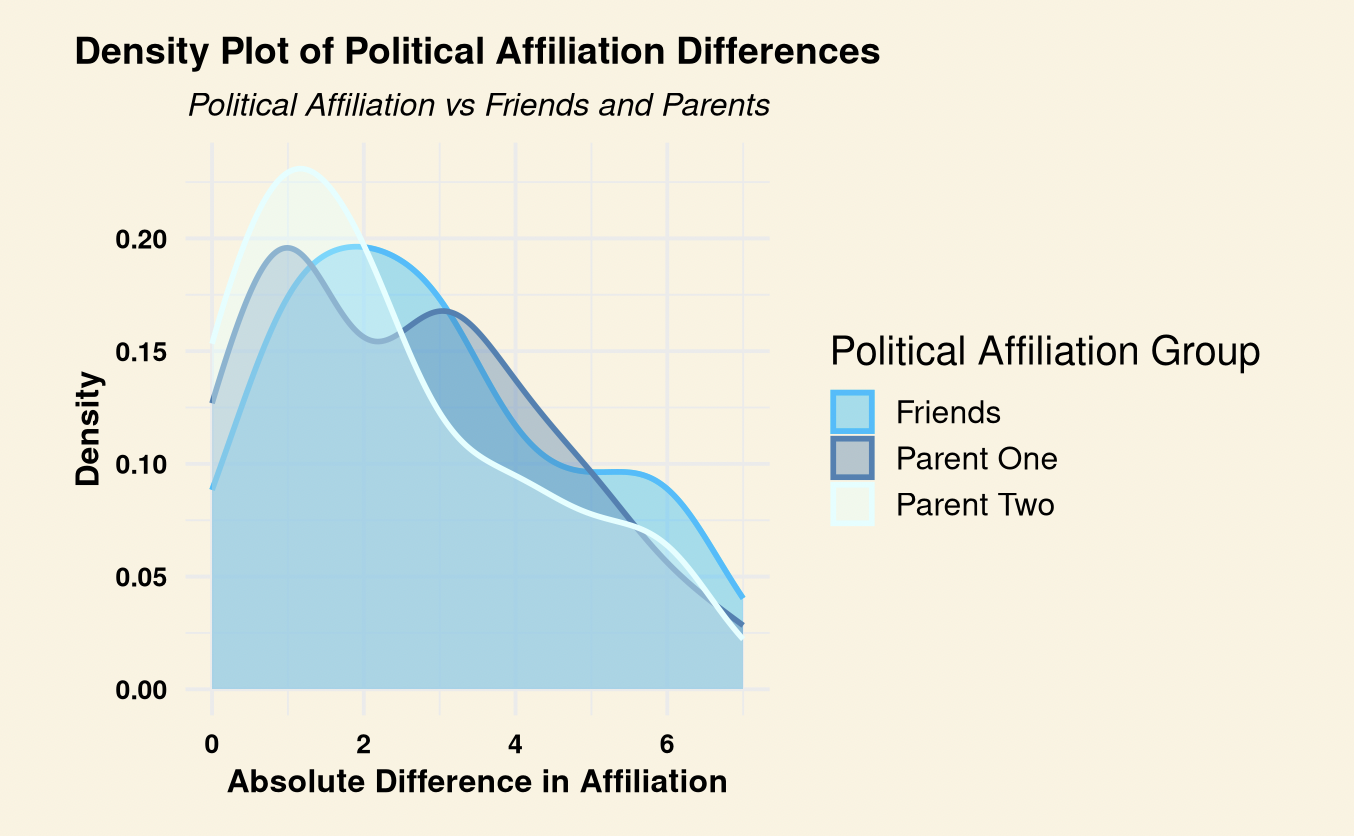
The density plot above shows that high density (a difference of 0-1 point) indicates that students share similar political affiliations with their friends or parents. Data that falls to the right on the graph shows greater differences between political alignments. Students align most closely with their parents, as shown by the peak at the beginning of the graph. While they also share similar views with their friends, the alignment is slightly weaker, as indicated by the bulge at the high end of the x axis.
So maybe more students have experienced the same thing I have. Does this shape who we thought would win the election? Let’s first take a look at our own political parties.
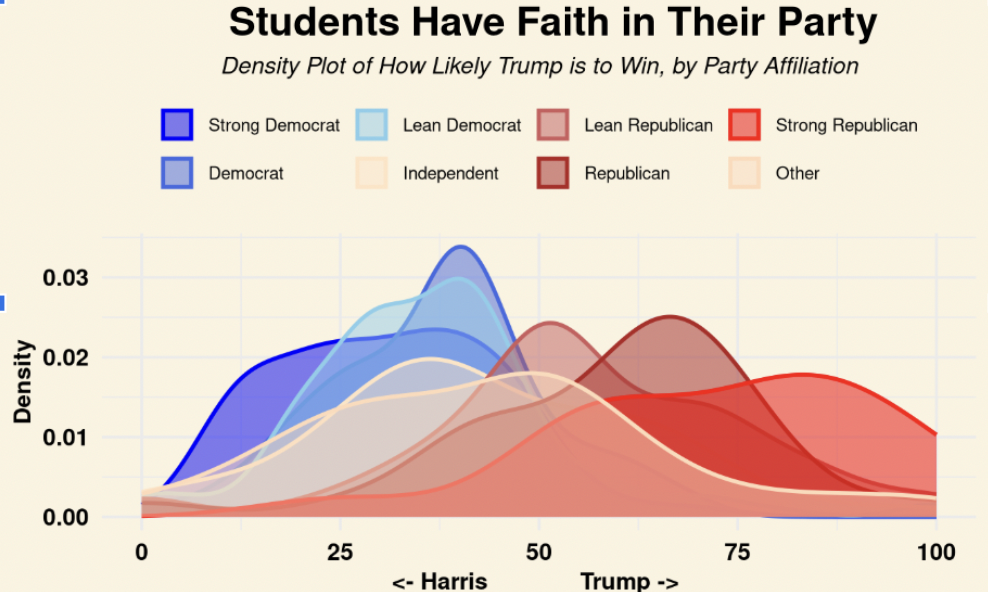
When asked to rate on a scale from 0 to 100, where a lower score (0-50) indicated belief that Kamala would win and a higher score (50-100) indicated belief that Trump would win, many students expressed stronger confidence in their own party. This resulted in a clear divide, with peaks separated by the 50 mark. So, how does the company we keep influence our confidence, like the sense of certainty I felt about my own party this year?
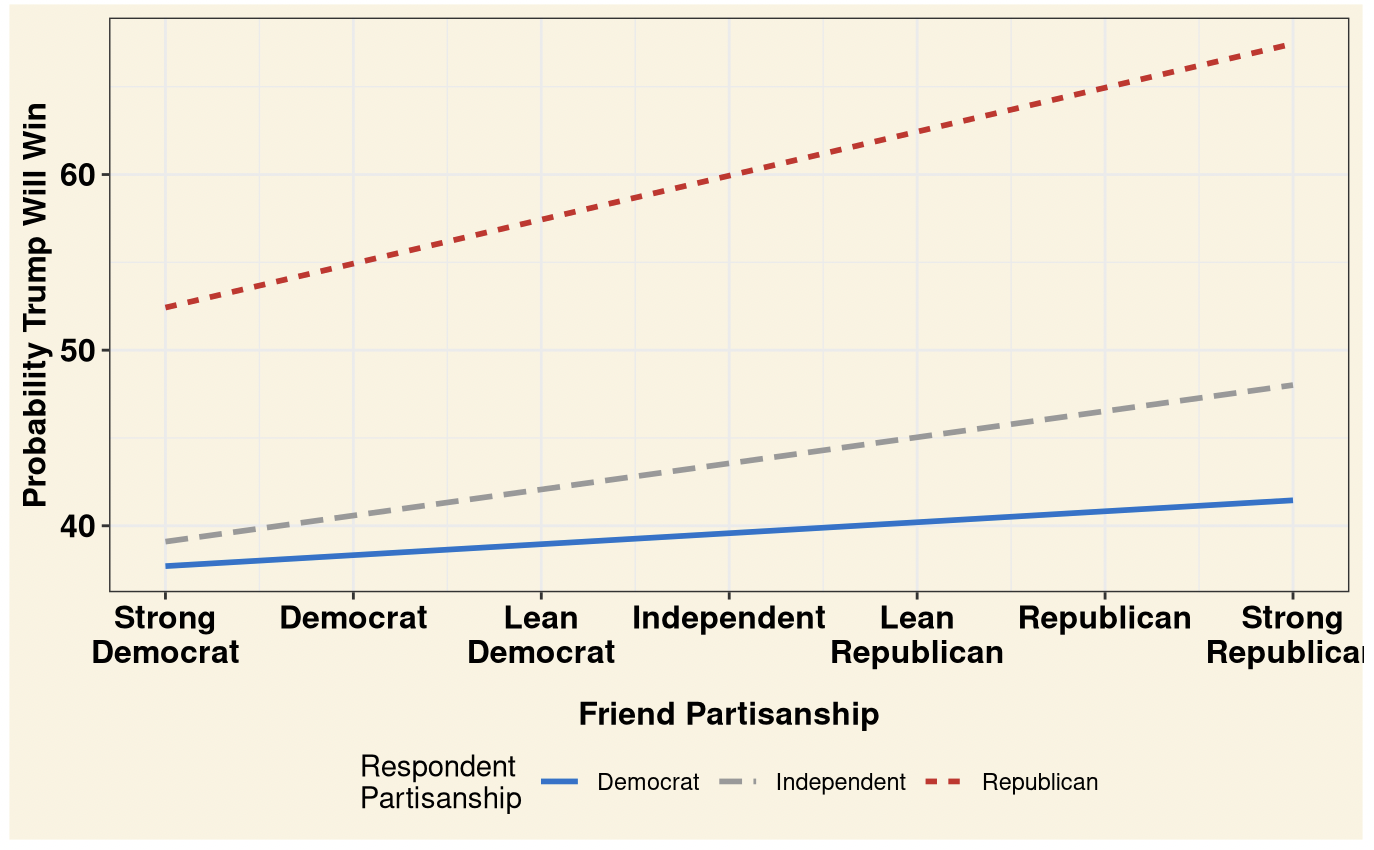
Our data shows (in the figure above) that for Democrats (blue line), being friends with a Republican (to the right on the x axis) does slightly increase their prediction that Trump would win. Though for the most part, Democrats seem pretty confident in their views regardless of who their friends are. Republicans (red line), on the other hand, still strongly believed that Trump would win even when they had Democratic friends, but their faith in his victory was drastically higher when they were friends with other Republicans. But, the impact of a student’s parents’ political views on their own beliefs are even stronger.

Both Democratic and Republican students’ prediction on the 2024 election was more heavily influenced by the beliefs of their parents. Students whose parents belong to opposing political parties tend to have less confidence in their own party’s candidate compared to students whose parents share the same political affiliation. This makes sense, as people tend to align more with their parents’ views, given the stronger influence family often has on our beliefs.
This might suggest that the people we surround ourselves with, whether friends or family, does have a notable impact on how we view the election and our confidence in the outcome – it at least did for me. Something else that shaped my predictions about the election was debating the candidates with my friends. It gave me a chance to think, “I guess that makes sense” or “Wow, people really think like that?”
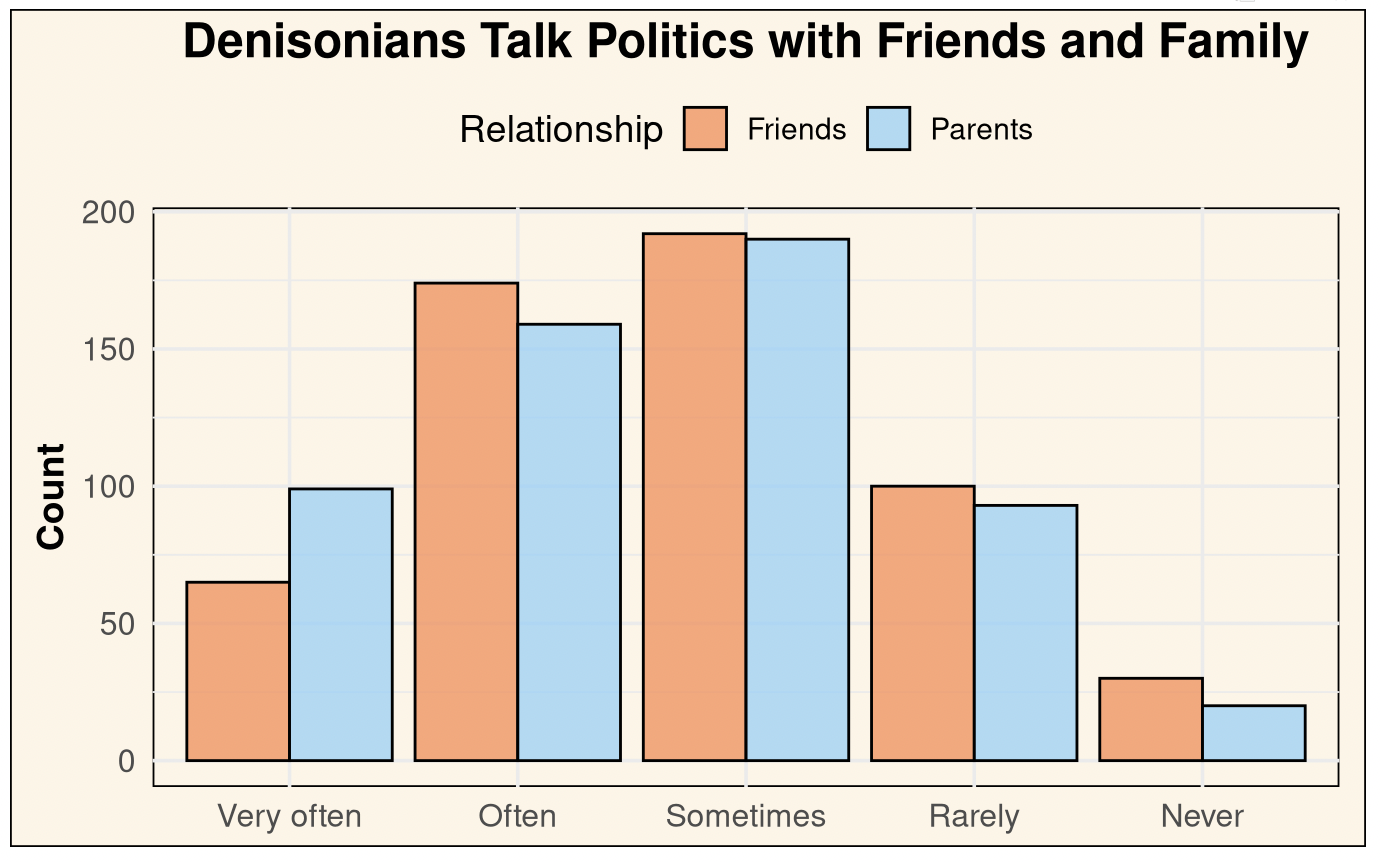
The survey results show that, for the most part, students do talk about politics with their friends and family at least to some extent. So to what extent does this impact the way we think?
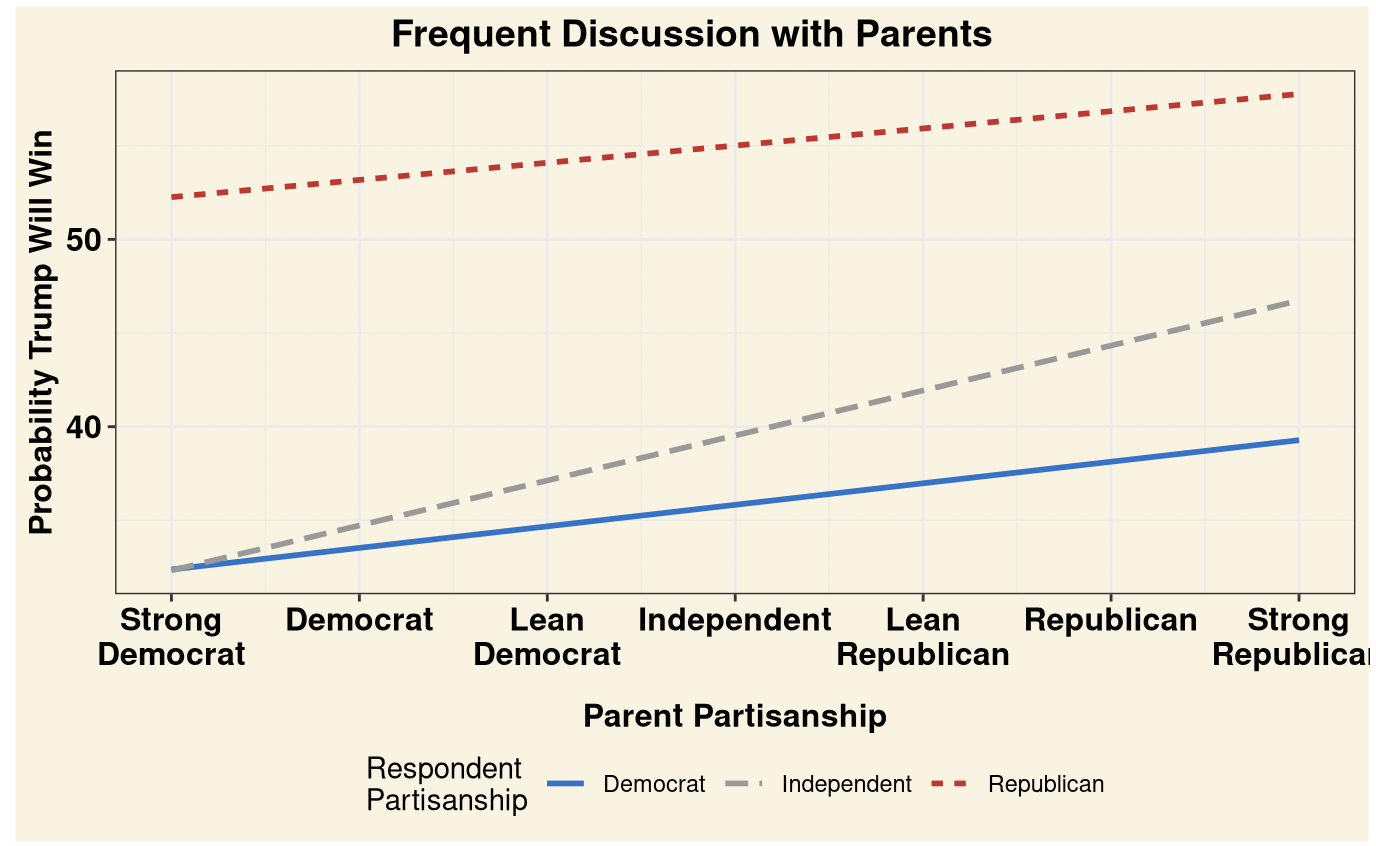

Having frequent political discussions with friends or family influences the predictions of Republicans and Independents more than it does for Democrats. This might suggest that Republicans at Denison are more open-minded, while Democrats may be more confident in their own views – or perhaps discussions with Republicans simply reinforce their beliefs. It’s important to remember that Democrats are surrounded by other Democrats – so the variation in discussion partners is overwhelmed by the larger context.
Regardless, in the end, surrounding yourself with opposing viewpoints, either family or friends, may have an impact on your own beliefs here at Denison. That may affect faith in your candidate, or holding back blasting swear words at the TV, like myself.
Emma Miller is a senior Politics and Public Affairs major and DPR minor at Denison. You can often find her taking laps around the library to find people to talk to, instead of sitting down and getting her work done.
 one twenty seven