By Anna Ragazzoni Xavier Batista
As I filled out this Fall’s 127 survey, I asked my friends, “Are any of us Republicans?” I was almost 100% sure we weren’t. I even started filling out the survey with the selection “0 friends out of 5”, without even considering the possibility of that number being bigger than 0. To my surprise, one of my friends responded “Well, yes… I consider myself a Moderate Republican.” The next prompt on the survey was the true test though. Right in front of me, a question that I could not run away from: “Are Republicans evil?” Donald Trump’s rhetoric has been getting more and more harmful. We cannot ignore the democratic threat he posed on January 6th, the racist remarks he made towards his opponent, Kamala Harris, and the hateful stories he disseminated about immigrants. What does that say about his supporters? Even more, how does that impact how we view his supporters?
Before we analyze how we perceive Republicans, we must first understand how Denisonians associate themselves, to gauge where our beliefs come from, and what we are willing to accept from those closest to us. According to the data collected by our Fall 2024 survey, there is a clear distinction between how Strong Democrats associate themselves, and how Strong Republicans do so. In the figure below, the bars show the concentration of friends of different partisan identities, so, for instance, 50 percent of the friends of strong Democrats are also seen as strong Democrats. When analyzing friend partisanship, Strong Democrats and Democrats are more likely to associate with other Democrats, while Strong Republicans and Republicans have a higher percentage of Democrat friends, which makes sense on our strongly Democratic campus.

I am interested in the tiny red sliver at the bottom of the “Strong Democrat” column above. Of the small percentage of Strong Democrats, Democrats, and Democratic Leaning respondents who have Strong Republican, Republican, and Republican Leaning friends, is anyone willing to cast the first stone and strongly agree that Republicans are evil? Actually, no! According to our survey, there are no Democrats with Republican friends who strongly agree or even agree that Republicans are evil. This supports my first hypothesis: having friends who describe themselves as Republicans helps to control our sectarian views, no matter how opposite their beliefs are to ours.

Can we see the same sort of dynamics with our parents? Similar to the results above, Denisonians also show how their choice regarding a political party is consistent with their parents’ political affiliation. As the below figure shows, Strong Republicans are more likely to have Strong Republican and Republican parents, while Strong Democrats are more likely to have Strong Democrat and Democrat parents. There is a clear correlation here: whether Republican or Democrat, we are more inclined to support the belief our parents do.

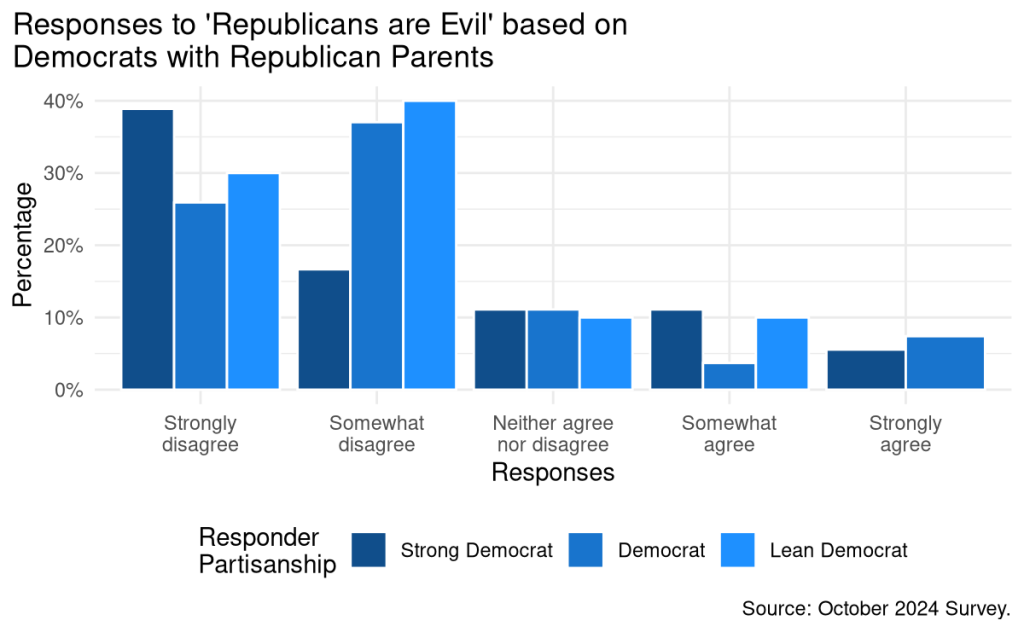
Ok, yes, Freud might be right; maybe it is all our parents’ fault. But how do their political beliefs shape how we perceive them? According to our survey, Strong Democrats, Democrats, and Leaning Democrats are more likely to strongly and somewhat disagree that Republicans are evil. This further confirms my first hypothesis: our views of political supporters change when we add a familiar face to them. Nonetheless, it is worth noting that, despite having a close familial tie with Republicans, some Strong Democrats and Democrats strongly agree that Republicans are evil. So, a few of us still hold their political beliefs close to their heart — at least closer than their parents.
For several Democratic-leaning Denisonians, having a parent, authority figure, or in my case, a friend who has opposite alignments to ours helps control extremist views. We need to cultivate relationships in which we can dialogue across lines of disagreement. With the results of the last election and the “gender reveal” of several Republicans across campus, political values are not going to be the last thing we think about when making new friends — and I can personally relate to that. But maybe we should all take advice from Dr. Weinberg and have a cup of coffee with someone we disagree with. And maybe the current state of the United States will inspire Democrats and Republicans alike to consider how their friendships reflect their own values, for better or worse.
Anna Ragazzoni Xavier Batista is an International Studies major and DPR minor. Just so you know, if she says she will be there in 5 minutes, do not believe her.
 one twenty seven
Wow, this has been so insightful and such an intriguing article! It’s interesting to see the prevalence of party discipline on campus especially when thinking about perceptions about one another. I hope to read more articles by this brilliant author!
LikeLiked by 1 person