By Emma Miller
Let’s face it, Gen Z does not have a good rep when it comes to political knowledge. Older generations label us as social media obsessed, inattentive to political information, and unaware of global events. But what about us Denisonians? Do we “autonomous thinkers, discerning moral agents and active citizens of a democratic society” still fall into this generalization?
Recent October 2024 polling of nearly 500 Denison students shows that the student body actually stays attentive to political news outside of what is presented on social media. When asked to rate on a scale of 0-100 how much news they received from various platforms—including TikTok, Twitter, YouTube, television, and news apps— the majority of students indicated that they relied on news apps or websites the most. In fact, the mean usage of news apps was nearly double that of social media platforms.

So Gen X and baby boomers can get off our case, right?
In a way, not quite. While Denisonians primarily obtain news from websites or television, the average student still rated, on a scale from 0 (none) to 100 (a lot), an average news consumption from Twitter and Youtube of 27 and Tiktok of nearly 40.
These ratings are significant when looking at social media’s implications for politics – specifically, Tiktok.
It feels like we hear about the dangers of TikTok over and over again. From your parents nagging you to the Senate’s agenda, people emphasize how the app spreads misinformation and sensationalism, along with the youth’s failure to cross-reference this information. But our liberal arts education separates us from these generationalizations, right?
Again, not quite.
Included in the same poll were nine questions testing political and governmental knowledge, such as trends in unemployment, tariffs, and the federal budget, as well as which party supports specific political positions. An index of these nine questions was created (each correct gets a point) which ranked respondents on their overall knowledge of politics and government. Results showed that the more Denisonians use TikTok to receive their news on politics, the fewer political knowledge questions they answered correctly. TikTok was the only media source to have this effect.

Those who used news apps or websites, or television, ranked the highest in political knowledge, while heavy social media users tended to earn modestly lower scores. The use of YouTube and Twitter for obtaining information is linked to lower scores on the political knowledge index the more the source is used. But, most striking, is Tiktok’s plummeting line, showing that the more use of the app results in significantly less political and governmental knowledge.
Why does TikTok correlate with lower political knowledge among Denison students? Some answers could come dangerously close – and though we don’t want to admit – to the boomers’ arguments. First, the platform often oversimplifies complex issues and prioritizes engagement. Its algorithm assigns content that aligns with users’ existing beliefs, which limits exposure to diverse perspectives. Many users fail to fact-check or seek additional information, leading to misconceptions.
But not only does the use of non-social media platforms correlate with higher political knowledge on campus, it also indicates greater levels of political interest and engagement. When students were asked to rate their interest in politics this year on a scale of 1 to 5, where 1 represents “extremely interested” and 5 represents “not interested at all”, those who frequently used radio or television sources reported higher levels of political interest than users of any social media platform.
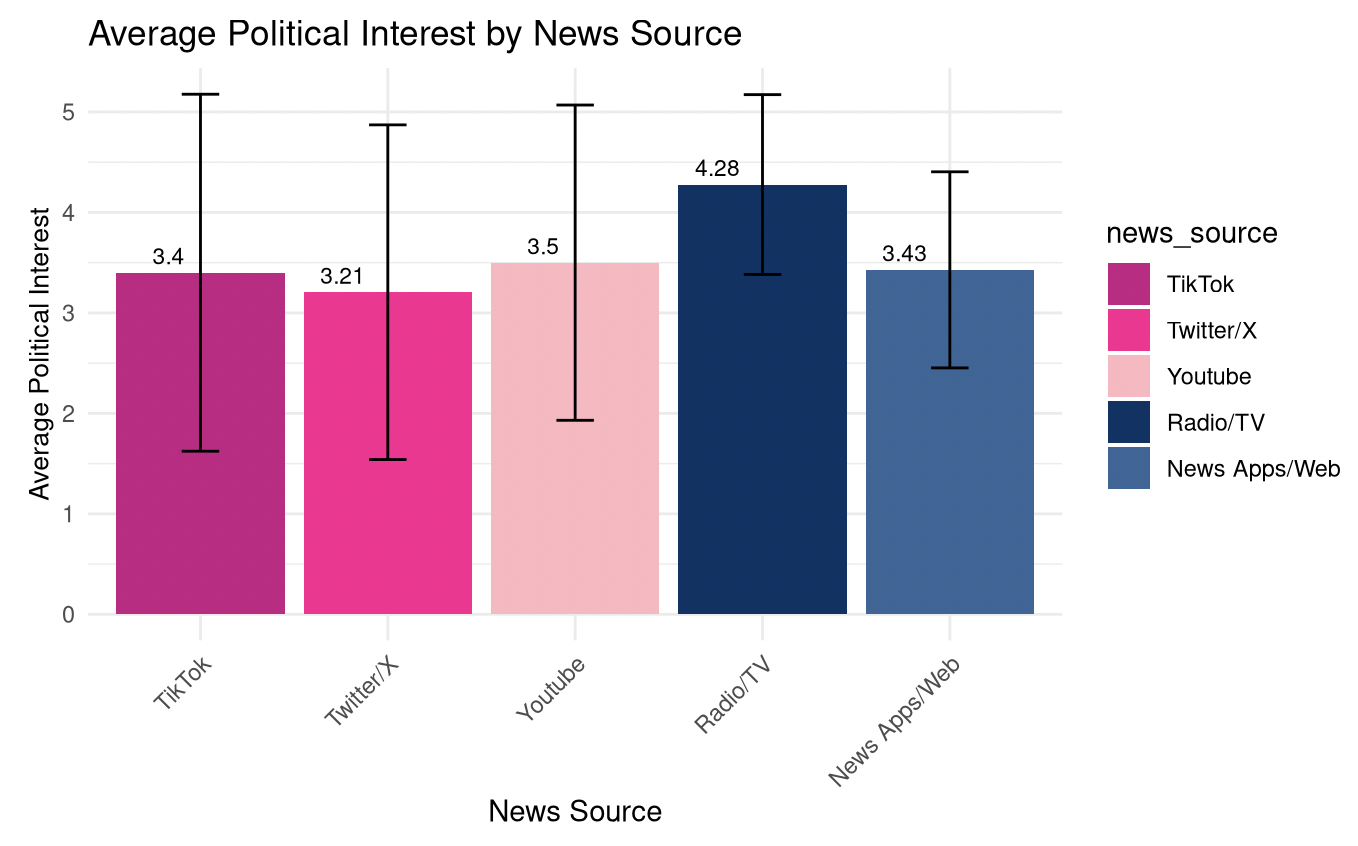
When students were asked, “If you are registered to vote, how likely are you to vote in the presidential election this year?” and instructed to rank their responses on a scale of 1 to 5, where 1 indicates “very unlikely” and 5 indicates “very likely”, non-social media users ranked more likely to vote. Interestingly, TikTok users were ranked a close second in terms of likelihood to vote and political engagement compared to non-social media users; however, they exhibited significantly lower levels of political knowledge.

So, the more social media usage among students to obtain political news correlates with lower levels of political knowledge, interest, and engagement.
Denisonians, it may be time to follow the advice of the boomers and say farewell to social media for political news and hello to news apps or websites. Afterall, we must live up to our liberal arts motto of being “active citizens of a democratic society,” and this year’s election may just ride on that.
Emma Miller is a senior Politics and Public Affairs major with a concentration in International Affairs and a minor in Data for Political Research.
 one twenty seven