By Joanna Passalaris
Whether it is ChatGPT, Gemini, or even Grok, AI has become increasingly present on college campuses. Students seem to be integrating AI into their studies even if professors don’t allow it. How exactly are students using AI and is it actually helping them?
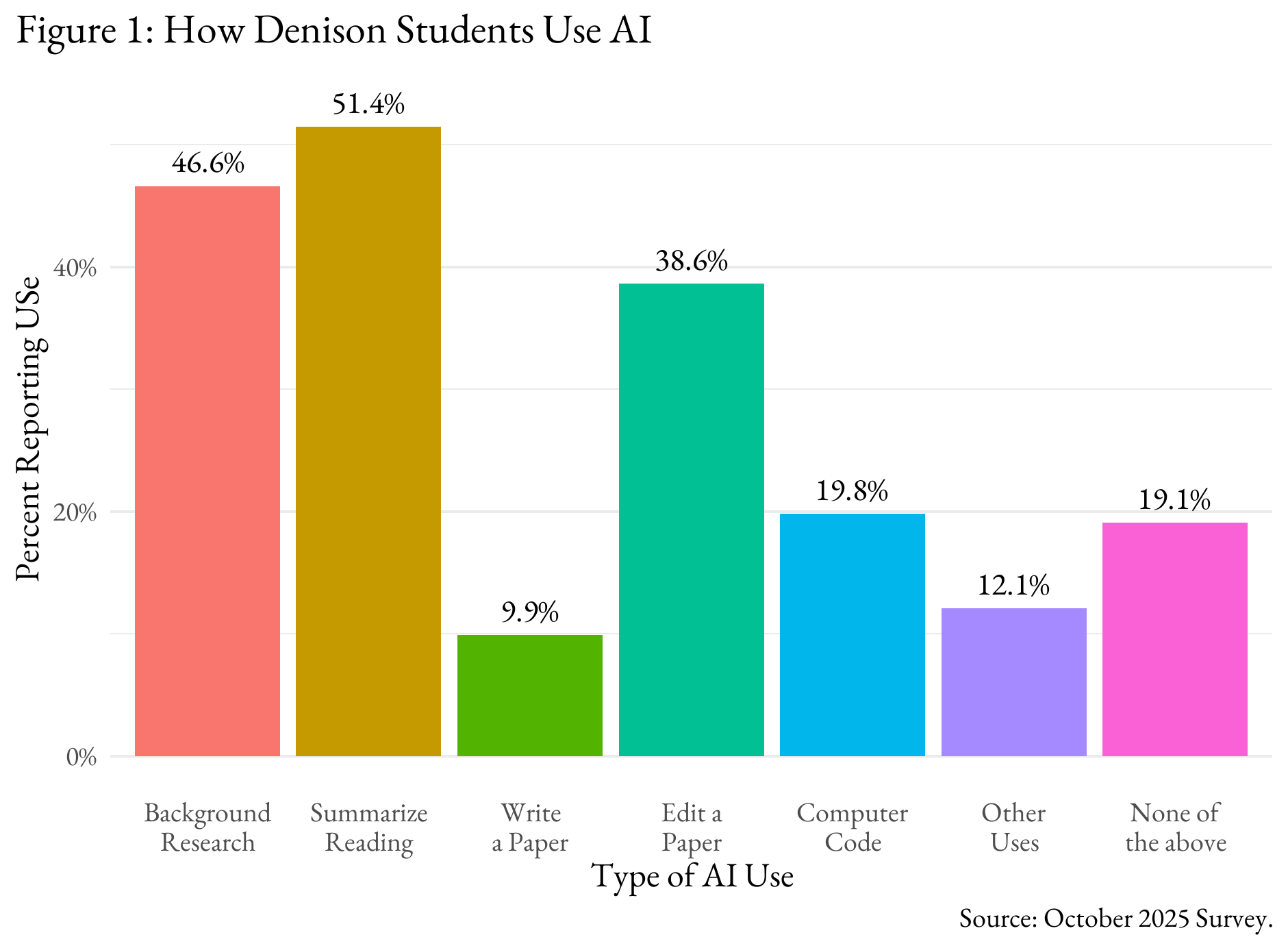
AI can be used for a range of tasks, from small things like editing a paper to writing an entire paper. Below, Figure 1 shows the percent of students at Denison that use AI for several different types of tasks. The most popular use, with half of the student population using it, is summarizing readings, and close behind is background research. This suggests that AI is primarily being used as a study aid to manage homework as opposed to entirely replacing it. That being said, almost 10% of students admit to having AI write the entirety of their papers. This last stat is no different from previous semesters (Spring 2024 and Fall 2024), but the rest show considerable increases.
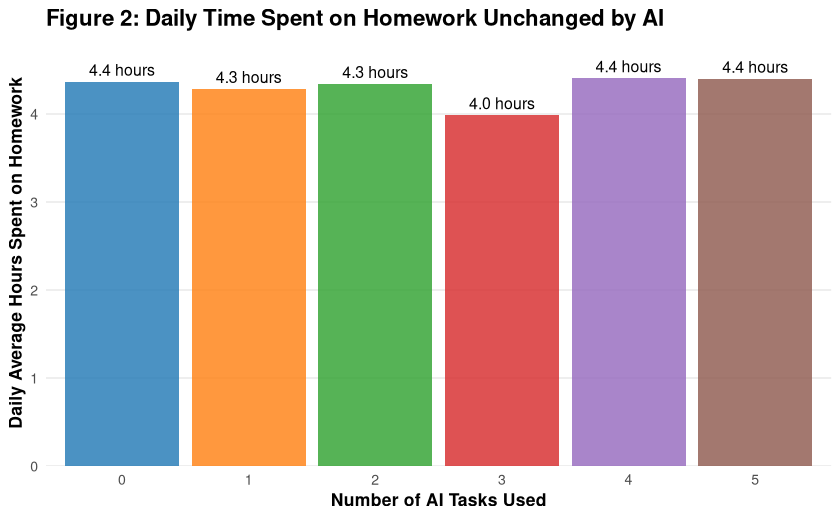
I’ve heard many students claim to use AI to save time on homework. With extracurriculars and a social life, students often don’t think they have enough time to finish their homework without AI. The graph below shows a different story. Regardless of how many different uses a student has for AI, the average amount of hours per day estimated to be spent on homework is the same – just over four hours. Even the students who claim to not use AI at all spend exactly the same amount of time on homework as those who use it in five different ways. So, summarizing a reading with AI might not actually be saving the student any time, but rather just gives them a watered-down version of the reading.
It is important to note that the AI use variable does not take into account how frequently AI is being used. We just know the usage types and not the hours spent. What we also don’t know is how much time studying students would spend in the absence of AI. Would it be the same four+ hours or would it be much more? We suspect that AI is leveling the playing field, but we can’t know that for sure without asking some more questions.
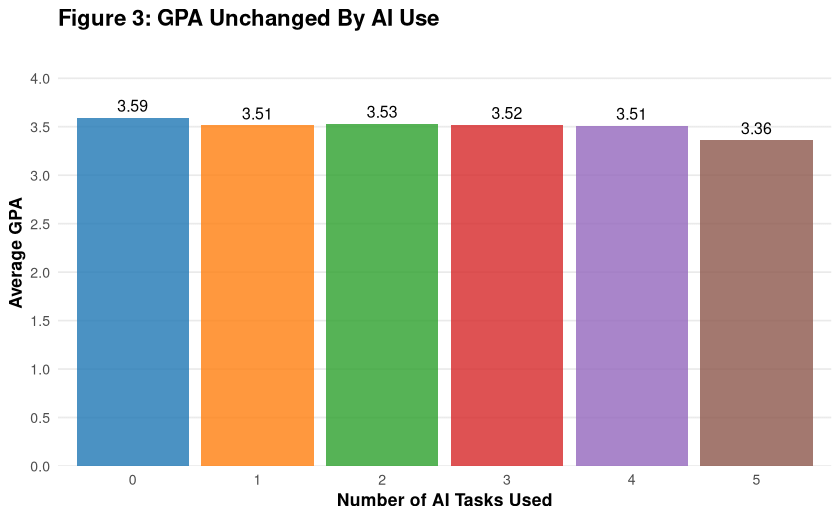
A similar trend, or lack thereof, is seen again when comparing AI use to GPA. Regardless of how many things a student uses AI for, the average GPA remains largely the same (~3.5). While incredibly small, there is actually a decrease in GPA as students use AI for more assignments, and students who don’t use AI at all have the highest GPA (both those differences are not statistically significant).
Similar to Figure 2, the lack of change could be simply because AI is completely ineffective, but it is more likely because it is enabling students to get a higher GPA (or spend less time on homework) than they otherwise would. Students that would traditionally spend more time on homework or get lower grades can use AI to catch up to the other students. Currently, AI is not this magic tool that guarantees no time spent on homework and a perfect GPA. Instead, it is allowing the majority of students to achieve almost identical academic results.
Looking at this evidence it is clear that AI use is becoming a part of the college experience, but it does not have the effects that some people believe it does. It is not creating a large gap in GPA or in hours spent on homework among AI and non-AI users. These constantly equal results could indicate that AI is leveling the academic playing field. Students who don’t use AI have to work harder to keep up with those using it. Conversely, students that would otherwise struggle more are able to succeed by relying on AI. This overarching equality suggests that AI is functioning more as a form of assistance instead of a major advantage. Is this equality fair though? Are the students doing the work themselves getting short changed? And what are the educational implications for those constantly using AI?
Joanna Passalaris is a senior Cinema major and a DPR minor at Denison. She tends to reread the same books and rewatch the same movies instead of trying something new.
 one twenty seven