By Joanna Passalaris
Drinking is classically considered an inherent part of the college experience, but what other vices do college students partake in? For years, smoking and nicotine usage have been on the decline after societal efforts had been made to reverse the cool image of smoking. Despite these efforts, nicotine use has continued. The rise of common sayings like “drunk cigs don’t count” show that gen z still has an active tobacco and nicotine culture.
From our October 2025 survey of Denison 414 students, we found that about 28% use some form of nicotine or tobacco – far from a majority but still a significant percentage. Below in Figure 1 you can see the distribution of use by product. Even though vapes and nicotine packets (such as Zyn) are the newer and more trendy items, cigarettes remain the most popular.

However, tobacco and nicotine use is not equal across all demographics. The data reveals a significant gender gap. As shown in Figure 2, men consistently use nicotine products more often than women. The difference for cigarettes and nicotine packets is large, but the gap for vapes is much narrower. This consistent trend suggests that gendered societal pressures or targeted marketing may be influencing these habits, making nicotine consumption a more male-coded behavior at Denison.

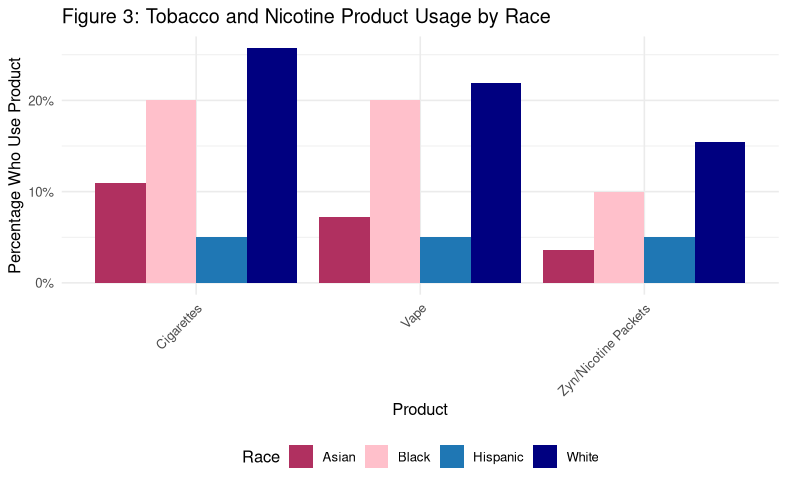
Another powerful indicator of tobacco and nicotine use is a student’s race. The contrast is stark, as illustrated in Figure 3. Usage rates among White and Black students are notably high and White usage is consistently higher. There is a steep drop to Asian and Hispanic students, who use nicotine and tobacco products the least consistently – hovering around 5%. These patterns strongly indicate that cultural attitudes and community norms play a major role in shaping nicotine habits.
But Figure 4 shows that Denison imposes its own culture, increasing the chance a student will use these products. Among freshman and sophomores, use rates are roughly the same, but there is an increase among juniors and again for seniors. At least part of the jump from sophomore to junior year is likely because students are turning 21, making nicotine products easier to get. Denison is all about being open to new experiences, but I don’t think this is what Weinberg meant.

The data shows that smoking and nicotine use at Denison is not random. It is a behavior shaped by gender, cultural background, and even time spent on the Hill. The fact that seniors are the most frequent users challenges the hopeful assumption that students will grow out of these habits and instead suggests that they may grow into them as part of the college experience.
Joanna Passalaris is a senior Cinema major and a DPR minor at Denison. She tends to reread the same books and rewatch the same movies instead of trying something new.
 one twenty seven