Miles D. Williams, Data for Political Research
The Israel-Hamas War is a major source of contention among Democratic-leaning voters this US Presidential election season. The Biden Administration maintains a supportive stance toward Israel as it engages in military operations in Gaza, but a contingent of left-leaning voters is critical of Israel’s methods and of US involvement. While it counsels restraint, the Biden Administration continues to lend military aid to Israel, even as the conflict escalates. What started with a localized military response in Gaza has expanded to a ground invasion in Lebanon and repeated volleys of missiles between Israel and Iran. The death toll Israel has inflicted in Gaza and now in Lebanon is already staggering, and the risk of a wider regional conflagration is high. In response, many Democratic-leaning voters have threatened to withhold support from the Democratic ticket for President—first from Biden and now from Harris.
Against this backdrop, I wanted to know where Denisonians stand on the Israel-Hamas war. Where do their sympathies lie? Are there partisan differences? And, will it affect how people vote? To answer these questions, I turned to responses from the recent 127 survey of nearly 500 Denison students in early October 2024 which asked, among many questions, where student sympathies lie in the Israel-Hamas war, along with a standard battery of questions about partisan identity and voting behavior. We’ve asked about student support concerning the war before, but it’s essential to update this discussion now.
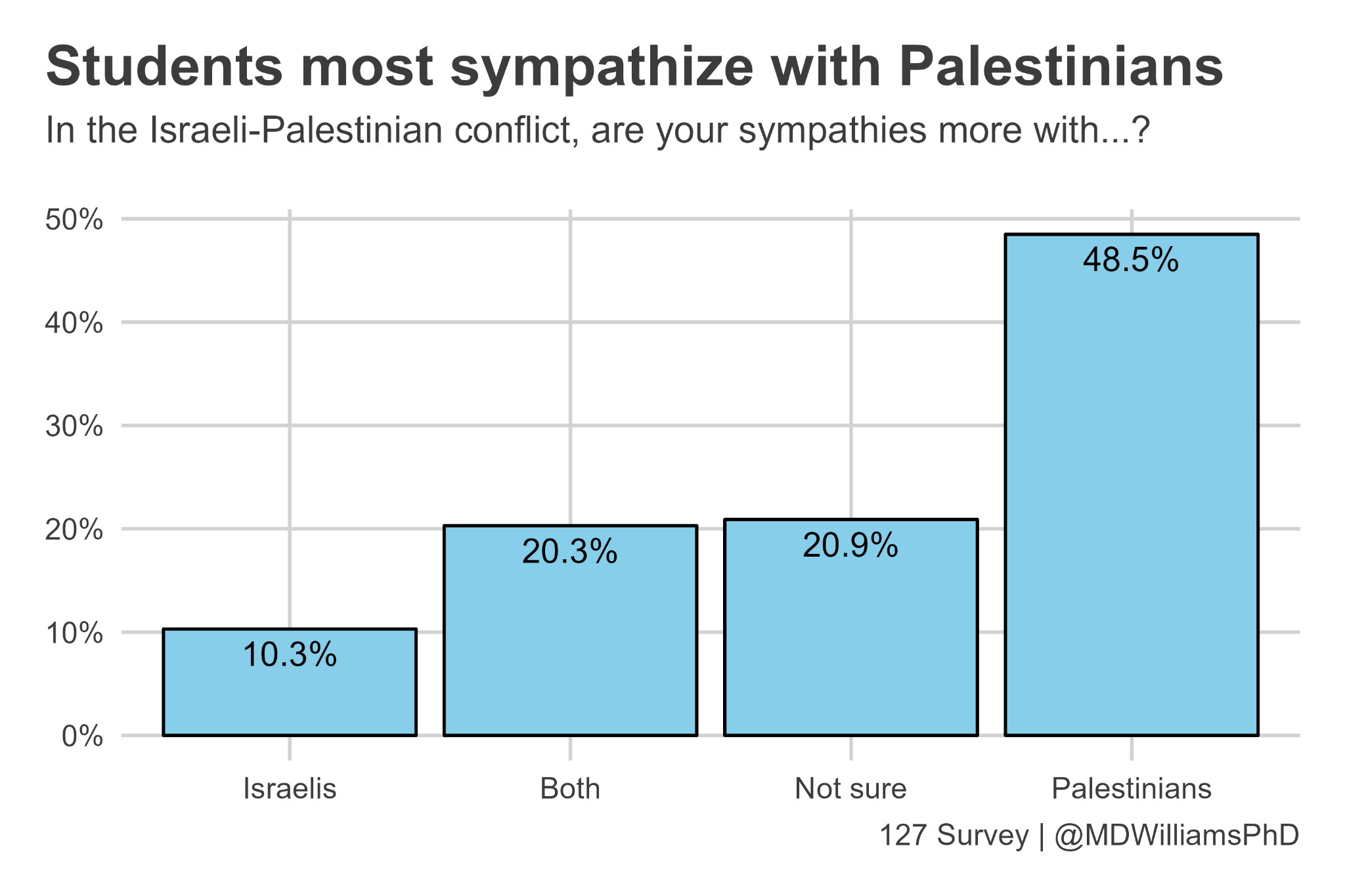
First up, where do student sympathies lie? Consistent with what I expected from a survey of college students, a plurality of respondents sympathize with the Palestinians while a minority sympathize with the Israelis. As the below figure shows, 48.5% of students say that their sympathies lie more with the Palestinians while 10.3% say their sympathies lie more with the Israelis. About 20% say their sympathies lie with both groups, and another 20% say that they aren’t sure.
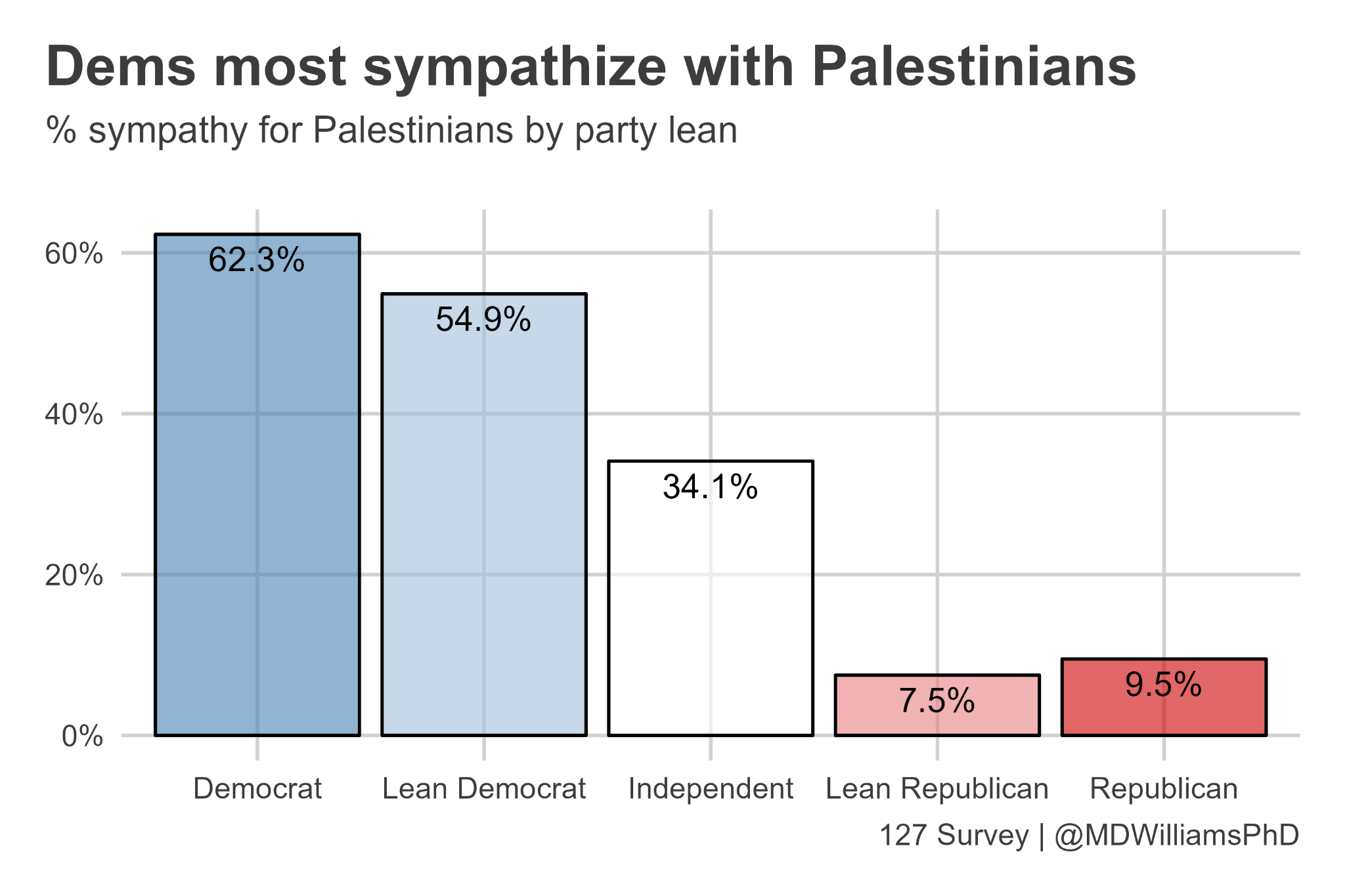
As I also expected, sympathy for the Palestinians over and above the Israelis follows partisan lines. The next figure shows that Democratic-leaning students are far more likely than Republicans to say that they most sympathize with the Palestinians, and the chasm is deep. Among Democratic students and independent but Democratic-leaning students, rates of sympathy for Palestine clock in at 62.3% and 54.9% respectively. The rate declines substantially among independents, dropping to 34.1%, and it declines dramatically among Republicans and independent Republican-leaning students—9.5% and 7.5%, respectively.
It’s no surprise that Democratic and Democratic-leaning students show the highest rates of sympathy for the Palestinians. Of course, this begs the question, will this change how Democratic students vote? Based on the 127 survey data, the answer is a big fat NO. Looking only at Democratic and Democratic-leaning students, I split the data by whether respondents sympathized most with the Palestinians or not, and then tallied up the share that said they would vote for Kamala Harris if the election were held today. Among Democratic Palestinian sympathizers, 94.8% said they would vote for Harris. Among Democratic non-sympathizers, 97.7% said they would vote for Harris. That’s a difference of less than 3 percentage points, and the difference isn’t statistically significant, meaning the likelihood of getting this difference due to random chance is pretty high.
Taken together, the data is clear. The typical Denisonian is most sympathetic toward the Palestinians in the Israel-Hamas war, and this sympathy is concentrated among Democratic and Democratic-leaning students. However, this sympathy is unlikely to change their support for the Democratic ticket come November.
This is significant for two reasons. First, Democratic-leaning students are among the most vocal detractors of the Israel-Hamas war and of the Biden Administration’s handling of it. If there were a group willing to withhold support from the Democrats in November over this issue, college students would be it. Here at Denison, this isn’t the case.
Second, the above point probably has something to do with the heightened levels of affective polarization that currently plague US politics. It’s really hard to hold your elected officials accountable if you are unwilling to vote against them in an election. Despite their dissatisfaction with the way a Democratic White House is handling the Israel-Hamas war, Democratic students can’t bring themselves to seriously consider voting any other way.
Miles D. Williams (“DrDr”) is an avid gym rat and wannabe metal guitarist who teaches courses for Data for Political Research. He tries to talk about his research on Twitter (it’s not “X”), but could do better.
 one twenty seven