By Paul A. Djupe, Data for Political Research
[3:08am] I just had my first true election freakout – the pit of the stomach, head-spin, wake up, phone scroll for an hour kind. I know I’m not the only one. Wait, am I the only one?
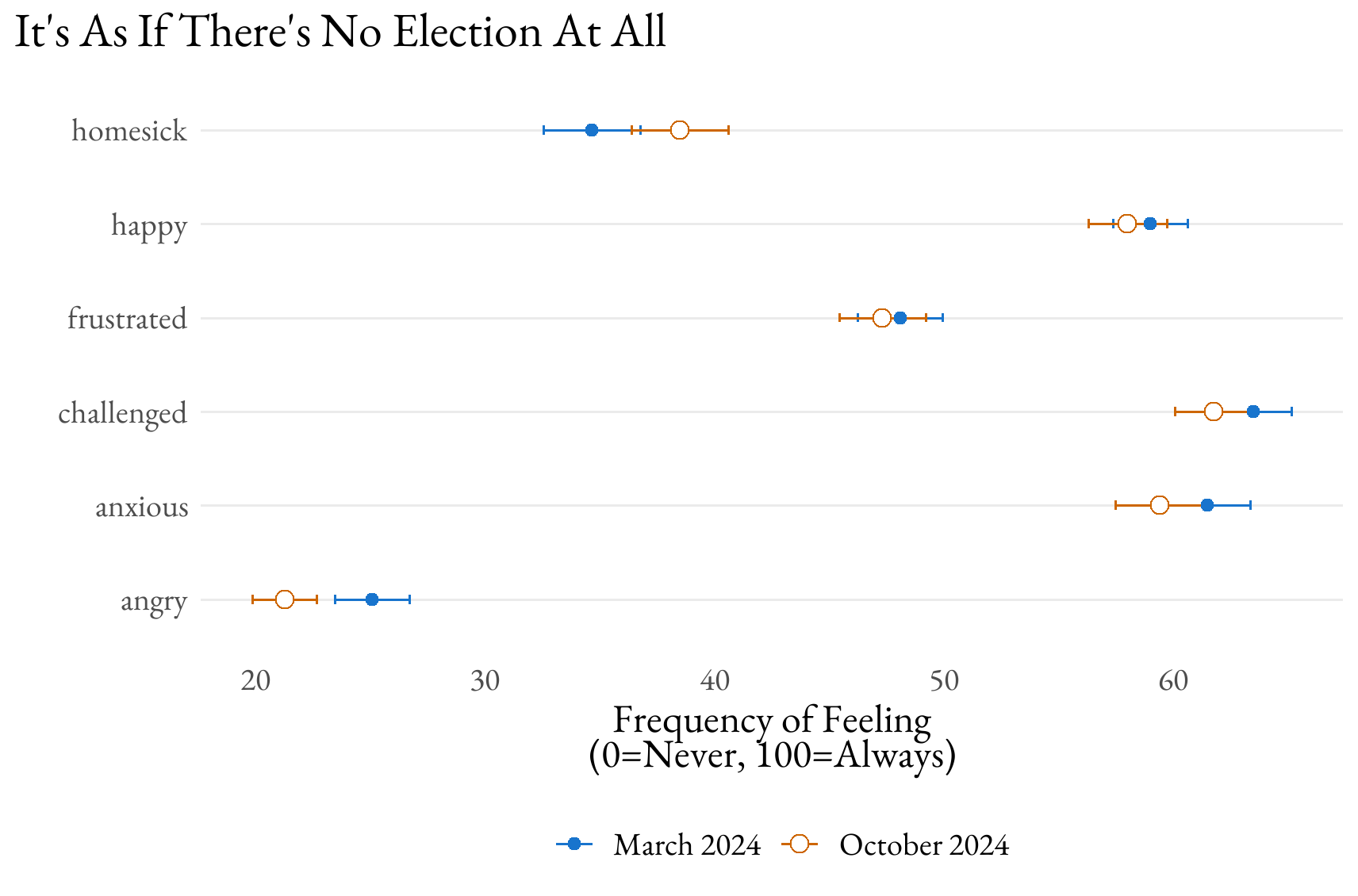
127 collected generalized emotion data from March 2024 and October 2024. In both surveys, we asked students how often they feel the emotions listed below. Truth be told, the point was to ask about homesickness and the other emotions were there for context. But they’re clearly useful for other purposes like asking if students are feeling more anxiety as the most consequential election in their lifetimes rapidly approaches.
Nope. Not even a little. If anything, they feel slightly less anxious, though the difference is very small. Nor are they feeling more or less happy, frustrated, or challenged. They feel a bit more homesick, but that’s a function of this being fall and not spring – don’t worry it’ll pass. And students are feeling less anger and I don’t know what that’s about.
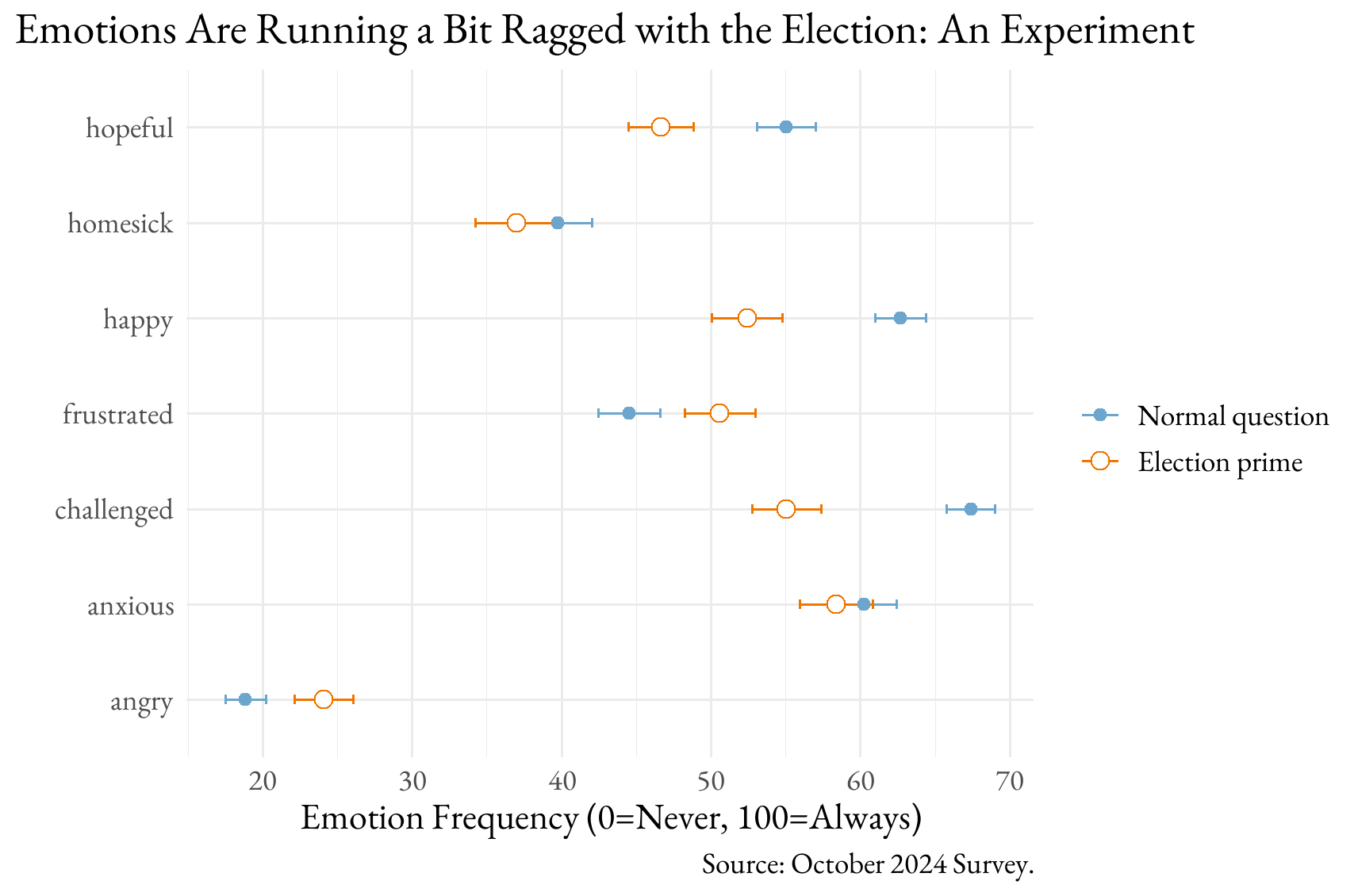
Maybe the election is just not front of mind – it’s the middle of the semester after all and there’s a lot going on. So I aimed to fix that. The October 2024 survey included an experiment to make the election front and center. A random half of the respondents were asked the emotions questions with a slightly different introduction: “Given that we are one month out from the 2024 presidential elections, how are you feeling?” Half just got the last clause. Would this simple prime encourage you to remember your emotions differently?
For sure. An election reminder didn’t change homesickness nor anxiety (ok, it’s just me). But apparently the election is the thief of joy – reported frequency of happiness drops by 10 points as does hopefulness and “stimulated/challenged.” Tellingly, frustration increases a bit. Is it the existential dread? I suspect it’s just thinking about the state of the outside world rather than focusing on campus life, but we’ll look at beliefs about the election in another post soon.
Remember that you had to be reminded about the election in order to register the drop in happiness, challenge, and hopefulness, which means you typically aren’t thinking about politics. But students are actually way more interested in elections and politics in October when 46 percent are extremely or very interested than back in March when only 25 percent were. AND political interest is actually linked to greater frequencies of happiness and feeling challenged.
There’s an important relationship that’s worth talking about for a moment. That reminder of the election serves to depress hopefulness, but only among a particular subset of Denisonians – those who are not at all interested in politics. The more interested you are, the more hopeful you are and the more the world, with election 2024 in it, looks like everyday life on campus. And that’s because for the politically interested, the election is like one big classroom with all sorts of things to learn about human nature and the institutions we’ve built to govern ourselves.

So maybe this is a bit too meta. I just worked through my anxiety by making some graphs and finding that students are doing the same thing (mostly sans the graphs). They’re handling the uncertainty and anxiety about the election just fine because they’re treating it as an opportunity to ask questions and learn about who we are and what we care about. Maybe I can go back to sleep now.
Paul A. Djupe is a local cyclist who has taught social science research methods and political science at Denison for millenia. He started onetwentyseven.blog a few years ago in a bid to subsidize collective action and also writes about religion and politics.
 one twenty seven