By Paul A. Djupe
This is the most consequential US election in our lifetimes. With it, democratic norms like mutual toleration and institutional forbearance hang in the balance. Will voters reward the candidate promising to radically reshape American government or will they make history with the first female president who promises to stay the course of the Biden Administration? Obviously we’ll see soon. In the meantime, where is Denison in all this?
We just wrapped up our October survey and special thanks to the nearly 500 students who responded across the week it was open to take. They somehow overcame the need to vent about receiving an email and shared their thoughts and experiences to enable this to happen. I appreciate you.
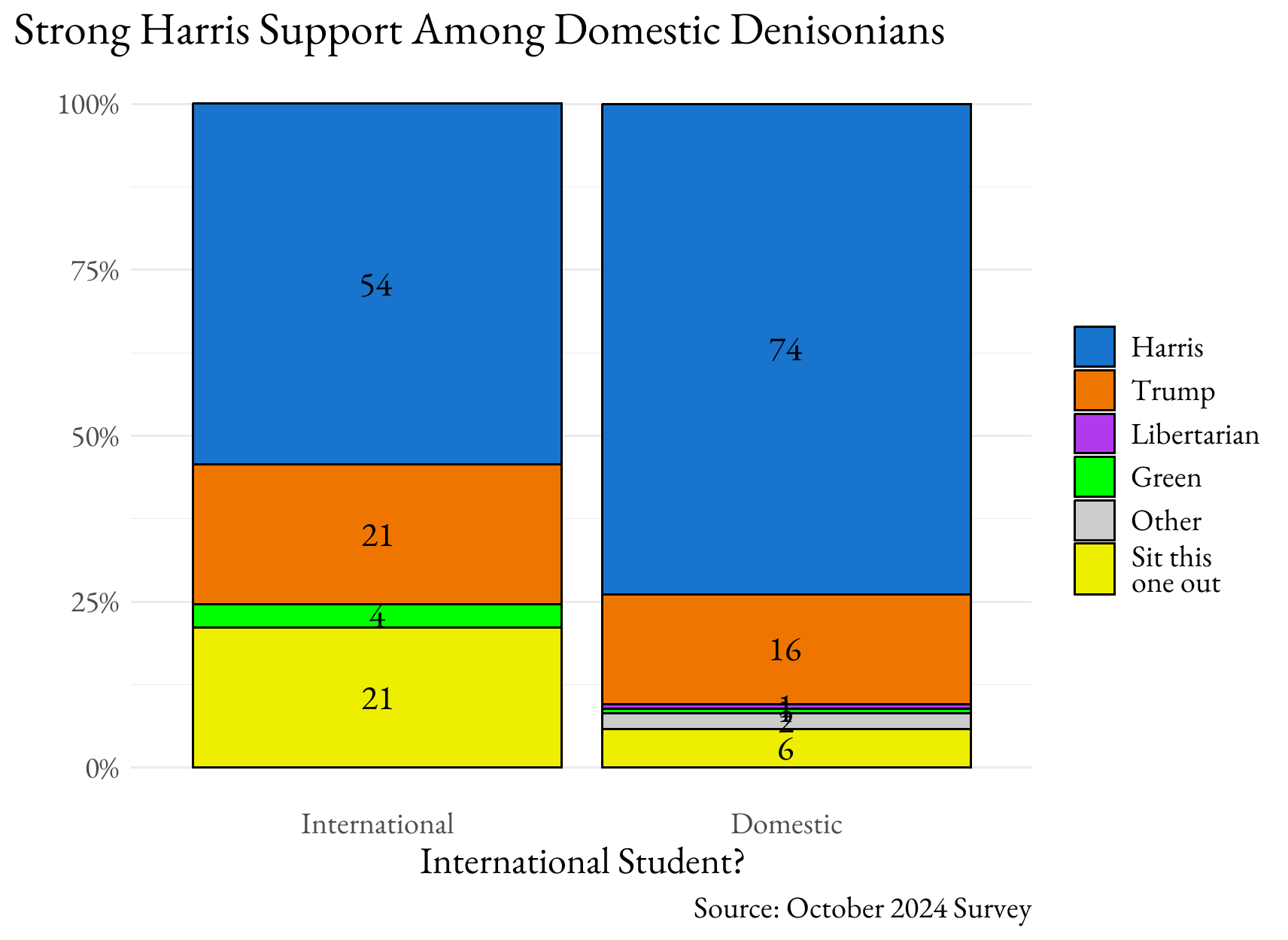
The survey results suggest that three-quarters of domestic (American citizen) students support Harris, 10 percent for minor parties or non-participation, while 16 percent support Trump. That’s a substantial drop from the survey figures in 2020 when 86 percent of students supported Biden. If we dump the sitter-outers, then Harris is closing in on Biden in 2020 with 78 percent support. It’s always rough being the incumbent party in presidential politics – there’s never the same urgency as when you’re the outparty (like in 2020).
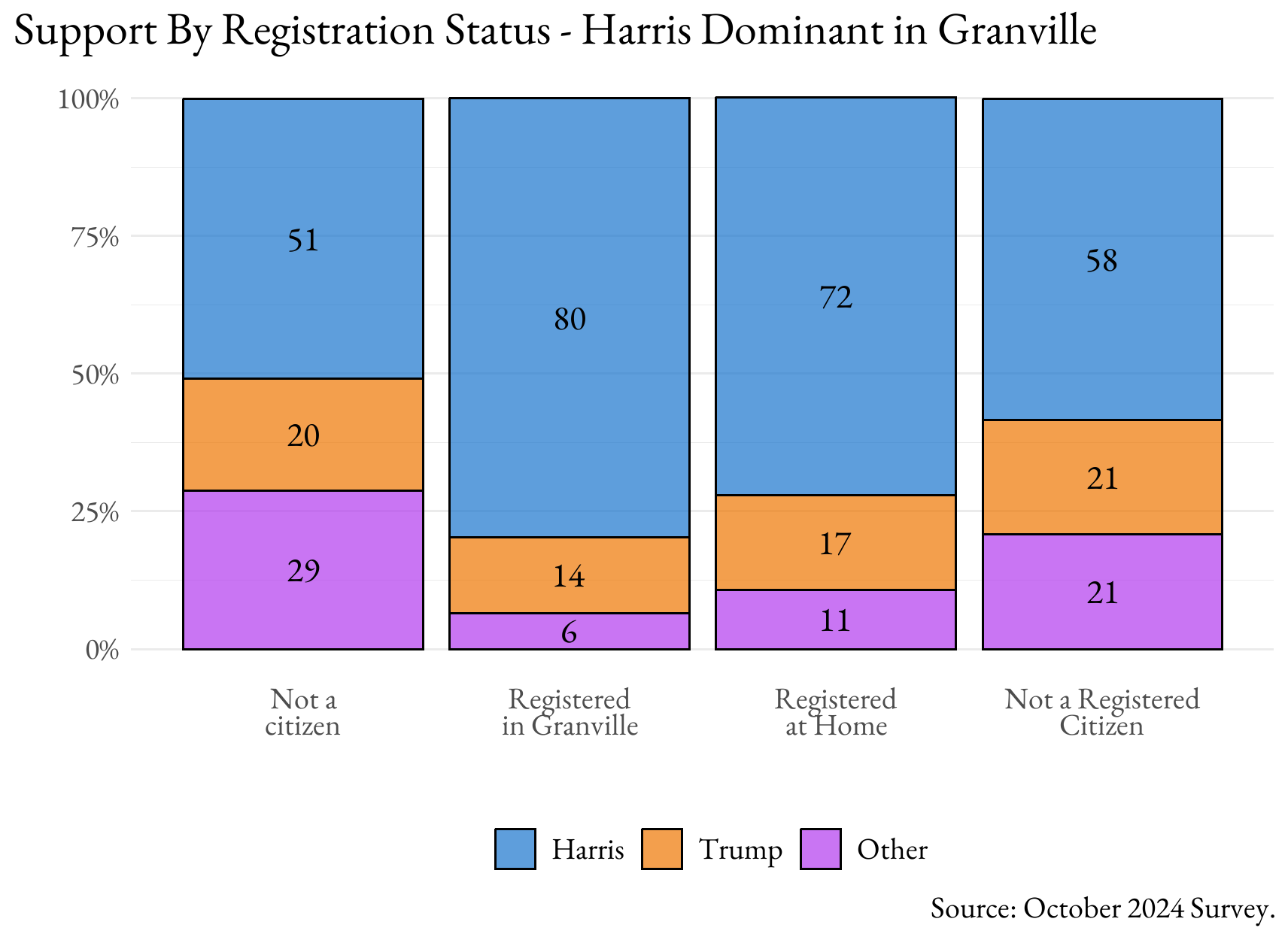
Of course not everyone is registered to vote and many have changed their registration to Granville for a variety of reasons. Maybe they may be more likely to cast a decisive ballot in Ohio (especially the US Senate race) than they can at home. It’s clear that the partisan spread across the registration options draws different voters. It’s clear that registered voters, especially those with a Granville address, are more likely to be Harris supporters. Non-voters are closer to split and, in that way, look like the preferences of international students. Harris supporters on campus are not going to swing Ohio in her favor, though they could help out Sherrod Brown who is in a very tight race with Republican car-dealer Bernie Moreno.
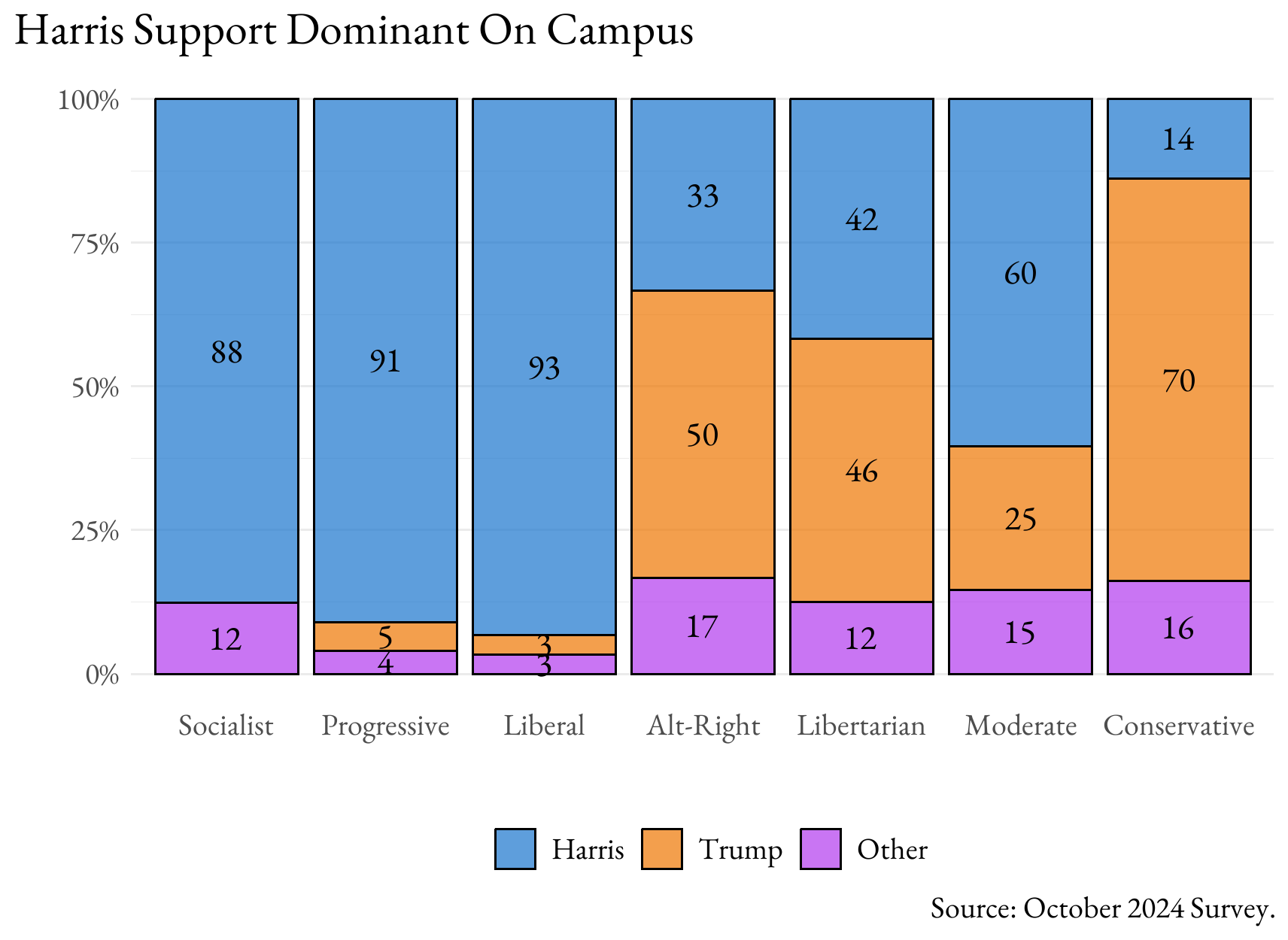
I was just reading on Facebook how a far left former student was not going to vote for Democrats because they are too conservative. I’ve heard that sort of argument before – they (Democrats) have to lose so they move more to the left – so I was curious if we could see any inkling of it in our data. The figure below shows a range of ideological identifications, including socialist, and how they reported their vote choice. Socialists are near the same rate of support for Harris as progressives and liberals. Their defection rate, however, is triple that of progressives and liberals. Still about 9/10 of each of those groups on the left support the Democratic candidate. So, there’s some of that defeat them so they have to work harder for my vote worldview here, but not much.
The degree of defection among more conservative ideological identities is astounding, though. Only 70 percent of conservatives indicate a vote for Trump. The plurality of libertarians are voting Trump, but just barely. Most moderates are Harris supporters.
The Denison vote is pretty lopsided for Harris, though it’s not as lopsided as recent election cycles, especially 2020. I suspect that this is because of how Denison is recruiting. Given the interest of our president in talking across lines of disagreement, it’s hard to do that when there’s so little political disagreement in evidence. It is possible to recruit some though. Speaking of that, we’ll be looking for mutual tolerance, interest in talking through disagreement, and remaining open-minded in future posts. Should be fun.
Paul A. Djupe is a local cyclist who coincidentally has taught social science research methods and political science at Denison for millenia. He started onetwentyseven.blog a few years ago in a bid to subsidize collective action. He downloaded YikYak but hasn’t engaged yet (to everyone’s relief).
 one twenty seven