By Paul A. Djupe, Director of Data for Political Research
“White Evangelicals [in the US] Believe They Face More Discrimination Than Muslims” read a headline in The Atlantic in 2017. This was in the back of my mind when I decided to ask Denison students about this in February 2023. There are so many perceptions of the world that are out of whack these days, that I just had to know: Where do Denison students fit in this picture?
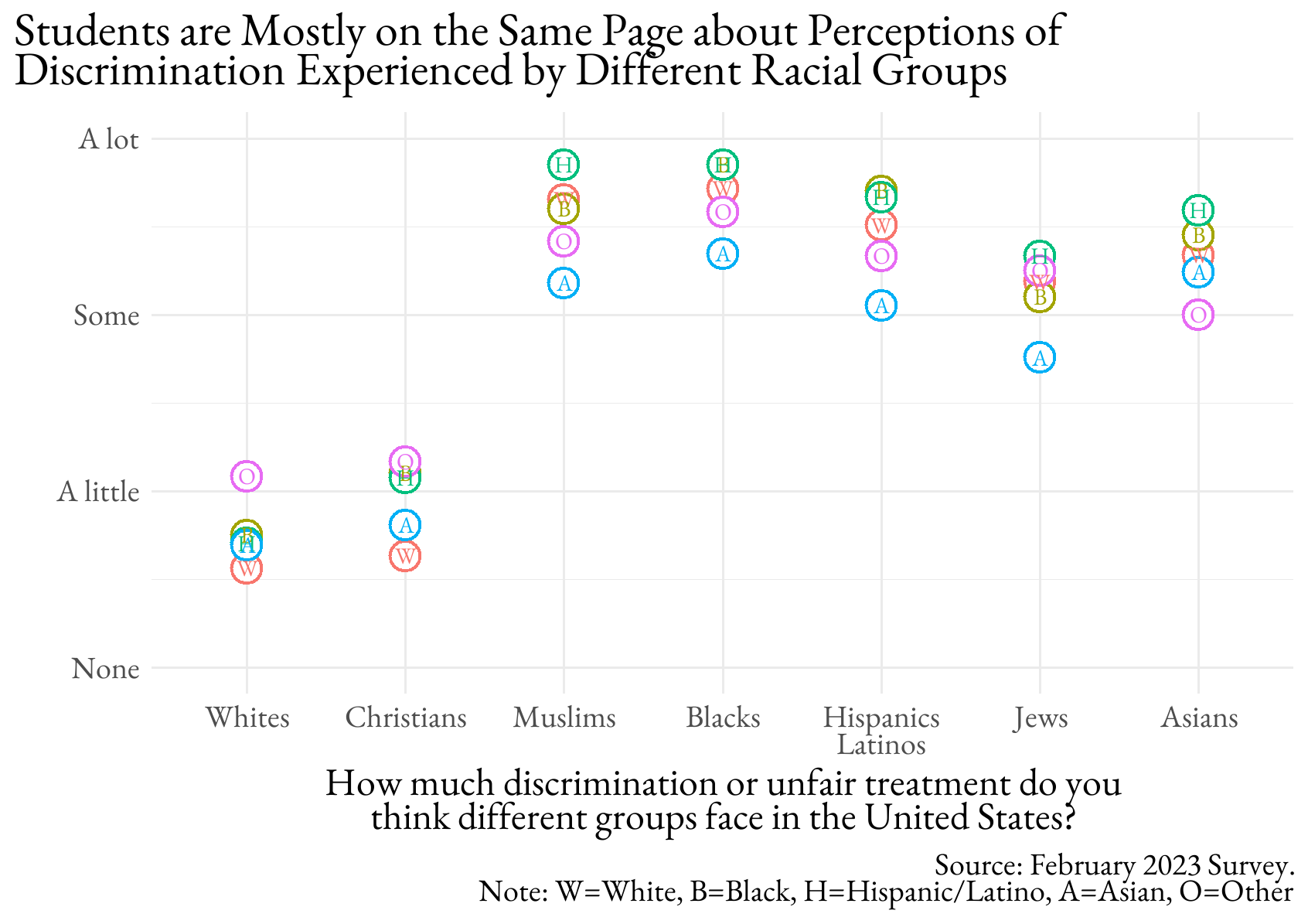
Since our student body is much younger, more educated (or soon will be), much more liberal, and attuned to different media sources, I didn’t think they would mirror those eye-catching headlines. And they didn’t. The figure below shows responses to a set of items asking, “How much discrimination or unfair treatment do you think different groups face in the United States?” The responses are split by the primary racial identification students picked. White students actually said that whites and Christians experience the least unfair treatment, though none of the groups really thought they experienced very much at all – the average is between “none” and “a little.”
Instead, all groups believed that racial minorities and two religious minorities experience considerable unfair treatment. Hispanic/Latino students perceived the most discrimination consistently, while white and Black students were often indistinguishable. It is interesting that Asian students perceived the least. But, if some of those students are international students, then they would not have the same evidentiary basis for comparison as domestic students. The other notable thing is that Muslims and Blacks are seen as experiencing the most unfair treatment, which squares with the evidence, especially in the pandemic.
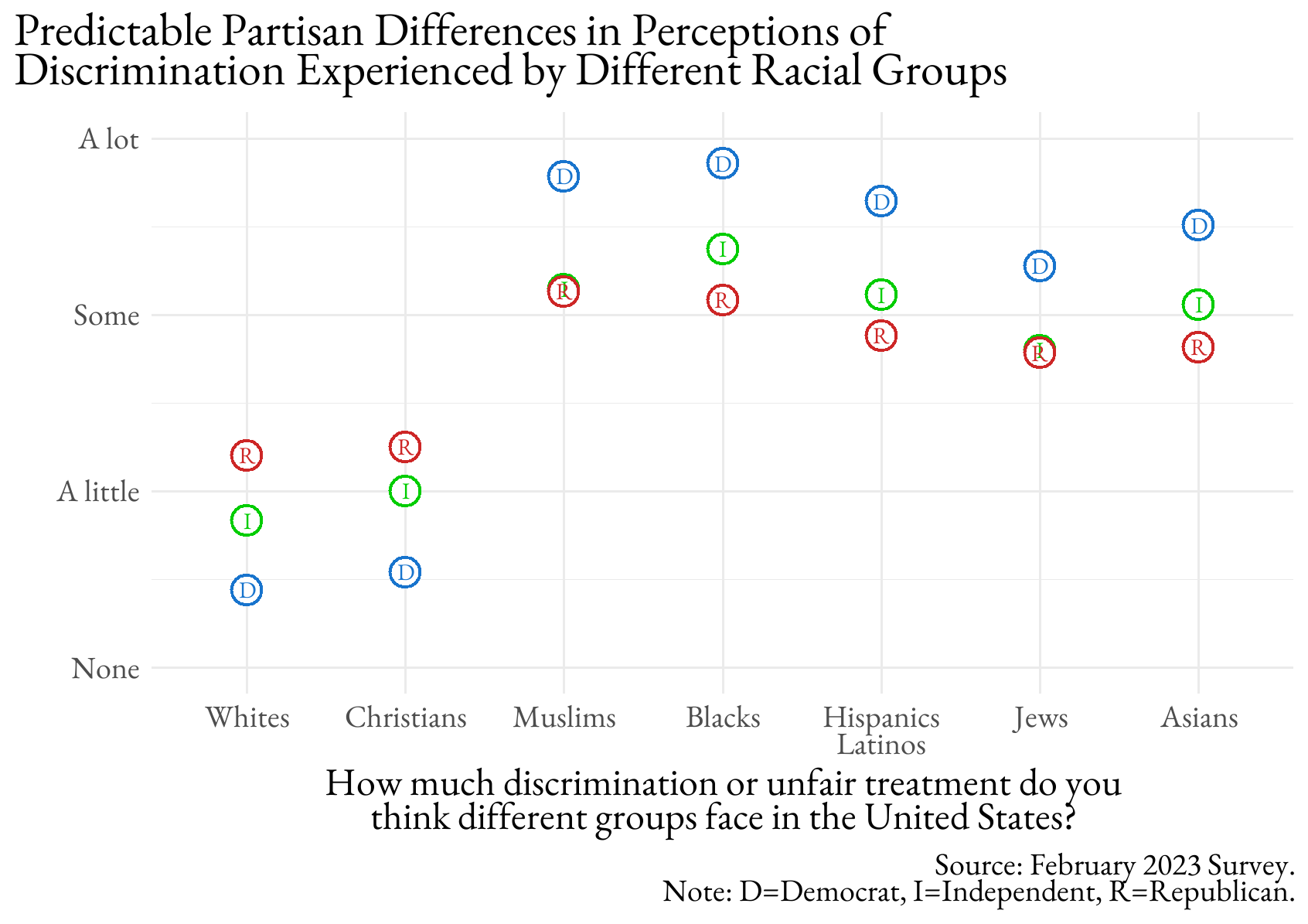
Of course, “white” doesn’t quite mean the same thing on campus as it does out in the US population. Whites on campus come from families that are, on average, quite a bit more affluent, educated, and liberal. So what do the patterns look like if check by partisanship? They look a bit more spread out as the figure below shows – Republicans perceive more unfair treatment toward whites and Christians, while Democrats report the least. The pattern reverses for perceptions of discrimination toward racial and religious minorities. BUT, the gaps don’t quite close – Denison Republicans still say Muslims experience more discrimination than whites and Christians. As we’ve reported before, campus Republicans are not generally cut from the same cloth as the national party.
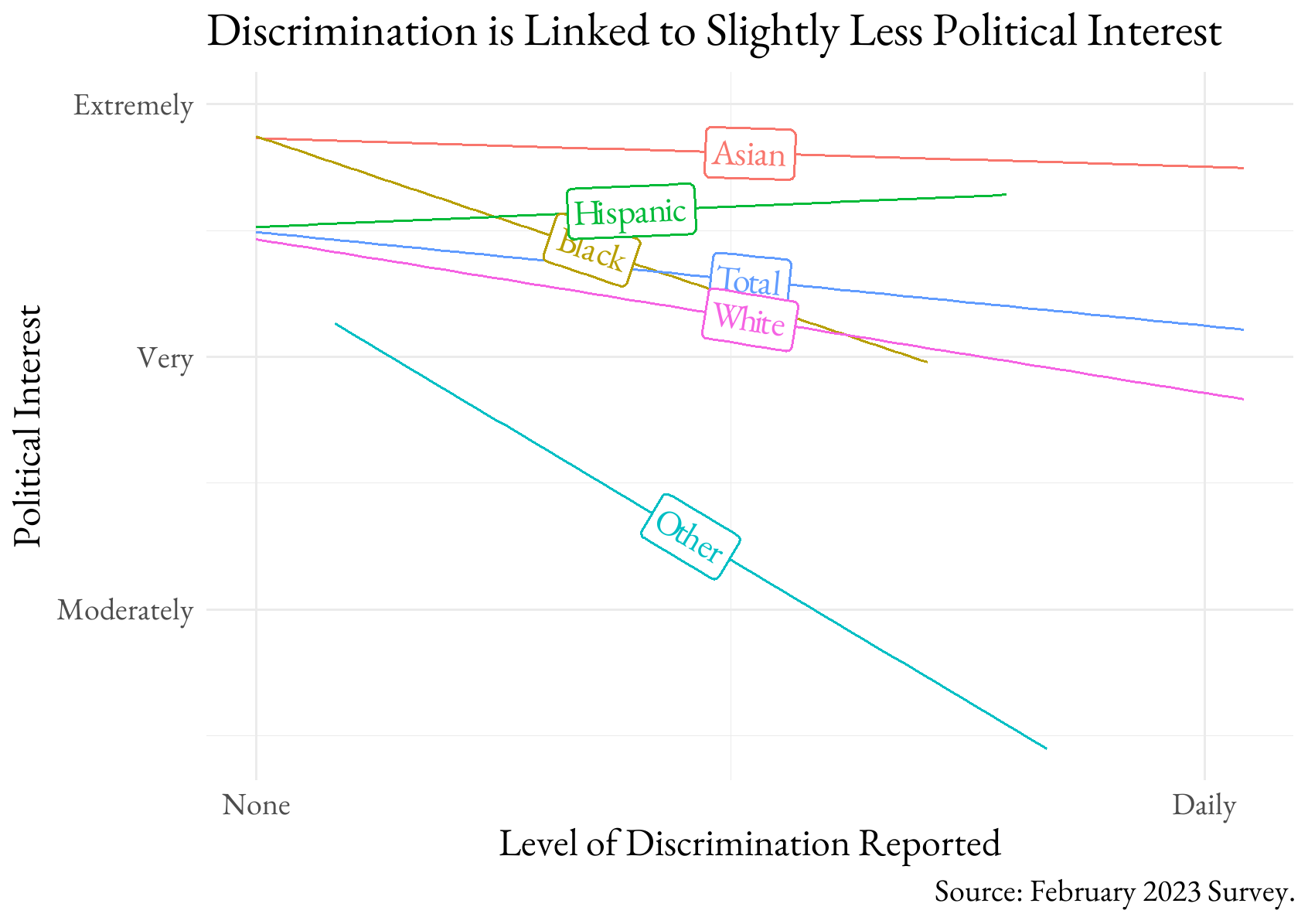
So, I took a look at the personal amounts of discrimination felt (what I used in the last post) and the link it had with political interest levels. By and large, there is a slight negative effect – more discrimination reported is linked with just a little less interest in politics. The relationship is stronger for Black students and the few “Other” in the sample. These relationships differ from what I’ve been seeing in the general population, which I think is a function of the question asked. My other questions have been asking about discrimination against groups (like those above) versus personal discrimination that I’m using here. Does that make any difference?
Yes, it does make a difference. I matched up the groups, so correlated the belief that whites face a lot of discrimination with political interest among whites. For most groups it doesn’t make a difference, but for Blacks, believing Blacks face more unfair treatment is linked with more political interest. This is not surprising since Black Americans have developed a very strong worldview, rooted in the Civil Rights movement and beyond, to combat discrimination in all its forms.
The awareness that a group is experiencing oppression can be more motivating than a personal struggle with the world. But this is just more reason that we should care about this topic and why we should continue to work to gain accurate perceptions of how much is out there.
Paul A. Djupe is a local cyclist who runs the Data for Political Research minor. He started onetwentyseven.blog a few years ago in a bid to subsidize collective action and spread accurate knowledge about campus and what goes on there. He also writes about religion and politics in the US.
 one twenty seven