By Paul A. Djupe, Director of DPR
There’s a pervasive stereotype that college students don’t know what it’s like in the real world, that they exist in sheltered, posh campuses like Denison’s. From my pov, it’s always worth checking out whether that’s in fact true and there are lots of ways to do it. One that courses spend an inordinate amount of time on is discrimination. I’m not arguing that it’s wrong to do so, but I wonder how much experience students have with perceived discrimination in their own lives.
Naturally, a 127 survey from February 2023 asked about this, following the effort to do so back in Spring 2017, where I found that students were “United by discrimination (experiences).” There was a bit of a difference between men and women, but the standout was Black students who were much more likely to report experiencing discrimination. Is that still true?
In each of these surveys, we asked, “In your day-to-day life how often have any of the following things happened to you?” The different dimensions that we asked about are listed below in the figure with people’s responses, which ranged from never to “almost every day.”
Before we dig in, let’s be clear: We do not know where these experiences happened or happen – it could be Denison and it could not. Seems like not, but I’ll talk about that below with some data.
Here’s perhaps the key thing – most students experience a form of discrimination more often than never. Most of that is being treated with less respect than others or treated as if you’re not smart. It is not lesser service in restaurants, threats, or being seen as threatening – those are experienced by a minority of students, but about 10 percent of students note that they experience these three on a roughly monthly basis (or more often).

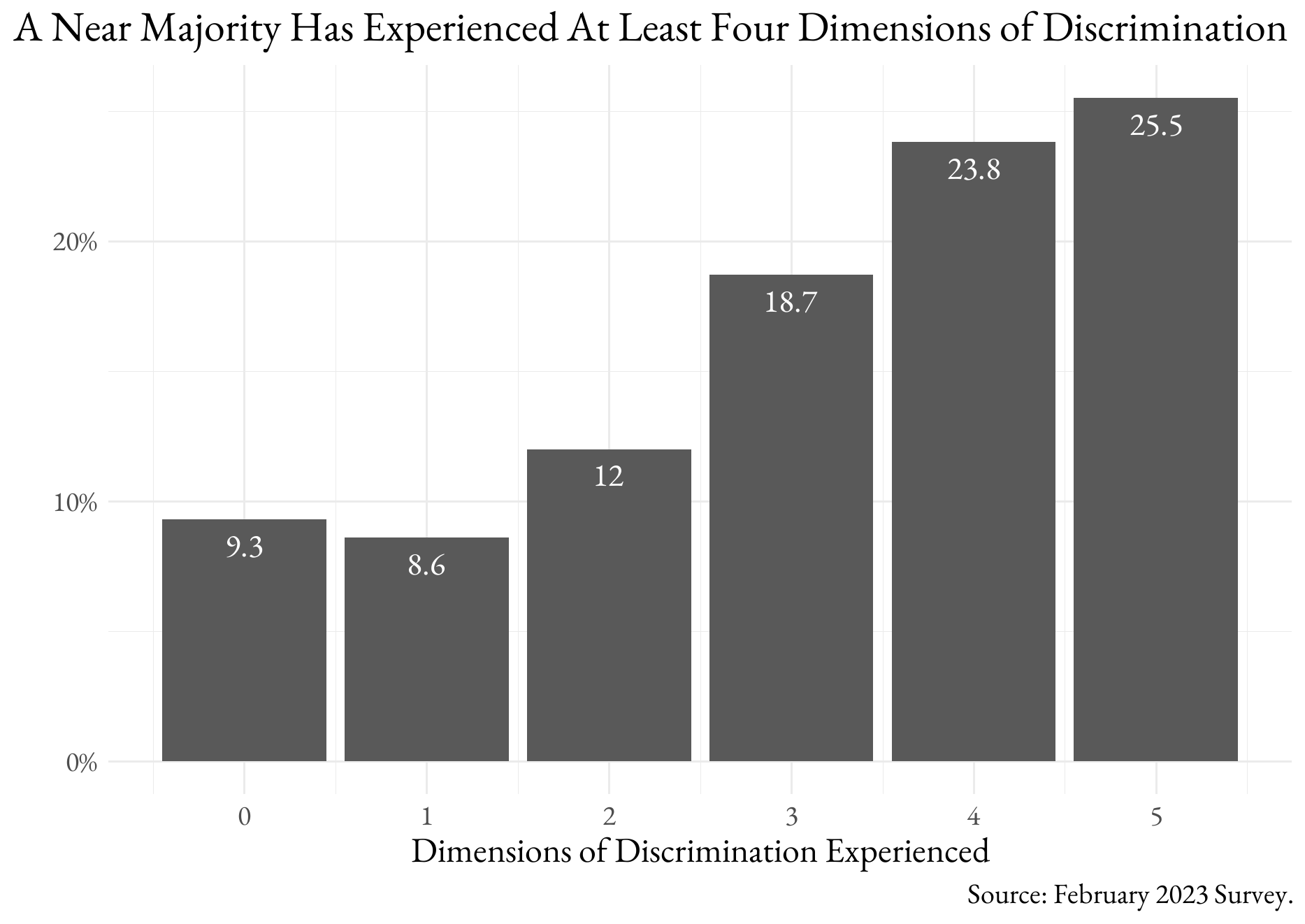
Here’s how that tallies across all dimensions. Only 9 percent report never experiencing any of this treatment, ever. A whopping quarter of students had experienced all 5 and almost a majority have experienced at least 4. There look like there are serious divisions in the amount of discrimination experienced, but most everyone has experienced something. Perhaps those are grounds to build on.
Now perhaps to the main event. (I’m using the collective amount/frequency of discrimination faced added up over the five dimensions asked about). I think that the racial history of the United States strongly suggests that Black Americans have faced the most discrimination for so many reasons, that discriminatory intent is coded in our institutions and socialization, but also for group competitive reasons – it is in the interests of some groups to discriminate against Blacks. That’s why it is surprising to see that Black students on campus do not report more dimensions of discrimination than White students. Only Asian students report more (and if there were enough “other” then they would too).
I think we would also suspect that non-heterosexual students and trans/non-binary (a category of convenience given the small numbers in the data) would face more discrimination but there’s no support for that in the data and of course that’s a good thing – there’s no oppression merit badge to be won here.
What I think is particularly interesting is that discrimination experiences follow class distinctions. Upper class students are less likely to report discrimination compared to those in lower classes (self-designated). This makes sense because, to an extent, money can buy respect and deference.
Here’s another interesting tidbit. I wondered if discrimination experiences might grow across time at Denison. As we know, Denison has historically not been free from negative interactions. But, the data here suggest that experiences with discrimination do not climb with time. That’s not quite definitive about what the campus experience is like, but it is suggestive.
(Methodological side note – the results are just about the same if we just look at the dimensions of discrimination noted, which show no increase across class year, Asian students standing out as facing more, and a hint that class drives that number down).

Discrimination experiences seem like the kind of thing that we’re stuck with, that prejudice is endemic to humanity and group relations, and that they are grounded in history and encoded into our institutions. So, that’s why it’s really interesting to see patterns change. Here we see the rise of experiences reported by Asian students, which is worth investigating further. In a broader context, asking these questions to the American public has netted the finding that Whites think they (and Christians) face as much or more discrimination than Blacks and Muslims. That’s pretty wild and tells us a LOT about what kinds of communication has been flying in American politics over the last decade and change. So, we should continue to ask these questions, get new data, and keep our eyes open to new patterns that tell us society is shifting in important ways.
Paul A. Djupe is a local cyclist who runs the Data for Political Research minor. He started onetwentyseven.blog a few years ago in a bid to subsidize collective action and spread accurate knowledge about campus and what goes on there. He also writes about religion and politics in the US.
 one twenty seven
This post made me really curious about descrimination felt by ESL vs. non-ESL individuals. Asians have a higher percentage of English as a Second Language speakers. ESLs and the LGBTQ+ community share some interesting similarities. Non-English speaking international students and LGBTQ+ often lack community/family support unless they actively seek it, because both of them are not geographically concentrated, naturally.
LikeLike
Good question! We should ask ESL status in our next survey.
LikeLike